




















A new analysis from the International Energy Agency highlights structural vulnerabilities across global energy supply chains, warning that concentration risks persist even as clean energy technologies scale into a multi-trillion-dollar market. The findings, outlined in Energy Technology Perspectives 2026, emphasise the need to strengthen resilience and industrial competitiveness amid rapid deployment and shifting policy landscapes.
Concentration and Supply Chain Vulnerabilities
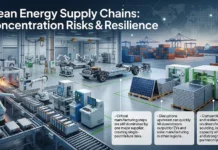
The report identifies that manufacturing capacity for key clean energy technologies including batteries, solar PV and electric vehicles remains heavily concentrated geographically. China accounts for between 60% and 85% of production capacity across multiple supply chain stages, with even higher shares in certain processing segments.
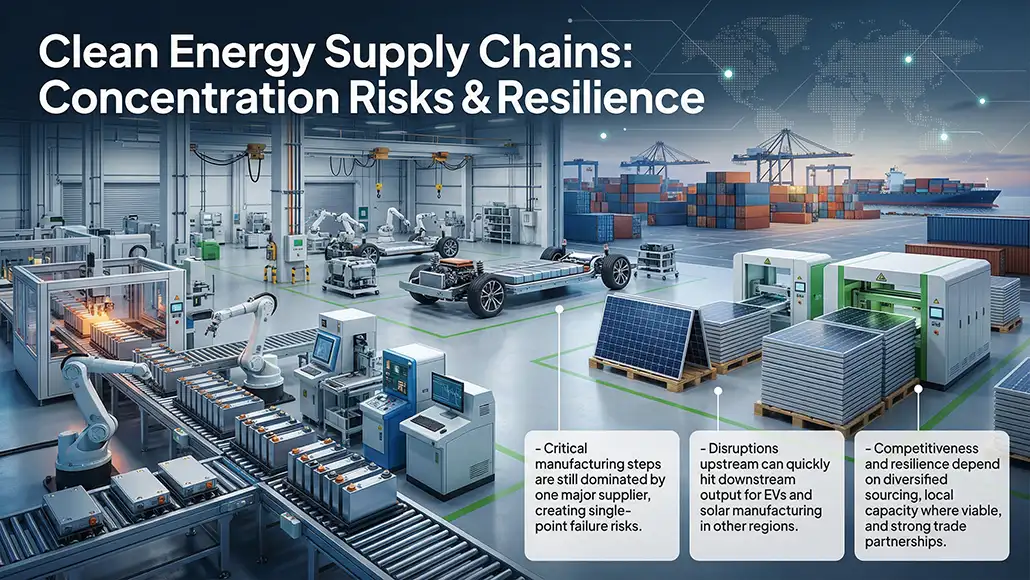
A key analytical addition in this edition is the N-1 supply chain security assessment, which evaluates system resilience if the largest supplier is removed. The findings show that while global production outside the leading exporter could theoretically meet overall demand at final manufacturing stages, each major energy supply chains pathway includes at least one step where less than 25% of demand could be met without the dominant producer. This indicates the presence of single-point vulnerabilities capable of disrupting entire value chains.
Power Info Today observes that this structural imbalance reflects the deep integration of global manufacturing systems, where dependencies at intermediate stages pose systemic risks beyond final assembly capacity.
Economic Exposure to Disruptions
The report quantifies the economic implications of supply disruptions across technologies. A one-month halt in battery supply chain exports from China would reduce electric vehicle manufacturing output in other regions by approximately USD 17 billion, with more than half of the losses occurring in the European Union. Similarly, disruption to solar supply chains would result in around USD 1 billion in lost monthly output from solar PV module manufacturing outside China, with Southeast Asia and India accounting for over 40% of the affected production .
These findings underscore the extent to which downstream manufacturing remains exposed to upstream and midstream bottlenecks.
Market Growth and Investment Trends
Despite these risks, the report highlights strong expansion across energy technologies. The global market for clean energy technologies has grown at an average rate of 20% annually over the past decade, reaching nearly USD 1.2 trillion in 2025. Under current policy settings, this market is projected to double to around USD 2 trillion by 2035, with further expansion to nearly USD 3 trillion under stated policy scenarios.
Emerging technologies are also gaining traction. Investment in low-emissions hydrogen production reached nearly USD 8 billion in 2025, reflecting an 80% year-on-year increase. Carbon capture, utilisation and storage (CCUS) investment has expanded significantly as well, exceeding USD 5 billion annually, although a large share of announced projects has yet to reach final investment decisions.
Trade Dynamics and Industrial Policy Influence
Trade remains a central component of energy technology deployment and manufacturing. Global trade in clean energy technologies continues to expand, with projections indicating that the value of trade could more than double by 2035 under current policy trajectories. China remains the largest exporter by a wide margin, reinforcing its position across global value chains.
At the same time, governments are increasingly adopting industrial and trade policy measures, including tariffs and domestic manufacturing incentives, to strengthen local production capacity. However, the report notes that trade, industrial policy and energy policy remain interconnected, with no single factor determining supply chain evolution.
According to Power Info Today’s analysis of the report, these policy interactions are shaping not only cost structures but also long-term supply chain diversification strategies.
Cost Structures and Industrial Competitiveness
The report highlights that industrial competitiveness varies across technologies and regions. China’s cost advantage is driven by factors including manufacturing efficiency, scale, integrated supply chains and access to low-cost inputs. In battery manufacturing, efficiency accounts for over 40% of the cost difference with Europe, while energy and labour costs contribute significantly to cost gaps in wind and solar manufacturing processes.
In upstream industries such as steel, aluminium and chemicals, energy costs can account for more than two-thirds of total production costs. The report notes that access to low-cost renewable energy could enable hydrogen-based steelmaking to become competitive under certain conditions in major producing economies, including the United States, China and India.
The report concludes that strengthening supply chain resilience will require a combination of industrial competitiveness, diversification strategies and international co-operation. While domestic manufacturing is gaining policy support, strategic partnerships and trade remain critical to balancing cost efficiency with supply security.