

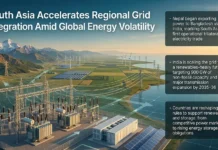

















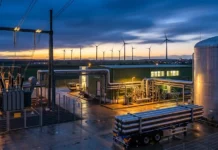
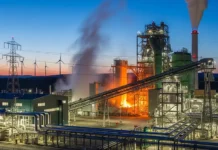
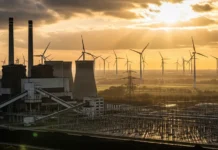


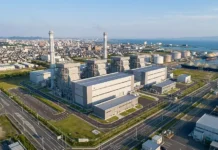

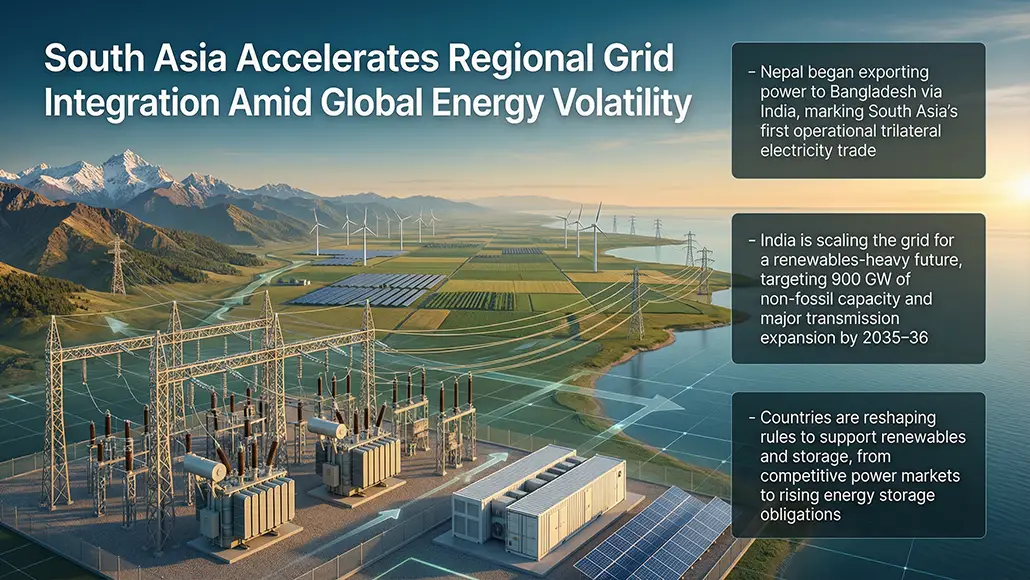

South Asia is undergoing a systemic transformation of its power sectors as nations move to mitigate the impacts of global fuel market disruptions. Driven by a strategic pivot toward energy security, the region is transitioning from isolated bilateral arrangements to complex trilateral trade and massive non-fossil capacity targets. India is leading this shift with a roadmap to achieve 900 GW of non-fossil fuel capacity by 2035-36, while Pakistan and Bangladesh are aggressively diversifying their fuel mixes to reduce dependency on the Strait of Hormuz, which currently facilitates over 90% of Pakistan’s oil and LNG imports. According to Power Info Today’s analysis, these clean energy transition developments collectively indicate a shift toward more structured cross-border energy integration across the BBIN (Bangladesh, Bhutan, India, Nepal) subregion.
Key Announcements and Strategic Milestones
A historic milestone was recorded on June 15, 2025, when Nepal began exporting 40 MW of electricity to Bangladesh through India’s transmission network. This tripartite framework established the first operational cross-border electricity commerce beyond simple bilateral deals in South Asia. In addition to this, Bhutan has recently commissioned the 1,020 MW Punatsangchhu-II hydroelectric project and its first large-scale 22.38 MW Sephu solar plant, signaling a move toward a more diversified renewable portfolio.
Meanwhile, India’s Central Electricity Authority (CEA) has outlined a massive grid expansion plan to support a peak demand projected to reach 459 GW by 2035-36. This roadmap introduces operational measures such as Solar Hour and Non-Solar Hour concepts to optimize the use of existing transmission lines for wind and battery storage during low-solar periods.
Investments and Financial Frameworks
The scale of the regional clean energy transition requires unprecedented capital mobilization. India’s transmission roadmap alone proposes the addition of 137,500 circuit kilometers of lines at an estimated cost of nearly ₹7,93,300 crore. Bangladesh’s draft Energy and Power Sector Master Plan (EPSMP) 2026-2050 estimates a requirement of $107.4 billion for the electricity sector and up to $85 billion for primary energy.
In Pakistan, the people-led solar revolution has already demonstrated significant fiscal impact, helping the country avoid approximately $12 billion in oil and gas imports as of February 2026. Furthermore, the Asian Development Bank (ADB) has remained a critical financier, with $20.54 billion cumulatively invested in 86 projects across the subregion as of December 2023.
Policy and Regulatory Shifts
Nations are introducing market-oriented reforms to attract private participation. Pakistan has launched the Competitive Trading Bilateral Contract Market (CTBCM) to move away from a single-buyer model toward a competitive structure where generators and large consumers negotiate directly. Similarly, Sri Lanka has enacted amendments to the Electricity Act to unbundle the Ceylon Electricity Board (CEB) into separate state-owned enterprises for generation, transmission, and distribution.
India has notified a long-term trajectory for Energy Storage Obligations (ESO), which will increase to 4% by FY 2029-30, requiring that at least 85% of stored energy be procured from renewable sources. From an industry standpoint, Power Info Today believes these regulatory frameworks are being structured to support the management of intermittency associated with large-scale non-fossil capacity deployment.
Operational Impact and Technology Deployment
The operational focus has shifted to grid stability and high-voltage transfer. India is implementing 1150 kV AC transmission systems to carry large volumes of electricity from renewable-rich states like Rajasthan and Gujarat to industrial hubs. In the battery energy storage system (BESS) sector, battery prices have dropped 65% since 2021, making co-located solar-plus-storage systems cheaper than new thermal plants in many contexts.
Nepal’s performance in the first five months of FY 2025/26 underscores the operational success of regional trade, with the country earning Rs. 18.26 billion from power sales to India and Bangladesh. However, analysts warn that Pakistan’s rapid 5 GW rooftop solar surge is creating revenue erosion for distribution companies, highlighting the need for urgent grid modernization and tariff restructuring.
Market and Strategic Relevance
The regional energy landscape is now defined by the necessity of decoupling growth from volatile fossil fuel imports. While fossil fuels still account for roughly 69.99% of South Asia’s primary energy mix, the non-fossil capacity is outpacing fossil growth. India reached a historic milestone in July 2025, where renewable generation met 51.5% of the country’s total daily electricity demand. As the war in Iran continues to threaten global trade routes, the push for an integrated South Asian grid connecting the hydropower of the Himalayas with the solar-rich plains of India and the coastal wind potential of Sri Lanka has transitioned from a developmental goal to a matter of regional energy security.
Power Info Today observes that the growing emphasis on cross-border electricity trade, grid expansion, and storage integration reflects a broader alignment of regional energy systems with evolving security and supply stability priorities.