




































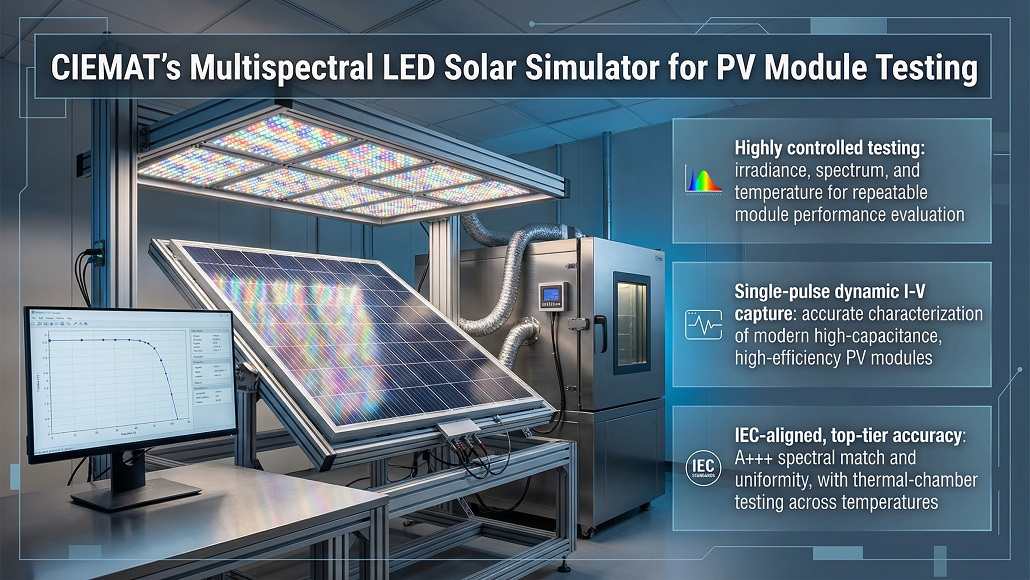

Spain’s Center for Energy, Environmental and Technological Research (CIEMAT) has introduced a solar simulator designed to support advanced photovoltaic module testing, marking a new step in precision measurement capabilities. The institute confirmed that the system has been commissioned for both the electrical characterization of commercial photovoltaic modules and the experimental study of emerging PV technologies. Developed internally by the Photovoltaic Solar Energy Unit at CIEMAT, the platform is engineered to deliver highly controlled testing conditions, including irradiance, spectral distribution, and temperature, enabling consistent and repeatable performance evaluation.
At the heart of the setup is a multispectral LED array built from emitter modules arranged across 15 cm × 15 cm plates, spanning the entire module testing surface. The configuration incorporates 37 LED types and 32 independently managed spectral channels, allowing accurate reproduction of the solar spectrum. According to CIEMAT, the system achieves spatial irradiance uniformity exceeding 0.4% and supports illumination pulses of up to 500 ms. When combined with dynamic I-V acquisition, the solar simulator enables precise single-pulse testing of photovoltaic modules with high electrical capacitance.
The system’s architecture integrates long pulse duration, stable temporal performance, and controlled voltage sweep mechanisms to ensure accurate characterization of modern high-efficiency modules. It also enables spectral optimization across a range of photovoltaic technologies, including crystalline silicon, heterojunction (HJT), PERC, TOPCon, perovskites, and thin-film devices. CIEMAT highlighted that the multispectral LED configuration improves spectral matching compared with conventional xenon lamp-based solar simulators, supporting more reliable testing outcomes.
Additionally, the equipment features a high-speed acquisition platform capable of capturing dynamic I-V curve sweeps during illumination, simultaneously measuring current and voltage. This allows the calculation of key electrical parameters such as short-circuit current, open-circuit voltage, maximum power, maximum power point (MPP), and fill factor (FF). The system also complies with IEC 60904-9 procedures for irradiance and temperature corrections and has achieved an A+++ / A++ / A+++ classification based on spectral match, spatial uniformity, and temporal stability. Integrated with a large-volume thermal chamber, the platform enables testing across varied temperature conditions, supporting detailed analysis of module behavior under realistic operating environments.