




















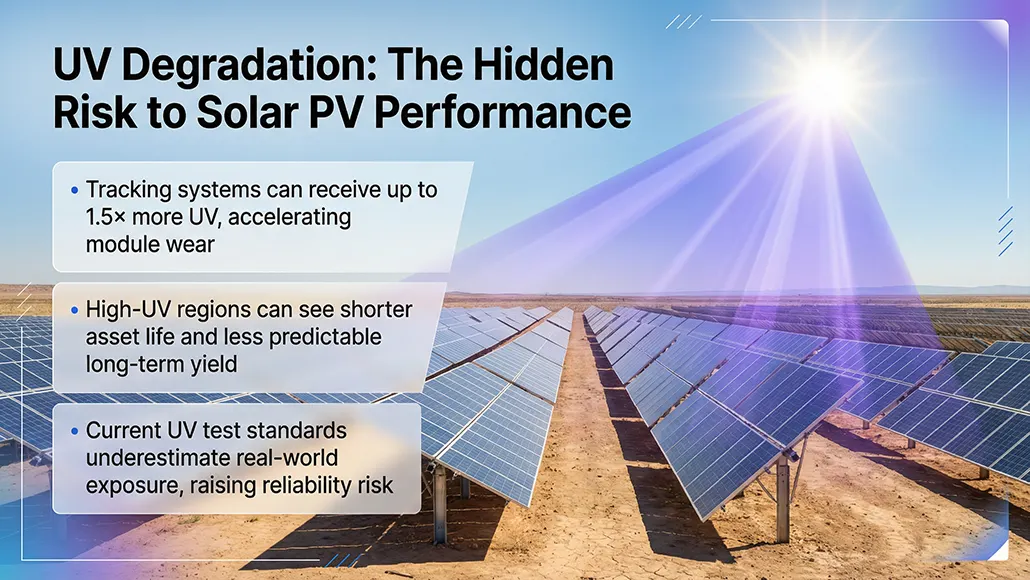

A new global modelling study led by UNSW Sydney has identified UV degradation as a critical but under-recognised factor affecting the long-term performance of photovoltaic (PV) assets, with implications for solar PV system design, asset lifecycle planning, and testing standards across the energy sector.
Global Model Reveals Uneven UV Exposure Risks
Engineers from UNSW have developed a high-precision global model that quantifies ultraviolet radiation exposure on solar panels based on geography, atmospheric conditions, and mounting configurations. The model delivers the first global-scale comparison between fixed-tilt and tracking PV systems, enabling developers and asset owners to better anticipate performance outcomes across regions.
The findings indicate that UV radiation varies significantly across climates, with arid and tropical regions experiencing the highest exposure levels. As outlined in the IEEE study , UV irradiance can exceed 80 W/m² in arid zones, compared to less than 30 W/m² in high-latitude regions, highlighting substantial geographic variability.
This variability directly translates into differences in degradation behaviour, even for identical module technologies installed under similar configurations.
Tracker Systems Face Elevated Degradation Exposure
The study highlights that system design plays a decisive role in UV exposure. Solar panels mounted on single-axis or dual-axis tracking systems receive significantly higher UV radiation compared to fixed-tilt installations.
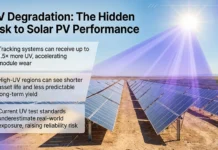
- Tracking systems can receive up to 1.5 times more UV radiation
- Annual UV-driven degradation can reach 0.35% per year
- Fixed-tilt systems typically see around 0.25% per year
Over a standard 20-year operational lifecycle, this differential compounds into measurable performance loss. The IEEE analysis further notes that tracking systems can experience approximately twice the degradation rates in arid and semi-arid regions compared to fixed-tilt systems .
While trackers improve energy yield, the findings introduce a trade-off between generation efficiency and long-term asset durability.
UV Degradation Impacts Asset Lifespan
A key conclusion of the research is that UV degradation alone can account for a substantial share of total module performance loss in solar PV systems.
In high-irradiance environments:
- UV-related degradation may contribute nearly 25% of total annual degradation
System lifespan could be reduced by 7–10 years - This challenges the commonly assumed linear degradation rates of around 0.5% annually used in financial and performance modelling.
As observed by Power Info Today, this non-linear degradation profile introduces uncertainty in long-term yield forecasts and levelised cost of energy (LCOE) calculations, particularly for utility-scale solar projects in high-UV regions.
Testing Standards Underestimate Real-World Conditions
The study raises concerns over existing international testing frameworks. Current standards, such as UV preconditioning requirements of 15 kWh/m², fall significantly short of real-world exposure.
In regions like Alice Springs, Australia, this threshold can be reached in just over a month, compared to decades of expected operational exposure.
According to the IEEE findings :
- Standard test exposure levels represent only a fraction of lifetime UV dose
Even enhanced protocols fail to replicate 25–30 years of field conditions - This mismatch suggests that modules passing certification may still face accelerated degradation in operational environments.
Technology Shift Increases UV Sensitivity
The transition toward high-efficiency PV technologies is further amplifying the issue. Advanced cell architectures such as TOPCon, heterojunction (HJT), and PERC are designed to capture a broader solar spectrum, including UV wavelengths.
However, these designs may increase vulnerability to UV-induced material degradation. The IEEE paper notes that modern architectures often use UV-transparent materials and modified passivation layers, which can heighten sensitivity to UV exposure and accelerate performance decline .
Strategic Implications for Solar Project Development
The introduction of a global UV modelling framework provides actionable insights for developers, manufacturers, and asset owners.
Key applications include:
- Site-specific module selection based on UV exposure profiles
- Improved accelerated stress testing prior to deployment
- Optimisation of mounting configurations for lifecycle performance
- Enhanced financial modelling incorporating non-linear degradation
Power Info Today notes that the findings reinforce the need for climate-specific engineering approaches in solar deployment, particularly in high-radiation geographies where performance risks are most pronounced.
Towards Climate-Specific Reliability Standards
The study underscores the necessity of revising industry standards to reflect real-world environmental stressors. Climate-specific testing, higher UV exposure thresholds, and regionally adaptive reliability benchmarks are identified as critical next steps.
Ultimately, the research positions UV degradation as a central variable in solar PV systems’ performance, requiring greater integration into design, testing, and investment decision-making frameworks across the energy sector.