











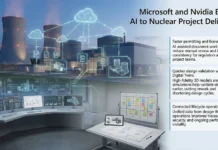





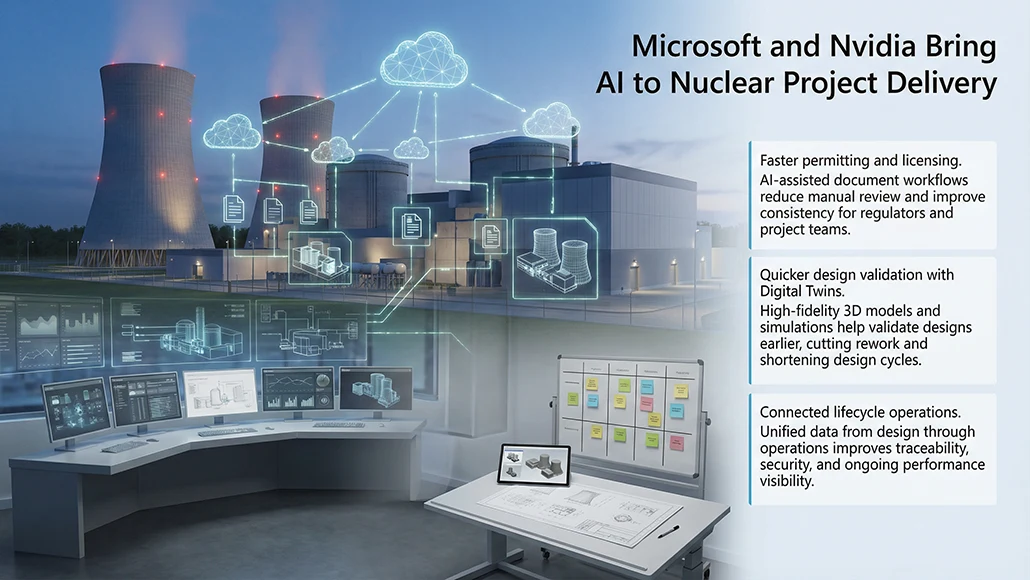

Microsoft has unveiled an AI for nuclear collaboration with Nvidia, positioning the partnership as a response to mounting energy demand and inefficiencies in traditional project delivery. The initiative is designed to introduce end-to-end digital tools that streamline permitting, accelerate design cycles, and optimise operational workflows across nuclear infrastructure. In outlining the rationale, Darryl Willis, Corporate Vice President, Worldwide Energy and Resources Industry at Microsoft, highlighted structural constraints facing the sector. “The world is racing to meet a historic surge in power demand with an infrastructure pipeline built for the analogue age,” he said in a blog post. “Driven by the exponential expansion of digital technologies and the reindustrialisation of supply chains, the mandate for always-on, carbon-free power is urgent and absolute. Nuclear energy is the essential backbone for this future, but the industry remains trapped in a delivery bottleneck. Before a shovel even hits the dirt, critical projects are slowed by highly customised engineering, fragmented data, and mountains of manual regulatory review.”
The collaboration between Microsoft and Nvidia introduces a unified, AI-enabled framework that applies disciplined engineering principles throughout a nuclear plant’s lifecycle from site permitting and design through to construction and continuous operations. According to Microsoft, these capabilities are embedded within a connected platform intended to improve repeatability, traceability, and security while reducing development timelines and rework. Expanding on the technical value, Willis noted: “By unifying data, traceability, and simulation across phases, AI accelerates design validation with high-fidelity 3D models and Digital Twins, improves licensing consistency through AI-assisted document workflows, and connects design assumptions to operational performance – giving operators, regulators, and stakeholders clearer, continuous visibility.”
As part of the AI for nuclear ecosystem, New York-based Everstar an Nvidia Inception startup will integrate its domain-specific AI capabilities into Microsoft’s Azure cloud platform. Everstar CEO Kevin Kong emphasised the operational implications of the partnership, stating: “The nuclear industry has been bottlenecked by documentation burden and regulatory complexity for decades. This partnership means our customers get the secure, scalable cloud deployments they demand. It’s a significant step toward making nuclear power fast, safe, and unstoppable.” The company also confirmed its involvement with the US Department of Energy, Idaho National Laboratory, Argonne National Laboratory, and Microsoft under the DOE’s Genesis Mission, marking its first public milestone in a broader roadmap aimed at compressing timelines across licensing, design, manufacturing, and operations.
Everstar further disclosed that its Gordian AI platform successfully converted a DOE safety analysis document into sections equivalent to a US Nuclear Regulatory Commission licence application within a single day an activity that typically requires four to six weeks of expert effort. The Genesis Mission, launched by Donald Trump through an Executive Order dated 24 November last year, draws inspiration from the Apollo Programme. The White House described it as an initiative to unite computational power, scientific data, and research expertise into a coordinated system. Led by the DOE, the programme aims to leverage AI and advanced computing to double the productivity of US science and engineering within a decade, while delivering breakthroughs in energy, scientific discovery, and national security.