

















Key Takeaways:
- Integrating renewable energy into large scale hydrogen production requires careful orchestration of solar, wind and hydro resources with electrolysers, storage and sometimes the grid, to manage intermittency, minimise curtailment and optimise utilisation, enabling competitively priced renewable hydrogen for power, industry and transport.
- Project developers must choose between grid connected and off grid hydrogen production models, or hybrids of the two, each with distinct implications for capital cost, operating flexibility, revenue stacking and system design, while power to hydrogen optimisation increasingly depends on advanced forecasting, digital control and market‑aware operating strategies.
Integrating renewable energy into large scale hydrogen production is one of the most important engineering and economic challenges in the clean energy transition. Hydrogen produced from solar, wind and hydro resources can provide a low‑carbon feedstock and fuel for power generation, industry and transport, but only if projects are designed to handle the inherent variability of renewables while keeping costs under control.
At the heart of integrating renewable energy into large scale hydrogen production lies a delicate balance: matching the intermittent output of renewable plants with the operating needs of electrolysers and downstream users, all within the constraints of grid infrastructure, market rules and financing requirements. Getting this balance right can turn fluctuating renewable power into a stable stream of hydrogen with predictable volumes and prices.
The role of solar, wind and hydro in renewable hydrogen
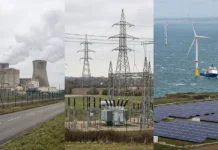
Solar photovoltaics, onshore and offshore wind, and hydropower each offer distinct profiles that shape how they can best support hydrogen production. Solar power is highly predictable on a daily basis but varies seasonally and drops to zero at night. Wind can be more erratic hour by hour but may provide stronger output during nights or seasons when solar is weaker. Hydropower, where available, often offers the most dispatchable renewable source, as water can be stored in reservoirs and released when needed.
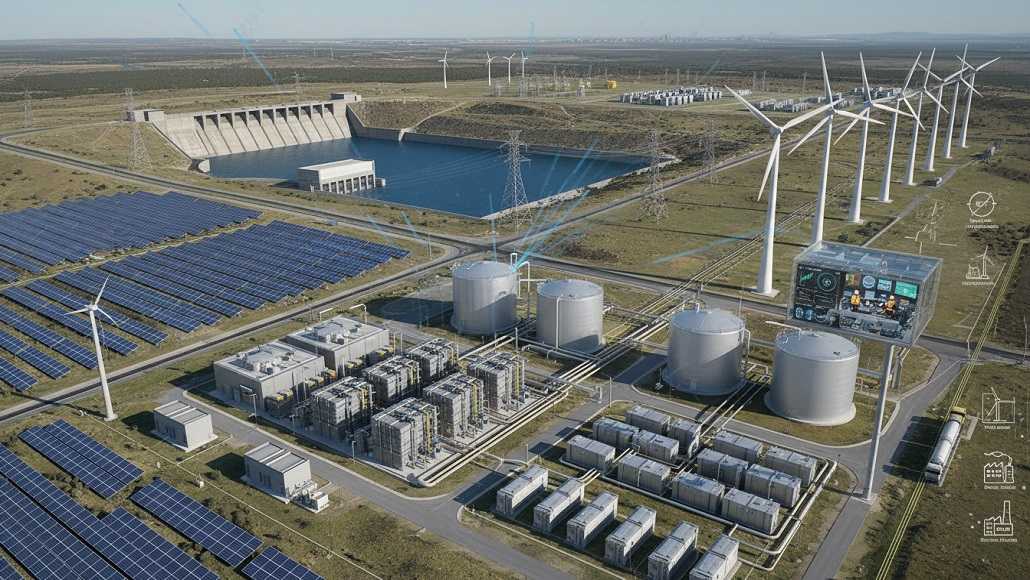
Integrating renewable energy into large scale hydrogen production often involves combining these resources into hybrid plants. For example, a project might pair solar and wind in the same location, feeding a shared electrolyser facility. When the sun shines and the wind blows, the plant operates at or near full capacity; when one resource is weak, the other can partially compensate. If hydropower is accessible, it can serve as a balancing resource, smoothing the aggregate supply and helping the electrolyser run more steadily.
This multi-resource approach increases overall capacity factor and can improve both the utilisation and economics of electrolysers, which prefer operation within defined load ranges for efficiency and durability. The more consistent the input power, the lower the unit cost of hydrogen, all else being equal.
Managing intermittency and designing for flexibility
The central technical challenge in integrating renewable energy into large scale hydrogen production is managing intermittency. Electrolysers can operate flexibly, but frequent on‑off cycling or rapid load changes can affect efficiency and lifetime, depending on the technology. Alkaline electrolysers tend to prefer smoother operation, while PEM electrolysers can follow renewables more dynamically, albeit with higher capital costs.
Project designers have several levers to manage intermittency. One is oversizing the renewable capacity relative to the electrolysers. By installing more solar or wind capacity than the electrolysers can use at peak, developers can increase the number of full‑load hours the electrolysers experience, even if surplus renewable power must occasionally be curtailed. This approach can reduce the levelised cost of hydrogen but raises upfront capital expenditure for generation.
Another lever is incorporating energy storage, either on the electricity side or the hydrogen side. Battery storage can help smooth short‑term fluctuations in renewable output, providing a steadier input to the electrolysers. On the hydrogen side, storage tanks, underground caverns or other forms of hydrogen storage allow the plant to produce hydrogen when electricity is abundant and cheap, then supply customers continuously regardless of real‑time renewable output.
Controls and forecasting play a crucial role as well. Advanced forecasting of solar and wind generation enables operators to plan electrolyser loading schedules, maintenance windows and hydrogen logistics. Real‑time control systems can adjust production based on electricity prices, grid conditions and hydrogen demand, optimising economic returns while staying within technical limits.
Power-to-hydrogen optimisation strategies
Power-to-hydrogen optimisation goes beyond simply matching generation to electrolyser capacity. It involves a holistic view of the value chain, including electricity prices, policy incentives, grid tariffs and hydrogen offtake contracts. Integrating renewable energy into large scale hydrogen production means deciding when to operate electrolysers at full power, when to partially load, and when to pause altogether.
In favourable conditions, such as regions with abundant low‑cost solar or wind, it may make sense to run electrolysers mostly when power prices are very low or negative, accepting lower utilisation in exchange for cheaper input energy. In other contexts, developers may prioritise high utilisation to spread fixed costs, even if electricity is occasionally more expensive.
Complex projects may also earn revenue from providing grid services. Grid-connected electrolysers can participate in balancing markets or frequency response, modulating their load to help stabilise the system. This opens additional income streams and can change the optimal operating pattern, especially where ancillary service markets are well developed.
Ultimately, power-to-hydrogen optimisation aims to minimise the levelised cost of hydrogen while respecting technical constraints and contractual obligations. Integrating renewable energy into large scale hydrogen production is therefore as much a matter of smart operations and market participation as it is about physical plant design.
Grid-connected versus off-grid production models
A key strategic choice for developers is whether to pursue grid-connected or off-grid models for hydrogen production, or some hybrid of the two. Each approach offers distinct advantages and trade-offs when integrating renewable energy into large scale hydrogen production.
In a grid-connected model, the electrolyser complex is linked both to dedicated renewables and to the broader electricity grid. When on-site solar or wind output is high, the plant uses that energy preferentially. During periods of low on-site generation, it can draw additional power from the grid ideally from low-carbon sources to maintain hydrogen production. This approach enhances utilisation and provides operational flexibility but exposes the project to grid tariffs, market price volatility and potential constraints on grid capacity.
Grid connection also enables electrolysers to act as flexible loads, offering system services and taking advantage of low wholesale prices. In regions where the grid is already relatively low carbon, grid-connected solutions can produce hydrogen with acceptable emissions intensity while maximising uptime.
Off-grid models, by contrast, dedicate specific renewable assets entirely to hydrogen production, with no physical connection to the wider grid. Integrating renewable energy into large scale hydrogen production in this way simplifies exposure to power markets and can make emissions accounting straightforward. It is particularly attractive in remote locations with excellent resources but limited grid infrastructure.
The trade-off is that off-grid projects must size generation and electrolysers carefully to balance utilisation against capital cost. Without the grid as a buffer, excess renewable output beyond electrolyser capacity is simply curtailed, while periods of low generation reduce hydrogen production. Storage options become more critical, and hybrid resource configurations such as combining solar and wind take on added importance.
Hybrid schemes blur the line, using limited grid connections for backup or emergency supply while relying primarily on co-located renewables. Choosing among these models depends on local grid characteristics, policy frameworks, resource quality and the needs of hydrogen offtakers.
Technical and operational considerations at scale
As projects scale from megawatt to hundreds of megawatt or gigawatt size, integrating renewable energy into large scale hydrogen production introduces additional technical and operational considerations. The physical footprint of solar arrays, wind farms and electrolysers grows, making land use, permitting and community engagement critical issues. Transmission and collection networks must be designed to move power efficiently within the project area, and water sourcing for electrolysis must be secured and managed responsibly.
At large scale, modular design becomes valuable. Standardised electrolyser skids, repeatable solar or wind blocks, and flexible control architectures allow phased development, where capacity is added over time as markets and policies evolve. This reduces risk and allows learning from early phases to inform later expansions.
Reliability and maintenance strategies also become more complex. With many units in operation, predictive maintenance based on data analytics can minimise downtime and extend equipment life. Spare parts logistics, local workforce development and supplier relationships all contribute to the long-term success of integrating renewable energy into large scale hydrogen production.
Coordination with offtakers is crucial. Hydrogen delivered to power plants, industrial sites or export terminals must meet quality, pressure and scheduling specifications. Contracts need to account for variability in production and define responsibilities when output falls short due to low renewable generation or equipment outages. As markets mature, more sophisticated contracting structures such as take‑or‑pay arrangements with flexibility bands will likely emerge.
Toward a mature renewable hydrogen ecosystem
Over time, integrating renewable energy into large scale hydrogen production will give rise to a more interconnected ecosystem. Renewable hubs supplying hydrogen to multiple sectors, shared pipeline networks, storage clusters and regional export terminals will knit together what are currently stand‑alone pilot projects. In such a context, the ability to integrate solar, wind and hydro resources optimally, both technically and economically, becomes a key differentiator for successful projects and regions.
As technology improves, costs fall and experience accumulates, integrating renewable energy into large scale hydrogen production will move from a frontier engineering challenge to a standard practice. The projects being built today experimenting with different resource mixes, control strategies and grid configurations are laying the foundation for this future, showing how renewables and hydrogen together can support a deeply decarbonised energy system.