





































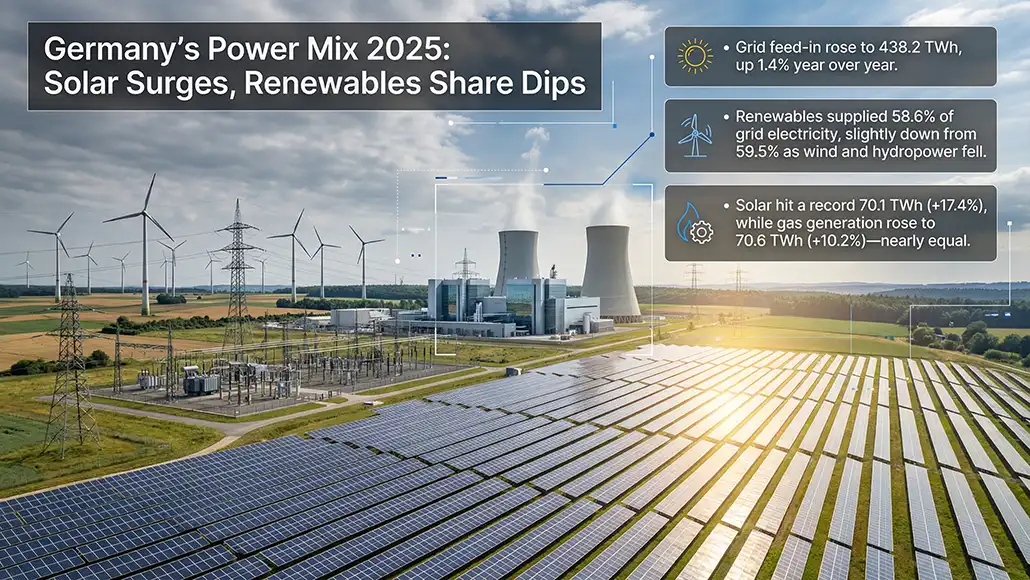

Preliminary figures released by Germany’s Destatis indicate that 438.2 TWh of electricity was fed into the country’s grid in 2025, marking a 1.4% increase compared with 432.1 TWh in 2024. Renewable energy sources generated 256.9 TWh, marginally lower than the 257.1 TWh recorded the year before. As a result, the share of renewables in electricity supplied to the grid declined slightly, slipping from 59.5% in 2024 to 58.6% in 2025.
The statistics cover electricity delivered to the public supply grid rather than overall electricity consumption. They do not include power produced by industrial facilities and consumed on site, electricity generated from residential photovoltaic systems used directly within households, grid losses, or net electricity trade.
Separate estimates from Germany’s Working Group on Energy Balances place total gross electricity generation at 500.9 TWh in 2025, compared with 494.4 TWh in 2024. Meanwhile, gross electricity consumption is estimated at 517.2 TWh, according to the Center for Solar Energy and Hydrogen Research Baden-Württemberg (ZSW) and the German Association of Energy and Water Industries (BDEW). Within this broader consumption figure, renewable energy sources accounted for 55.8%.
Within the grid feed-in statistics, electricity generation from fossil fuels showed an increase. Combined output from coal and natural gas reached 181.3 TWh, up 3.6% from 175.0 TWh in 2024, raising their share of generation from 40.5% to 41.4%. Gas-fired power recorded the strongest rise among fossil fuels, climbing 10.2% to 70.6 TWh from 64.1 TWh the previous year, which lifted its share of electricity fed into the grid from 14.8% to 16.1%. By contrast, coal-fired generation edged down slightly to 96.8 TWh, compared with 97.3 TWh a year earlier, reducing its share from 22.5% to 22.1%.
Wind power remained the largest individual source of electricity generation in Germany, though output declined 3.6% to 131.3 TWh in 2025, down from 136.3 TWh in 2024. Its contribution to grid electricity therefore fell from 31.5% to 30.0%. Among renewable sources, hydropower experienced the sharpest reduction, dropping 22.5% to 15.8 TWh from 20.4 TWh, while biogas generation decreased 3.0% to 27.4 TWh from 28.2 TWh.
Solar generation moved in the opposite direction, reaching a record 70.1 TWh in 2025, representing a 17.4% increase compared with 59.7 TWh in 2024. Solar generation (photovoltaics) ranked as the fourth-largest generation source after wind, coal, and natural gas, with the gap between gas and solar shares narrowing to 0.1 percentage points.
Cross-border electricity flows also shifted during the year. Imports declined 2.7% to 79.6 TWh in 2025, down from 81.7 TWh in 2024, while exports rose 8.7% to 60.2 TWh from 55.4 TWh. As a result, the import surplus decreased from 26.3 TWh to 19.4 TWh.