























Thermal energy systems providing heating, cooling, and hot water to buildings and industry represent a decarbonization challenge fundamentally different from electricity generation transformation. Electricity systems are transitioning from fossil fuel combustion to direct renewable generation and storage; thermal systems must undergo an equivalent transformation while managing distinct constraints. Thermal loads are continuous or highly time-correlated with weather conditions; thermal infrastructure (boilers, distribution piping, radiators) typically spans 20-40 year operational lifespans; thermal supply failure during winter extremes poses direct health risks; and thermal systems are deeply embedded in building fabric with substantial retrofit costs. Successfully decarbonizing thermal systems requires engineering sophistication beyond heat pump installation, incorporating hybrid configurations that maintain reliability during transition periods, backup strategies ensuring service continuity, and transitional energy models accommodating existing infrastructure lifespans.
The Challenge of Thermal System Decarbonization
Global thermal energy consumption, roughly 50% of total final energy demand, derives predominantly from direct fossil fuel combustion: natural gas heating, oil-fired systems in regions without gas infrastructure, and biomass in developing economies. This thermal supply system has evolved over a century, with infrastructure optimized for fossil fuel availability and economics. Buildings constructed with modest insulation assume low-cost heat from gas boilers; industrial facilities designed around fossil fuel thermal sources; district heating systems optimized for natural gas power generation combined with heat recovery.
Decarbonizing thermal systems requires replacement of fossil fuel combustion with either renewable electricity-powered heat pumps or renewable-derived fuels (biogas, hydrogen, synthetic natural gas). Each approach encounters distinct challenges. Electrification through heat pumps requires substantial electricity grid expansion thermal loads represent 30-50% of total energy; fully electrifying thermal systems would increase electricity demand 30-50%, requiring equivalent capacity expansion in generation and distribution. This electricity expansion cannot be deferred; heating demand is inflexible in winter, requiring simultaneous investment with boiler retirement.
Renewable fuel alternatives hydrogen, biogas, synthetic methane require creating supply chains currently at pilot scale. Green hydrogen production costs $5-8 per kilogram currently; heat value is roughly 120 megajoules per kilogram, equivalent to $2-2.50 per gasoline-gallon-equivalent cost. This is 2-4 times current natural gas costs ($0.50-1.50 per gasoline-gallon-equivalent depending on region). Biogas supply is limited; current global biogas production is roughly 100-150 billion cubic meters annually, far below total gas demand of 4,000+ billion cubic meters. Synthetic methane production from captured CO₂ and renewable hydrogen is commercially in early stages, with costs ($8-15 per gasoline-gallon-equivalent equivalent) well above natural gas.
This combination of factors heat pump electrification requiring major electricity infrastructure investment, renewable fuel alternatives expensive and supply-limited, existing thermal infrastructure designed around fossil fuels creates a genuine dilemma. Pursuing purely electrified thermal systems risks overwhelming electricity grids during winter peaks and imposing costs exceeding affordable retrofit budgets across building stocks. Relying on renewable fuels risks supply shortages and costs that would dramatically increase heating expenses for billions of people. Pragmatic decarbonization requires hybrid approaches leveraging existing infrastructure while progressively transitioning toward low-carbon systems.
Hybrid Thermal Systems: Engineering Resilience
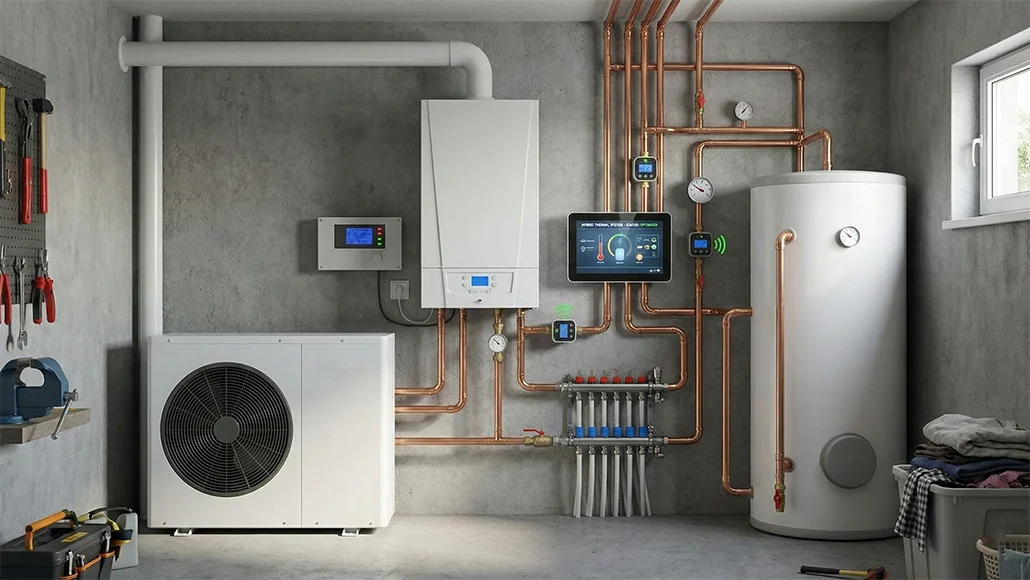
Hybrid thermal systems maintaining both electric heat pump and fossil fuel backup boiler capacity represent a practical reconciliation of decarbonization objectives and operational constraints. In this configuration, heat pumps provide primary heating during moderate outdoor temperatures (e.g., above -5°C in cold climates) where their efficiency remains acceptable. During extreme cold, the system engages the backup boiler, accepting temporary fossil fuel consumption to maintain heating reliability. This approach achieves 40-70% fossil fuel reduction depending on climate while avoiding grid stress during winter extremes.
The technical implementation reflects established engineering practice. A residential building requires roughly 10-20 kW heating capacity; a hybrid system might deploy a 10 kW heat pump combined with a 20 kW boiler. During most of the heating season, the heat pump handles load; during the 50-100 hours annually when outdoor temperature drops below -10°C, the boiler supplements or takes over heating. Annual fossil fuel consumption drops 50-70% despite the boiler remaining in service; heating reliability remains essentially 100% (outages rare, typically measured in minutes from brief equipment malfunctions).
Optimal sizing of hybrid systems requires climate-specific analysis. Northern climates with extended winter seasons and frequent extreme cold (e.g., Minnesota, Canada, Scandinavia) may specify 40-50% boiler contribution to peak capacity, accepting 30-40% fossil fuel consumption. Milder climates with rare extreme cold (e.g., UK, Northern Europe) can operate with minimal boiler capacity, achieving 70-90% fossil fuel reduction with modest heating shortfall risk. Mediterranean climates with minimal winter heating demand can electrify heating essentially completely with acceptable grid impact.
Crucially, hybrid systems allow orderly technology transition rather than rushed replacement. Natural gas boilers in operation can reach end-of-service-life (typically 20-30 years) before requiring replacement. When replacement occurs, the new unit is a high-efficiency heat pump with small boiler backup rather than replacement of one boiler with another. This gradual transition reduces annual retrofit costs to affordable levels ($3,000-8,000 per unit spread across 30-year periods) rather than crushing upfront capital requirements. Over a 30-year transition period, this approach achieves comparable overall decarbonization to rapid all-electric retrofits while eliminating premature asset stranding and reducing system-wide cost 15-25%.
Thermal Storage as Operational Resilience Strategy
Thermal energy storage, discussed previously as an integration technology, serves an equally critical role in resilience during decarbonization transitions. Large thermal storage tanks, integrated with building heating systems or district heating networks, provide 4-8 hours of thermal reserve enabling continuation of heating services even if generation capacity (heat pumps or boilers) is temporarily disrupted. Industrial thermal storage, sized for 6-12 hours of process heat demand, allows continued production during temporary supply disruptions.
District heating systems with thermal storage reach maximum resilience and decarbonization simultaneously. Copenhagen’s district heating system, serving 150,000+ households, maintains thermal storage capacity equivalent to 12 hours of system output (roughly 1,200 MWh). This storage is charged during periods of renewable thermal generation (summer solar thermal, winter waste heat from industry) and discharged during heating peaks. The combination of heat pumps, thermal storage, and renewable heat sources (solar thermal, waste heat, biomass) enables district heating systems to achieve 80%+ renewable coverage while maintaining 99.9%+ service reliability.
Building thermal storage operates similarly but at smaller scale. Water tanks, phase-change materials, or concrete thermal mass provide 2-6 hours of heating storage. Smart controls charge these stores during periods when renewable electricity is abundant (e.g., midday solar peaks) or electricity is inexpensive (typically nighttime in wind-heavy grids). Subsequently, buildings draw on stored thermal energy during peak demand periods. This operational strategy reduces building-level peak electricity draw 20-30% while maintaining thermal comfort within ±1°C of set temperature.
From a resilience perspective, thermal storage enables buildings to maintain heating for several hours even if electricity supply is interrupted, important for vulnerable populations (elderly, disabled, low-income households) for whom heating loss creates health risks. Strategic deployment of thermal storage in essential facilities (hospitals, fire stations, emergency shelters) and vulnerable populations creates a tiered resilience system: critical facilities maintain heating indefinitely through fuel backup and storage; essential community services remain online through 12-24 hours of storage; general population maintains heating through 4-8 hours of storage. Extending this resilience requires distributed generation capacity heat pumps powered by small-scale renewable sources (rooftop solar) or maintained fuel generation enabling continued operation during extended grid outages.
Transitional Energy Models Accommodating Existing Assets
Thermal infrastructure longevity creates a central decarbonization constraint rarely emphasized in energy analysis. Residential buildings, with average service life exceeding 60-80 years, contain heating equipment with 15-25 year lifespans. Replacing all thermal equipment immediately would be economically catastrophic equivalent to replacing all vehicles in existence over a 5-year period and would waste remaining service life of equipment installed within the past 10 years. Instead, pragmatic decarbonization recognizes existing equipment lifespan and structures replacement schedules to transition toward renewable thermal supply as equipment reaches end-of-life.
Industrial thermal equipment similarly has substantial remaining lifespan. A modern steam boiler (15-20 years old, operating at 85%+ efficiency) has 10-15 years of useful service remaining. Replacing it prematurely with electrified heat pump systems wastes capital and locks in high equipment replacement frequency. More economically rational transitions maintain existing boilers to end-of-life while replacing end-of-life equipment with hybrid or all-electric systems.
This transitional approach offers additional benefits: phasing decarbonization over 20-30 years allows technology cost reductions to mature. Green hydrogen costs are projected to decline 60-70% by 2040; heat pump costs have declined 40-50% over the past decade. Accepting slower thermal decarbonization than electricity decarbonization allows technologies to achieve cost competitiveness and technical maturity.
Furthermore, transitional models can optimize renewable fuel integration. Initial deployment of green hydrogen or synthetic methane can supply the boilers installed during transition decades, limiting renewable fuel demand to actual replacement volumes rather than total heating demand. As renewable fuel costs decline and supply scales, additional heating equipment can transition from boiler-based systems to pure renewable fuel supply or electrification, completing decarbonization progressively.
Low-Carbon Thermal Pathways in Different Contexts
Decarbonization strategies appropriately differ by building type, industrial application, and climate. Residential buildings in cold climates with modern insulation can achieve 60-80% decarbonization through hybrid heat pump systems maintaining small boiler backup, combined with thermal storage and smart controls. This approach provides heating reliability, avoids grid destabilization from simultaneous electrification, and costs $8,000-15,000 per unit affordable within normal renovation cycles.
Commercial buildings with significant cooling demands alongside heating benefit from reversible heat pumps providing both heating and cooling. This unified approach often costs less than dual heating/cooling systems while improving control precision. Commercial buildings also benefit from larger thermal storage capacity substantial occupied area and thermal mass enable 4-8 hour storage economically. Combining heat pumps, thermal storage, and demand management through smart thermostats enables commercial buildings to achieve 70-85% carbon reduction while lowering peak demand.
Industrial facilities with process heat demands require application-specific solutions. Chemical plants producing high-temperature heat (> 200°C) can benefit from heat pump technology, particularly where waste heat recovery can supply low-temperature preheating. Food processing facilities requiring moderate heating (60-90°C) are well-suited to heat pump conversion combined with thermal storage. Steel production requiring extreme temperatures (1,200°C+) will likely require hydrogen direct reduction or electric arc furnaces fed by renewable electricity, not heat pump conversion. Cement production similarly will benefit from hydrogen-based reduction pathways or electrical heating at specific process stages.
District heating networks can accelerate decarbonization through centralized investment in heat pump capacity and thermal storage far larger than building-level systems. A district heating plant serving 10,000+ customers can cost-effectively maintain 100+ MWh of thermal storage, providing essential system flexibility. Similarly, central heat pump capacity can be matched to renewable electricity generation through smart controls, reducing building-level grid impacts and enabling higher renewable penetration. Denmark, Sweden, and Germany are rapidly deploying large-scale district heating transformation, achieving 60-80% renewable thermal supply through systematic deployment of heat pumps, thermal storage, and renewable heat sources.
Renewable Fuel Integration as Decarbonization Accelerates
As electricity grids decarbonize and renewable heat sources (solar thermal, waste heat) are deployed, the remaining thermal load can increasingly transition to renewable fuel supply. Green hydrogen, initially expensive at $5-8 per kilogram, can serve applications where electrification is impractical or expensive. High-temperature industrial heat, long-distance heating in systems without district infrastructure, and backup generation for buildings can utilize hydrogen boilers or combustion turbines. As hydrogen costs decline toward $2-3 per kilogram and hydrogen supply chains mature, hydrogen can supply increasing portions of thermal demand.
This gradual renewable fuel integration, combined with declining hydrogen costs, creates a plausible pathway toward 100% decarbonized thermal systems by 2050-2060. The transition is not rapid current generation buildings will emit CO₂ during 30-40 year remaining lifespans but is economically rational and technically feasible. Attempting acceleration through premature equipment replacement or unfounded reliance on immature renewable fuel technologies would cost $1-2 trillion more globally while delivering little incremental carbon benefit given the decarbonization achievable through existing technology pathways deployed prudently.
Policy Frameworks Supporting Thermal Decarbonization
Regulatory frameworks should reflect pragmatic decarbonization timelines while creating market incentives for renewable thermal supply. Requirements mandating heat pump installation in all building retrofits have proven counterproductive, triggering opposition and slowing renovation rates. Alternatively, policies that mandate minimum thermal performance improvements (30-50% emissions reduction per retrofit) while allowing technology choice (hybrid heat pumps, improved insulation, renewable fuel switching) achieve greater decarbonization by maintaining broad participation.
Pricing mechanisms matter critically. Carbon pricing set at $150-250 per metric ton of CO₂ would make renewable hydrogen cost-competitive with natural gas boilers, creating market incentives for hydrogen deployment. Electricity rates reflecting true renewable integration costs including system-level flexibility and storage costs would fairly price heat pump operation against renewable thermal alternatives. Dynamic pricing mechanisms allowing large thermal consumers (district heating, industrial facilities) to adjust consumption patterns in response to wholesale electricity costs enable demand-side flexibility without requiring all consumers to directly manage complex pricing.
Building renovation investment programs should account for asset lifespans, allowing thermal equipment to reach end-of-life before requiring replacement. Concurrent investment in grid reinforcement, thermal storage infrastructure, and renewable heat source development creates enabling conditions for cost-effective decarbonization rather than forcing expensive premature transitions.
Integration as Resilience Strategy
Successful thermal energy decarbonization will result not from rapid technology replacement but from integrated strategies combining hybrid systems maintaining reliability during transition, thermal storage providing flexibility, building performance improvement reducing demand, renewable heat source deployment (solar thermal, waste heat), and progressive renewable fuel integration. This integrated approach achieves aggressive decarbonization targets 50-75% reduction in thermal sector emissions by 2040 while maintaining heating reliability, managing system-wide costs, and accommodating existing infrastructure lifespans.
The fundamental insight is that thermal system reliability during transition is not secondary to decarbonization but central to it. Public acceptance of rapid decarbonization depends on maintaining affordable, reliable thermal services. Strategies ensuring this reliability hybrid systems, thermal storage, backup capacity, and orderly transitions are not compromises to decarbonization but essential enablers of rapid, deep, and sustained emissions reduction across the thermal sector.