





























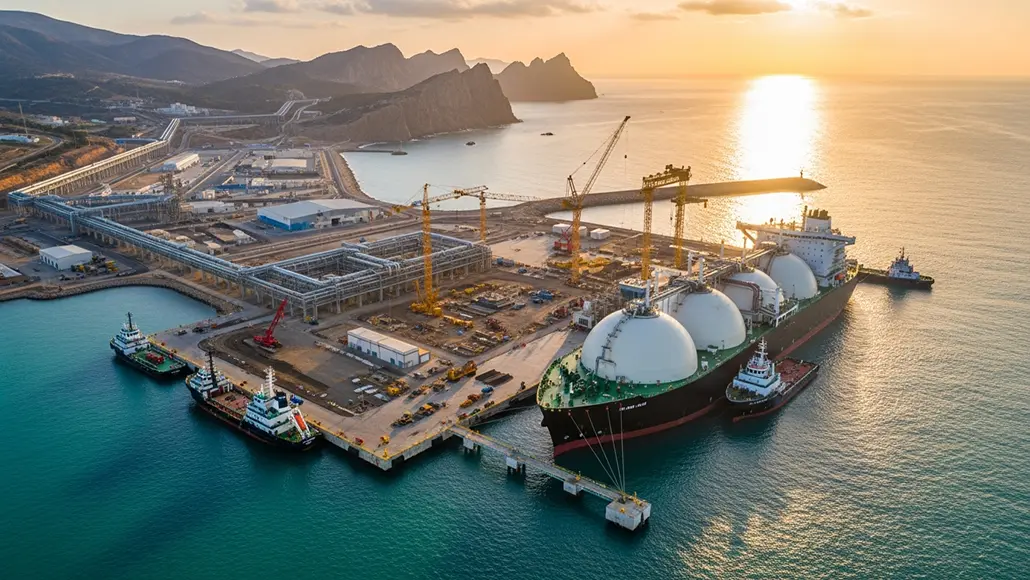

Morocco is almost there when it comes to creating an around $1 billion LNG hub at a new deep-sea port located at its Mediterranean coast, as it plans to go ahead and boost imports in order to curb the usage of dirtier fuels.
The nation has recently gone on to issue a tender for a company so as to supply a floating storage as well as a regasification unit, which will be moored at the Nador West Med port that is about to start operating in 2026. It’s also looking to go ahead and pick firms in order to build and finance as well as operate new pipelines that are connecting the port to prominent industrial areas.
By being a $1 billion LNG hub, Morocco looks forward to becoming a player in LNG imports, with the government planning to spend almost $3.5 billion in order to boost gas consumption to 12 billion cubic meters by the decade from the present from 1.2 billion cubic meters. The new projects are going to help counter the loss of Algerian supplies in 2021 after a diplomatic dispute, whereas gas is an important bridge fuel for the manufacturing industries that go on to export goods to Europe.
The Ministry of Energy Transition and Sustainable Development has forecasted that the FSRU would cost around $273 million, whereas the new pipelines will need investments of around $681 million. The pipelines are going to be connected to the Maghreb-Europe link, by way of which Morocco imports gas from Europe, since the projects are also going to form the backbone of a gas network that may as well, one day, carry green hydrogen across home as well as abroad.
The gas plans of the country involve spending $1.5 billion when it comes to infrastructure so as to become a player in LNG imports and replace dirtier feedstocks like fuel oil or even coal in the industrial sector, and also investing $2 billion in order to construct gas-fired plants, which would indeed triple the amount of power that gets generated through gas.
Morocco looks forward to decarbonizing its economy completely by 2050 by way of phasing out coal along the way through including expansion within solar and wind generation and also battery-storage facilities. Authorities anticipate almost $11 billion in investment so as to add 12.5 gigawatts of renewable capacity from 2025 to 2030, therefore representing almost 80% of all the new installed capacity within that period.
Gas is also going to play a limited role when it comes to replacing coal, with planned renewable expansion having a much larger percentage of new capacity, opines the Imal Initiative for Climate and Development’s director, Rachid Ennassiri.
Notably, when it comes to offers for the FSRU tender, they are going to be opened in early February 2026, and pre-qualified candidates for the new pipelines are going to get revealed around the same time.