































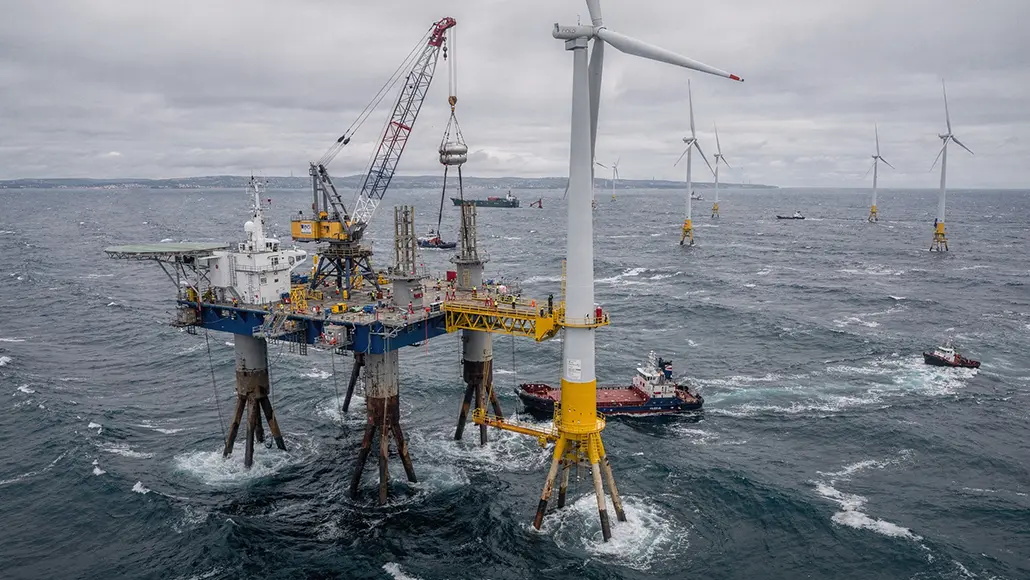

Maersk Offshore Wind and Seatrium said their under-construction offshore wind installation vessel has completed sea trials, marking a key step toward delivery. The Maersk Offshore Wind installation vessel was tested in the South China Sea, with participation from both companies and the vessel’s classification society.
Seatrium said the vessel, which measures about 475 feet (145 meters) in length, performed as expected during trials. The companies are continuing work toward the agreed delivery date by the end of February. In late December, Seatrium reported the vessel was approximately 99.8% complete.
The vessel was designed to operate with a feeder system using barges to move components from shore. The barges interlock with the installation vessel, allowing it to remain offshore while reducing installation time. The ship’s largest crane is designed to lift up to 1,900 tonnes and reach about 590 feet (180 meters) above deck. The Maersk Offshore Wind installation vessel is also designed to handle the largest offshore wind turbines, and will include 100 cabins and a walk-to-work gangway.
The project resumed after a contract dispute between Maersk Offshore Wind and Seatrium last year. Maersk Offshore Wind had cited construction issues and attempted to cancel the contract, leading both parties to arbitration. The dispute was resolved in December, with Seatrium agreeing to finance $250 million of the $360 million contract value. The financing is structured as an interest-bearing credit facility of up to 10 years, secured by a mortgage on the vessel and priority repayment rights, with payments tied to the vessel’s future earnings.
The vessel is contracted to Equinor for the Empire Wind offshore project located south of Long Island, New York. That project is among five offshore wind developments ordered to halt work in December under the Trump administration. Equinor has filed a lawsuit seeking a preliminary injunction to resume construction, warning in court filings that failure to restart work by January 16 could trigger cascading impacts that may lead to cancellation.
Equinor also noted that Heerema’s heavy-lift vessel Sleipnir is currently transporting the project’s topside and is scheduled for installation in late January. If installation cannot proceed, the company said the topside may need to be shipped to Europe, citing uncertainty around securing suitable storage facilities and cranes in the United States.
Maersk Offshore Wind has not commented on its outlook. The company was established after exiting oil services to focus solely on wind energy and is owned by AP Moller Holdings. It has previously highlighted long-term growth opportunities in offshore wind. The company has stated that a second, larger jack-up installation vessel was designed with GustoMSC, though no order has been announced.
The first WTIV was ordered in 2023 and is being built at Seatrium’s Singapore yard, with delivery planned for the United States in 2025. In 2024, Maersk Offshore Wind announced a partnership with Edison Chouest Offshore, under which Bollinger Shipyards would construct the tugs and barges required for the feeder-based installation system.