
























Separation is the quiet workhorse of the process industries. Refineries separate crude into fractions. Chemical plants separate reactants from products. Food processors separate water from solids. Pharmaceutical sites separate and purify compounds to exacting standards. Yet separation is also one of the biggest energy consumers in industrial operations, particularly when it relies on phase change boiling, condensing, freezing, or repeated compression. In many facilities, separation steps dominate both operating cost and carbon footprint, which is why energy efficient separation technologies are becoming central to competitiveness and decarbonisation.
The key phrase energy efficient separation technologies process industries captures the direction of travel: reduce power consumption while maintaining or improving product quality and reliability. This is not just about swapping one unit operation for another; it is about rethinking flowsheets, choosing the right separation “driver” (pressure, concentration, electrical potential), and integrating systems so energy is used once and reused wherever possible.
Why Separations Consume So Much Energy
At a fundamental level, separation fights entropy. Mixtures tend to mix; separating them requires work. Traditional thermal separations especially distillation use energy to repeatedly vaporise and condense components. Distillation is incredibly versatile and well understood, which is why it is everywhere, but it is also famously energy intensive. In some chemical plants, distillation can account for the majority of site steam consumption.
Other separations such as evaporation, crystallisation, drying, and solvent recovery can be similarly demanding. The real-world burden becomes heavier when plants run conservatively to protect quality, using higher reflux ratios, deeper vacuum, or more drying time than is strictly necessary.
Energy efficiency in separation technologies therefore starts with measurement and diagnosis: where is energy being used, what is driving that energy use, and which constraints are truly quality-critical versus simply inherited practice?
Membrane Technology: A Growing Backbone of Efficiency
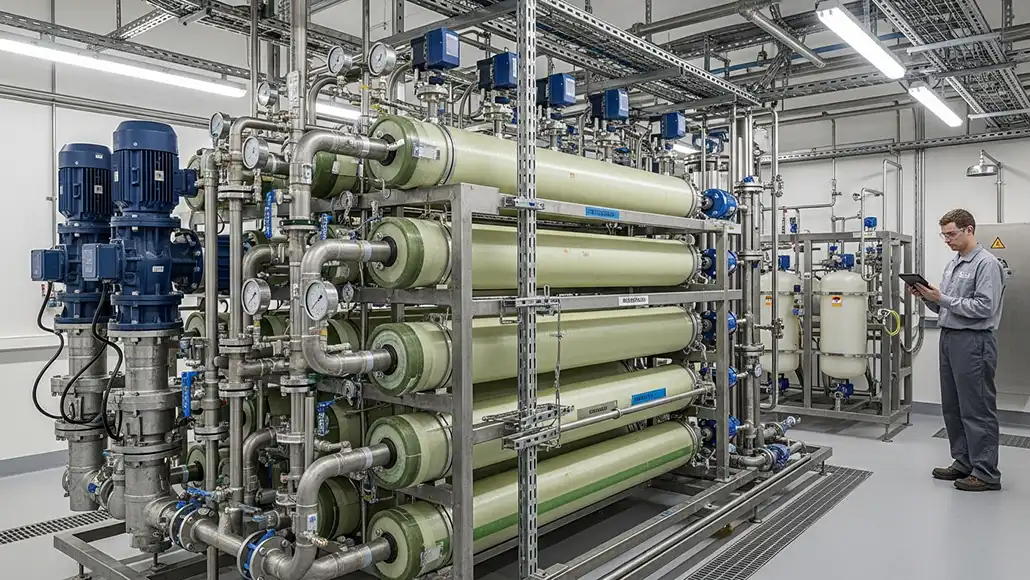
Membrane technology is often the first place engineers look when targeting industrial power savings, and for good reason. Membranes separate components without phase change, using pressure or concentration differences rather than boiling. That can dramatically reduce energy consumption, particularly in aqueous systems.
Reverse osmosis and nanofiltration have transformed water treatment, wastewater reuse, and product concentration in food and beverage. Gas separation membranes can remove CO₂ from natural gas, enrich hydrogen, or separate nitrogen and oxygen for specific applications. Pervaporation membranes can separate azeotropes and dehydrate solvents with lower energy input than conventional distillation.
The practical benefits are compelling: membranes are modular, relatively compact, and often easy to scale. However, they are not magic. They face fouling, chemical compatibility limits, and trade-offs between permeability and selectivity. In process industries, the most successful membrane deployments are those paired with smart pretreatment, robust cleaning strategies, and realistic expectations about lifetime performance.
Hybrid Separation Systems: When 1 + 1 > 2
One of the most powerful trends is hybridisation, where membranes, adsorption, extraction, or crystallisation are combined with distillation rather than replacing it entirely. In practice, the goal is to offload the most energy-intensive part of a separation to a more efficient method, then use distillation for the final polishing step.
For example, a membrane can pre-concentrate a stream so the distillation column handles less water, reducing steam demand. Alternatively, adsorption can remove trace impurities before a column, allowing the column to run at a lower reflux ratio while still meeting specification. Hybrid systems require thoughtful design and control, but they often deliver the best balance of reliability and energy efficiency.
Adsorption and Pressure Swing Systems
Adsorption-based separations use solid materials to selectively capture certain molecules. Pressure swing adsorption (PSA) and temperature swing adsorption (TSA) are widely used for hydrogen purification, air separation, and drying. These systems can be energy efficient because they avoid phase change and can operate cyclically with good controllability.
The energy profile depends on compression and regeneration requirements. PSA systems, for instance, may require significant compression energy, but the overall balance can still beat cryogenic methods at smaller scales. Materials innovation new adsorbents, tailored pore structures, and improved stability is steadily expanding what adsorption can do, particularly for CO₂ capture, volatile organic compound recovery, and solvent drying.
Advanced Distillation: Making the Old Work Better
Because distillation is so entrenched, improving it can yield enormous benefits. Advanced distillation is less about novelty and more about redesign.
Heat-integrated distillation links columns so heat rejected by one column becomes heat input to another. Dividing-wall columns combine multiple separation steps in a single shell, reducing energy use and footprint. Vapour recompression uses mechanical energy to raise vapour temperature so it can provide its own reboiler duty, reducing steam consumption. Structured packings and high-efficiency trays reduce pressure drop and improve mass transfer, enabling lower reflux and lower reboiler duty.
In many plants, the most effective separation energy project is not a radical replacement, but a careful retrofit: re-tray a column, optimise reflux and feed location, improve insulation, add advanced control, and recover overhead heat for preheating. These are practical steps with high credibility in operations teams.
Process Intensification and New Separation Drivers
Process intensification aims to shrink equipment size while improving efficiency and performance. For separations, this can mean spinning devices, compact heat exchangers, rotating packed beds, or electrically driven separations.
Electrodialysis, for example, uses electrical potential to move ions through membranes, making it suitable for desalination and certain chemical separations. In some cases, electrically driven separations align well with decarbonised grids, because they shift energy demand from steam to electricity, which can be progressively cleaned.
Supercritical fluid extraction and advanced crystallisation methods can also reduce energy and improve selectivity for high-value products, particularly in pharmaceuticals, specialty chemicals, and food ingredients.
Energy Integration: The Multiplier Effect
Separation technologies rarely operate alone. They sit inside a larger thermal and utility network. A distillation column is not just a column; it is a steam user and a condenser heat source. A dryer is not just a dryer; it is tied to air handling, humidity control, and often waste heat streams.
Energy efficient separation technologies therefore deliver their best results when paired with energy optimisation. Heat recovery can preheat feeds. Waste heat can drive evaporation in multi-effect systems. Heat pumps can upgrade condenser heat to reboiler duty. Pinch analysis and process simulation can reveal where small integration changes unlock large savings.
This integration mindset often distinguishes “good” projects from transformative ones. A standalone upgrade might save 5–10%. A fully integrated revamp can save far more while improving stability.
Reliability and Quality: The Non-Negotiables
Process industries live and die by specification. Any separation change must protect quality, and it must be reliable under real feed variability. Energy efficiency is valuable only if the plant can run consistently.
This is why piloting and staged implementation are so important. Membranes may perform beautifully in clean lab conditions but struggle with real fouling loads. Adsorbents may degrade under trace contaminants. Heat-integrated distillation may become sensitive to disturbances if controls are not upgraded. Operators need to trust the new system, and trust comes from robust design, clear operating procedures, and honest contingency planning.
Where to Start: A Practical Approach for Plants
A realistic roadmap begins with identifying the biggest energy consumers in separations, then ranking opportunities by technical risk and potential savings. Many sites start with distillation optimisation and heat integration because the assets already exist and the changes are familiar. Next come targeted deployments of membrane technology or adsorption where feed conditions are suitable. More advanced intensification projects often follow after the organisation has built confidence and has stronger data infrastructure.
The best plants also build capability in monitoring and control. Separation performance can drift slowly, and energy waste can creep back in through conservative setpoints and operational workarounds. Advanced control strategies, better sensors, and routine performance reviews help lock in savings.
The Future: Separations as a Competitive Advantage
As energy prices and carbon constraints tighten, the process industries will increasingly compete on how intelligently they separate. Energy efficient separation technologies process industries will not be a niche phrase for engineers; it will be a defining feature of low-carbon manufacturing.
Plants that modernise separations can cut steam demand, reduce cooling load, lower electricity use, and shrink emissions without compromising output. They also gain flexibility: modular membrane skids can be expanded, hybrid systems can adapt to new products, and improved control can handle more variable feedstocks.
In a world where customers want cleaner products and regulators want measurable progress, separation efficiency becomes more than operational housekeeping. It becomes a visible marker of technical maturity and strategic intent proof that a plant is not only producing, but producing wisely.