




















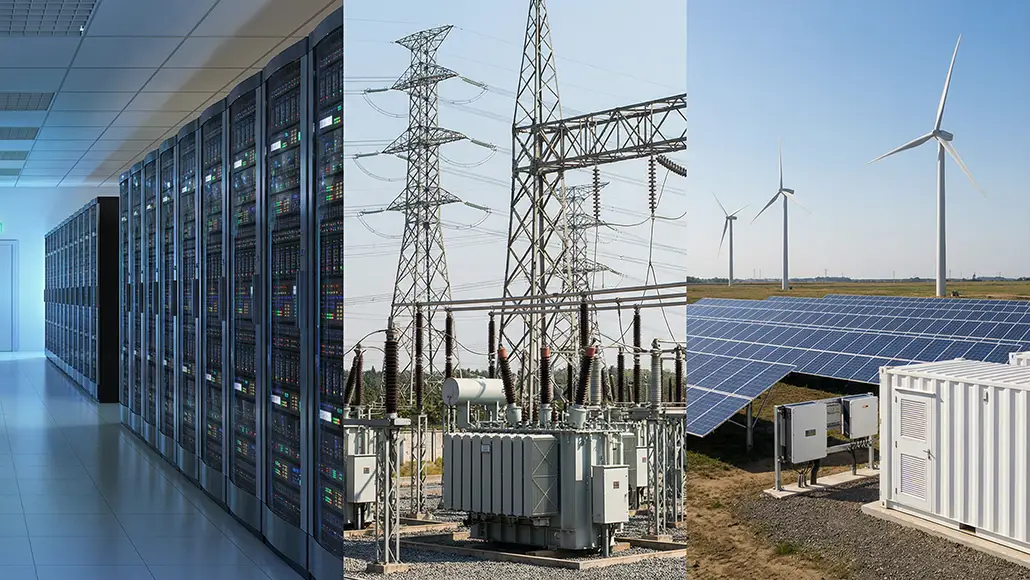

- Data centres are emerging as reliable anchor loads, creating a strong and predictable foundation for renewable energy development and long-term utility planning.
- Grid expansion, flexibility, and renewable deployment must move in parallel to ensure system reliability as large data centre loads are added.
- Utilities that act as clean energy partners rather than power suppliers are better positioned to capture long-term value from data centre growth.
The rapid expansion of data centres has emerged as one of the most consequential shifts shaping electricity demand in today’s power systems. Driven by cloud computing, artificial intelligence workloads, and the broader digitalisation of economies, these facilities are becoming some of the largest and most concentrated electricity consumers in multiple markets. For the power sector, this trend is not simply about rising demand, it represents a structural renewable energy opportunity that can reshape generation planning, grid investment, and long-term utility strategy.
For renewable energy professionals, the relevance of data centres lies in the character of the load they introduce. Data centres demand uninterrupted, high-quality electricity, operate continuously, and increasingly expect low-carbon supply as a baseline requirement. This combination is redefining procurement models and accelerating clean power deployment. When approached strategically, data centre growth can anchor renewable investment and support grid modernisation rather than strain existing systems.
Data Centres as a New Class of Baseload Demand
Unlike many traditional commercial or industrial consumers, data centres operate on a continuous basis with minimal variability. This gives them characteristics similar to baseload demand, offering utilities long-term visibility on electricity consumption. For power planners, this stability is valuable in an era where demand forecasting has become more complex due to electrification and distributed generation.
From a renewable development perspective, stable demand improves project viability. Long-term offtake commitments from data centre operators reduce revenue risk and support investment decisions for utility-scale renewable projects. This makes data centres an important enabler of the renewable energy opportunity, particularly in regions where demand growth has otherwise been modest.
At the same time, the geographic concentration of data centres can challenge local grids. Clusters of facilities may emerge faster than network upgrades can be delivered. This reinforces the need for early coordination between developers, utilities, and regulators to ensure capacity expansion keeps pace with project pipelines.
Corporate Clean Energy Commitments Drive Market Momentum
A defining feature of the data centre sector is the sustainability expectations set by its operators. Large technology companies increasingly view clean energy procurement as a core business requirement rather than a reputational add-on. As a result, data centres are actively shaping electricity markets rather than responding passively to them.
This dynamic has strengthened demand for long-term renewable contracts, creating a reliable route to market for new projects. Utilities that can offer structured clean energy solutions, such as green tariffs or facilitated power purchase agreements, are well positioned to retain large customers while expanding their renewable portfolios.
For the power sector, this alignment between corporate demand and clean generation represents a durable renewable energy opportunity. It allows utilities and developers to scale capacity with confidence, knowing that demand is contractually anchored and strategically aligned with decarbonisation goals.
Grid Infrastructure and System Planning Implications
The scale and pace of data centre development are forcing a reassessment of traditional grid planning approaches. Transmission and distribution systems designed around incremental growth must now accommodate large, discrete load additions within compressed timelines.
This shift has direct implications for renewable integration. New grid infrastructure is often required to connect renewable-rich regions to data centre hubs, while distribution networks must handle higher load densities without compromising reliability. Although these investments are capital intensive, they also deliver long-term system value by improving resilience and flexibility.
Energy storage and demand-side solutions are becoming increasingly important in this context. Flexible resources help manage variability and peak conditions, allowing renewable generation to serve a larger share of demand. For system operators, this reinforces the case for integrated planning that treats generation, networks, and flexibility as a unified system.
On-Site and Hybrid Energy Solutions Gain Relevance
To address reliability concerns and grid constraints, some data centre operators are exploring on-site or hybrid energy configurations. These solutions often combine grid-supplied renewable power with local generation, storage, or backup systems.
From a power sector perspective, this trend should be viewed as complementary rather than competitive. On-site resources can reduce peak demand, defer infrastructure upgrades, and support local grid stability when integrated effectively. Utilities that incorporate these assets into system planning can unlock additional operational value.
Hybrid models also broaden the renewable energy opportunity by enabling higher renewable penetration without compromising reliability. They offer flexible pathways for serving large loads while maintaining system integrity.
Redefining Utility–Customer Relationships
The rise of data centres is accelerating a shift in how utilities engage with large customers. Standardised tariffs are increasingly giving way to customised arrangements that reflect the scale, sustainability goals, and flexibility potential of data centre demand.
Utilities are being asked to act as strategic partners, supporting renewable procurement, managing interconnection processes, and offering grid services tailored to specific load profiles. Regulatory frameworks are evolving to balance timely infrastructure development with fair cost allocation.
For power sector professionals, this evolution demands new commercial and technical capabilities. Those utilities that adapt successfully will be better positioned to capture long-term value from large-load growth.
Conclusion: Turning Digital Demand into a Power Sector Advantage
The data centre boom presents one of the clearest renewable energy opportunities facing the power sector today. While the scale of demand introduces planning and infrastructure challenges, it also provides a stable foundation for clean generation growth and grid investment.
Realising this opportunity will require proactive coordination across the value chain. Aligning data centre development with renewable resource availability, accelerating grid upgrades, and embracing flexible energy solutions will be essential. Equally important is a strategic mindset that views rising demand not as a constraint, but as a catalyst for transformation.
For renewable energy and power sector professionals, the path forward is clear: those who integrate data centre demand into long-term clean energy strategies will help shape a more resilient, efficient, and decarbonised power system.