

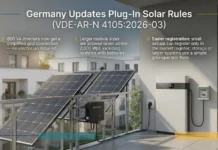
























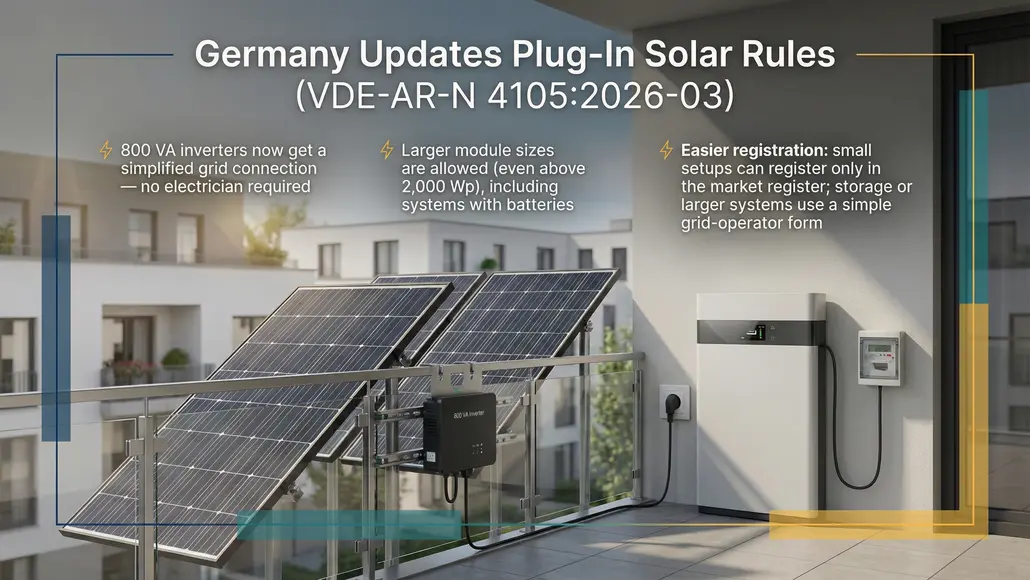

Germany has introduced an updated grid standard that significantly broadens the scope for plug-in photovoltaic installations, allowing larger systems to be deployed without requiring an electrician. The regulatory revision, embedded in VDE-AR-N 4105:2026-03, is expected to accelerate adoption by simplifying both installation and registration procedures for small-scale generation assets.
Under the revised framework, systems with inverter output up to 800 VA qualify for a streamlined connection process. Notably, this simplified route now extends to PV installations exceeding 2,000 Wp, including configurations incorporating storage or those applying for remuneration. System operators can independently complete registration through a designated form, removing earlier procedural barriers. While inverter output remains capped at 800 VA—effectively limiting grid feed-in—the updated standard eliminates formal restrictions on total module capacity within this category.
The revised Germany Plug-in PV Rule enable more flexible system design, particularly when combined with battery storage to maximize self-consumption. Industry estimates referenced in stakeholder discussions indicate that configurations approaching 10 kW may be technically feasible under the new structure, subject to compliance thresholds. These include mandatory smart meter installation for systems exceeding 7 kW, alongside adherence to technical standards such as DIN VDE V 0126-95 and DIN VDE V 0100-551-1.
In addition, the Germany Plug-in PV Rule clarifies registration requirements across system types. Plug-in PV systems without storage, below 2,000 Wp, and not seeking remuneration can now be recorded solely in Germany’s market master data register, bypassing grid operator notification. However, larger installations or those integrating storage must still undergo the simplified registration process with the grid operator. Storage units are permitted to draw electricity from both on-site PV and the grid, provided safety conditions—including overload protection and real-time monitoring—are met.
Industry participants highlighted that advancements in dynamic load management and thermal protection technologies could further enhance system efficiency within the 800 VA limit, especially when paired with storage. The regulatory shift comes amid rapidly increasing deployment of plug-in solar systems across Germany, where adoption rates are outpacing traditional residential rooftop PV installations.