


































Events Date: 9

US team build concentrated solar power heat concept at $30/MWh

Note* - All images used are for editorial and illustrative purposes only and may not originate from the original news provider or associated company.

Subscribe

- Never miss a story with notifications

- Gain full access to our premium content

- Browse free from any location or device.

Media Packs

Expand Your Reach With Our Customized Solutions Empowering Your Campaigns To Maximize Your Reach & Drive Real Results!

โ€“ Access the Media Pack Now

โ€“ Book a Conference Call

โ€“ Leave Message for Us to Get Back

Related stories

Digital Control Systems Advancing Power Electronics

The integration of digital control architectures into power electronics enables sophisticated monitoring and adaptive optimization, drastically improving the performance of renewable energy systems and electric vehicles.

Advanced Power Modules Improving Energy System Efficiency

Modern energy systems rely on high-performance power modules to manage electricity distribution effectively, offering enhanced power density and superior thermal management for industrial, renewable, and automotive applications.

Smart Grid Integration Improving Energy Efficiency

Smart grid technologies revolutionize energy distribution by incorporating advanced power electronics that facilitate the seamless integration of renewable sources and large-scale energy storage solutions.
- Advertisement -

A research team led by Tulane University and the University of San Diego has developed a hybrid solar energy converter that generates electricity and steam at a levelized cost of $30/MWh.

The research project began in 2014, supported by $3.3 million of funding from the U.S. Department of Energy (DOE) ARPA-E program. The team included members from San Diego State University, Boeing-Spectrolab and Otherlab.

The hybrid system uses multi-junction solar cells to generate electricity and redirect infrared rays to a thermal receiver, capturing more from the whole spectrum of sunlight. The thermal energy can be stored and dispatched for heat applications such as food processing, chemical production, water treatment or enhanced oil recovery.

The researchers conducted extensive prototype and field testing and the system demonstrated 85.1% efficiency and delivered steam at up to 240ยฐ C, Tulane University said.

The team is now moving towards pilot-scale validation, using follow-on funding from the Louisiana Board of Regents and Reactwell, a local commercial partner, it said.

โ€œThermal energy consumption is a huge piece of the global energy economy โ€“ much larger than electricity use. There has been a rising interest in solar combined heat and power systems to deliver both electricity and process heat for zero-net-energy and greenhouse-gas-free development,โ€ said Escarra.

The hybrid converter utilizes an approach that more fully captures the whole spectrum of sunlight. It generates electricity from high efficiency multi-junction solar cells that also redirect infrared rays of sunlight to a thermal receiver, which converts those rays to thermal energy.

The thermal energy can be stored until needed and used to provide heat for a wide range of commercial and industrial uses, such as food processing, chemical production, water treatment, or enhanced oil recovery.

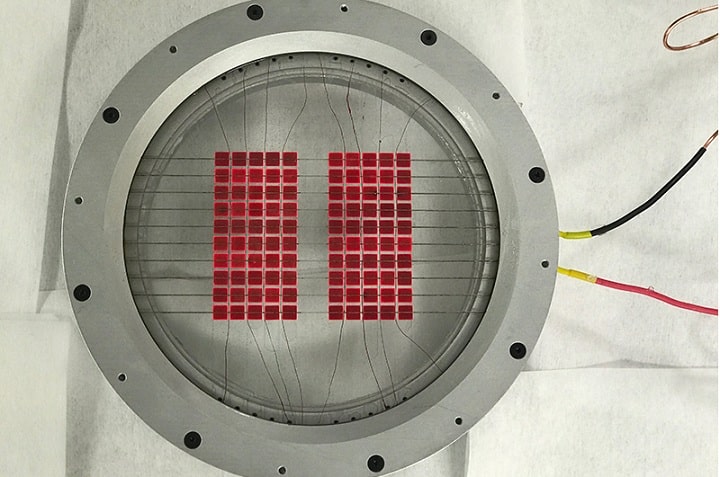
The hybrid solar energy converter features a solar module with glowing red cells built at Tulane. (Photo courtesy of Matthew Escarra)

The team reports that the system demonstrated 85.1 percent efficiency, delivered steam at up to 248ยฐC, and is projected to have a system levelized cost of 3 cents per kilowatt hour.

With follow-on funding from the Louisiana Board of Regents and Reactwell, a local commercialization partner, the team is continuing to refine the technology and move towards pilot-scale validation.

โ€œWe are pleased to have demonstrated high performance field operation of our solar converter,โ€ Escarra said, โ€œand look forward to its ongoing commercial development.โ€

The work led by Matthew Escarra, associate professor of physics and engineering physics at Tulane, and Daniel Codd, associate professor of mechanical engineering at the University of San Diego, is the culmination of a U.S. Department of Energy ARPA-E project that began in 2014 with $3.3 million in funding and involved years of prototype development at Tulane and field testing in San Diego.

The research is detailed this month in the science journal Cell Reports Physical Science. Researchers from San Diego State University, Boeing-Spectrolab and Otherlab were also part of the project.

Power Info Today brings together the global energy industry โ€” from generation and transmission operators to utility executives and energy transition leaders โ€” through trusted editorial, market intelligence, and digital engagement.

Our 2026 Media Pack offers integrated solutions to reach your audience:

  • Magazine & Digital Editions Showcase your brand within premium energy industry coverage read by executives and decision - makers worldwide.
  • Industry Insights & Reports Align with data - driven analysis, trend reports, and regional roundups across the global power and energy value chain.
  • Brand Authority & Credibility Position your company as a thought leader through expert commentary, interviews, and special features.

Latest stories

Related stories

Digital Control Systems Advancing Power Electronics

The integration of digital control architectures into power electronics enables sophisticated monitoring and adaptive optimization, drastically improving the performance of renewable energy systems and electric vehicles.

Advanced Power Modules Improving Energy System Efficiency

Modern energy systems rely on high-performance power modules to manage electricity distribution effectively, offering enhanced power density and superior thermal management for industrial, renewable, and automotive applications.

Smart Grid Integration Improving Energy Efficiency

Smart grid technologies revolutionize energy distribution by incorporating advanced power electronics that facilitate the seamless integration of renewable sources and large-scale energy storage solutions.

Wide Bandgap Semiconductors Driving Power Efficiency

Transitioning from traditional silicon to wide bandgap materials like Silicon Carbide and Gallium Nitride marks a significant leap in power electronics, enabling higher frequencies and improved thermal performance across industrial and automotive sectors.

Subscribe

- Never miss a story with notifications

- Gain full access to our premium content

- Browse free from any location or device.

Media Packs

Expand Your Reach With Our Customized Solutions Empowering Your Campaigns To Maximize Your Reach & Drive Real Results!

โ€“ Access the Media Pack Now

โ€“ Book a Conference Call

โ€“ Leave Message for Us to Get Back

Translate ยป