















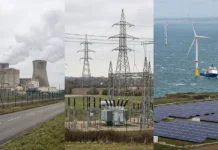












The electricity grid faces a fundamental challenge that has intensified as renewable energy deployment accelerates globally. Wind and solar generation are intermittent—varying not in response to electricity demand patterns but according to meteorological conditions. Solar generation peaks during midday but vanishes entirely at night, precisely when many regions experience secondary evening demand peaks. Wind generation varies unpredictably, sometimes producing abundant power during low-demand periods and zero output during peak demand hours. This intrinsic mismatch between renewable supply and electricity demand creates balancing challenges that conventional electricity systems, built around dispatchable generation from fossil fuels and hydroelectric plants, were not engineered to manage.
For decades, electricity system planners proposed solutions emphasizing supply-side interventions: massive energy storage deployments, long-distance transmission corridors delivering renewable generation from abundant locations to consumption centers, and maintained reliance on dispatchable conventional generation to fill gaps. These solutions remain necessary but prove increasingly insufficient as renewable penetration accelerates. The breakthrough insight emerging from recent research and pilot deployments is that the demand side of electricity systems—specifically, thermal loads in buildings managed by heat pumps with thermal storage—can provide flexibility services of equivalent value and scale to conventional generation resources while simultaneously decarbonizing heating and cooling.
The Thermal Storage Foundation
Heat pumps differ fundamentally from conventional generation resources in their thermodynamic basis. A fossil fuel power plant directly converts fuel energy into electricity instantaneously when grid operators request power. A heat pump, conversely, transfers thermal energy between a heat source and building thermal systems (space heating, domestic hot water, thermal comfort). This thermal energy can be stored in multiple forms: as temperature changes in building structures and air masses, in dedicated water tanks, or in phase-change materials engineered for thermal storage.
The storage capacity embedded in buildings is substantial. A typical residential building possesses thermal mass equivalent to several megawatt-hours of energy storage, achieved through concrete floors, masonry walls, and thermal insulation. This thermal mass can be charged by operating a heat pump to heat the building to the upper limit of occupant comfort during periods when electricity is abundant and inexpensive, perhaps during midday when solar generation peaks or during periods of low wholesale electricity prices. Subsequent heating or cooling requirements are satisfied through this stored thermal energy rather than requiring the heat pump to operate during peak demand periods.
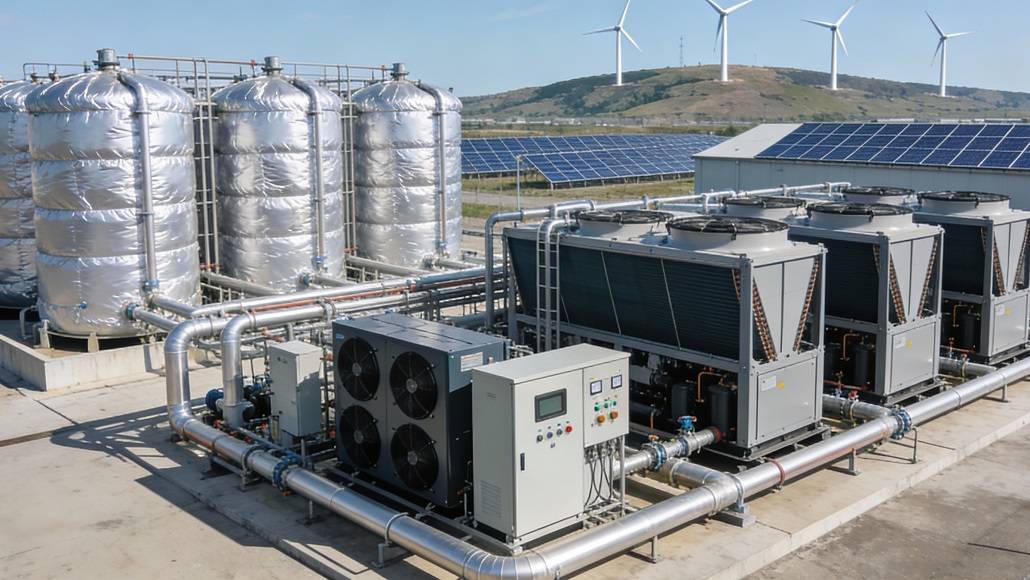
This thermal storage operates continuously, with no degradation characteristics common to electrochemical batteries. A building can undergo countless thermal charge-discharge cycles across years of operation without performance decline. The storage capacity can be amplified through dedicated thermal storage systems—insulated tanks containing hot or chilled water, phase-change materials, or other high-thermal-mass mediums. A 100-liter tank of hot water stores roughly 5-7 kilowatt-hours of thermal energy. A dedicated thermal storage system sized for a building with moderate thermal loads might store 20-50 kilowatt-hours of thermal energy at a cost substantially lower per unit of stored energy than electrochemical batteries.
The physics underlying thermal storage is straightforward, yet the practical implications for electricity grids are profound. Buildings with heat pumps and thermal storage can satisfy a substantial portion of their daily thermal loads without instantaneous electricity demand. Instead of the heat pump operating continuously at moderate power throughout the day in response to gradual thermal losses, it operates intensively during periods favorable from a grid perspective, then relies on thermal storage.
Demand Response and Load Shifting
For decades, electricity utilities operated demand response programs that seemed crude in retrospect. A utility would contact building occupants during peak demand periods, request they increase thermostat settings or reduce air conditioning use, and measure compliance through electricity meter data. These programs achieved meaningful peak demand reductions—5-15 percent was typical—but required active occupant participation and inevitably created comfort degradation during summer cooling peaks.
Modern heat pump systems operating with building thermal storage and sophisticated energy management systems achieve comparable demand response automatically, without requiring occupant intervention or comfort sacrifice. An intelligent energy management system continuously monitors outdoor temperature, forecasted weather, electricity prices, renewable generation forecasts, and grid operator signals. When conditions warrant—perhaps during a period of low renewable generation when wholesale electricity prices spike—the system automatically reduces heat pump operation, allowing indoor temperature to drift within acceptable comfort bands as stored thermal energy gradually releases. This occurs transparently to occupants; they experience no thermostat adjustment or conscious adaptation.
The flexibility magnitude is substantial. Research demonstrating heat pump demand response capabilities consistently finds that aggregated residential and commercial heat pump populations can modulate 20-40 percent of their typical load in response to price signals or grid operator requests. For a utility system with 100,000 heat pumps averaging 4 kilowatts of power consumption during cold weather peaks, this translates to 80-160 megawatts of controllable demand—equivalent to a large conventional power plant yet achieved through load modulation rather than generation.
The temporal dynamics of this flexibility differ from conventional generation resources. A fossil fuel plant can increase power output at rates of 5-10 megawatts per minute. Aggregated heat pumps operating through building thermal storage cannot respond as rapidly to instantaneous power requests—thermal time constants limit response speeds to seconds or minutes rather than instantaneous adjustments. For many grid balancing applications, this response characteristic is acceptable or even advantageous, as frequency regulation and load following services require response timeframes measured in seconds to minutes rather than instantaneous reactions.
Market Participation and Revenue Models
The regulatory frameworks and market structures in many electricity systems provide mechanisms through which aggregated heat pump flexibility can generate revenue for building owners and operators. In regions with competitive wholesale electricity markets, aggregation companies can bid heat pump flexibility into ancillary service markets, receiving compensation for maintaining available capacity and responding to system operator dispatch signals.
Frequency regulation markets, operated in deregulated regions by independent system operators, compensate providers for maintaining the ability to adjust power within seconds in response to automatic generator control signals. A frequency regulation service provider must bid available capacity, then respond to control signals with precision and speed. Detailed modeling of aggregated heat pump performance demonstrates technical capability to provide frequency regulation with performance metrics matching or exceeding conventional generation resources. A research team operating a pilot program involving 50 residential heat pump units in a utility territory demonstrated ability to achieve frequency regulation performance scores of 0.85-0.95 out of a maximum of 1.0, well exceeding typical thresholds for market participation.
The revenue from frequency regulation services is substantial. In the PJM Interconnection covering a substantial portion of the eastern United States, frequency regulation providers earn $20-40 per kilowatt of annual capacity commitment, with additional revenue based on performance and energy movements. An aggregator operating 10 megawatts of aggregated heat pump capacity could generate $200,000-400,000 in annual frequency regulation revenue, separate from the operational cost savings building operators achieve through strategic load shifting toward low-price periods.
Load-following services, compensating providers for matching gradually changing grid load with generation supply, provide additional revenue opportunities. Renewable-rich electricity systems with growing proportions of wind and solar generation experience continuously varying net load—the difference between total demand and renewable generation output. System operators must continuously adjust conventional generation (or demand resources) to match this varying net load. Heat pumps offering load-following services can receive premium compensation during high-renewable-penetration periods in exchange for adjusting thermal output to smooth net load variations.
Reserve services, which compensate providers for maintaining standby capacity deployable within 10-30 minutes during contingency events, represent a third revenue source. A contingency event—loss of a large power plant or transmission line—requires system operators to rapidly deploy reserves to restore balance between generation and demand. Aggregated heat pumps can maintain cold reserve capacity, ready to reduce load within contractual timeframes in response to dispatch signals.
Integration with Renewable Energy Systems
The synergy between heat pump flexibility and renewable energy penetration becomes increasingly compelling at higher renewable shares. Consider a electricity system with 80 percent wind and solar generation and 20 percent conventional generation. Throughout much of the year, wind or solar generation is abundant, driving wholesale electricity prices near zero. During these periods, system operators face an economic dilemma: continue operating conventional plants at minimal loading, incurring high unit costs; curtail renewable generation, wasting clean energy; or increase demand to absorb renewable output.
Heat pump aggregations operating under smart control can provide a demand-side solution. During periods of abundant renewable generation and low electricity prices, control algorithms automatically increase heat pump operation to pre-heat or pre-cool buildings. This increased heat pump demand absorbs renewable generation that would otherwise be curtailed, while simultaneously reducing subsequent peak-period heat pump operation. The result is dramatic: renewable curtailment can be reduced from 10-15 percent (typical in high-renewable-penetration systems) to 2-5 percent, substantially improving system efficiency.
Seasonal balancing represents another critical application. In high-latitude regions with substantial winter heating demands, the mismatch between winter thermal energy needs and available renewable generation is acute. Winter solar generation is minimal, while wind generation exhibits seasonal variation, and winter peaks often represent the system’s greatest challenges. Yet winter is precisely when heating demand peaks. By operating heat pumps with significant thermal storage capacity during periods of available renewable generation, building thermal systems store seasonal reserves. A heat pump system with 200-300 kilowatt-hours of thermal storage capacity could reduce February heating energy requirements by 30-40 percent by leveraging thermal energy generated and stored during prior months of higher renewable generation.
This seasonal storage function remains conceptually novel to most electricity system planners, yet the physical implementation is straightforward. A residential building with a heat pump and 200-liter hot water tank can store 30 kilowatt-hours of thermal energy. Commercial buildings with larger thermal mass and dedicated thermal storage systems can store significantly more. Aggregated across millions of buildings in a region, thermal storage capacity reaches terawatt-hour scales—equivalent to months of large battery storage deployments yet achieved at a small fraction of the capital cost.
Technical Challenges and Resolution Pathways
Implementing heat pump aggregation for grid services requires addressing several technical challenges. Communication infrastructure must deliver grid operator signals to thousands of distributed heat pump controllers with reliability and security sufficient for grid operation. While utility-grade communication networks have been deployed for advanced metering infrastructure, the messaging requirements for grid service participation are more demanding. However, existing cellular and broadband networks can support these communication requirements, and utilities deploying smart grid infrastructure are simultaneously building communication backhaul sufficient for heat pump control.
Standardization and interoperability present challenges. Manufacturers have historically designed heat pump controls independently, with proprietary communication protocols and control algorithms optimized for individual building operation rather than grid participation. Emerging industry standards for heat pump communication and control are establishing protocols enabling aggregation platforms to coordinate diverse equipment from multiple manufacturers. The SG-Ready standard, developed in Europe, specifies signal interfaces allowing grid operators or aggregators to communicate directly with heat pump controllers, enabling standardized grid service participation.
Modeling and validation of heat pump flexibility at scale remains an open research frontier. While individual heat pump performance is well understood, the aggregate behavior of thousands of units responding to coordinated control signals involves complex interdependencies. Weather variations affecting heating load, occupant comfort preferences and thermostat adjustments, diversity in building thermal characteristics—these factors introduce complexity not fully captured in simplified models. Large-scale pilot programs coordinating aggregated heat pump populations can validate predictive models and refine control strategies.
The Path Forward: From Technology to System Transformation
The evolution of heat pumps from appliances providing individual building heating and cooling to coordinated grid assets providing system-scale flexibility represents more than incremental technological improvement. It reflects a fundamental reconceptualization of how modern electricity systems can achieve reliability and affordability as renewable penetration accelerates. Rather than viewing the demand side as a relatively fixed constraint to which supply must adapt, modern electricity systems can leverage demand flexibility to complement variable renewable supply.
This evolution requires supporting changes across multiple domains. Regulatory frameworks must establish markets for demand flexibility and grid services, ensuring aggregators and building operators receive appropriate compensation for flexibility provision. Technical standards must establish communication protocols and performance metrics, enabling equipment interoperability and predictable performance. Utility rate structures must provide price signals rewarding flexible demand rather than penalizing buildings that actively manage consumption. Investment in communication infrastructure must proceed in parallel with heat pump deployment, ensuring connectivity and control capability.
Many regions have launched pilot programs and research demonstrations validating heat pump flexibility at scale. Germany’s Sector Coupling initiative, Japan’s virtual power plant programs, and numerous North American utility pilots have collectively demonstrated that aggregated heat pump flexibility can deliver promised grid services while maintaining occupant comfort and operational reliability. These pilots provide proof of concept and operational experience that should instill confidence that heat pump flexibility can be deployed at scale.
Thermal Flexibility as Grid Infrastructure
Heat pumps have transitioned conceptually from being viewed merely as efficient heating appliances to being recognized as critical grid infrastructure enabling decarbonization. This transformation is neither theoretical nor distant. Pilot deployments operating today demonstrate feasibility; regulatory frameworks are evolving to accommodate participation; and economics increasingly favor flexible heat pump operation through appropriate market structures.
The implications are profound. As renewable energy penetration rises and electrified heating and cooling loads expand, the flexibility inherent in thermal systems becomes increasingly valuable. Buildings equipped with heat pumps and thermal storage connected through smart control systems to aggregation platforms can provide grid services previously delivered by centralized power plants. This demand-side flexibility enables substantially higher renewable penetration, reduces required infrastructure investment, improves system reliability, and maintains electricity affordability. The future electricity system that successfully navigates decarbonization will not simply replace fossil fuel plants with renewable generation—it will fundamentally reimagine buildings as grid assets providing both thermal comfort and grid services. Heat pumps are the technology enabling this transformation.