
























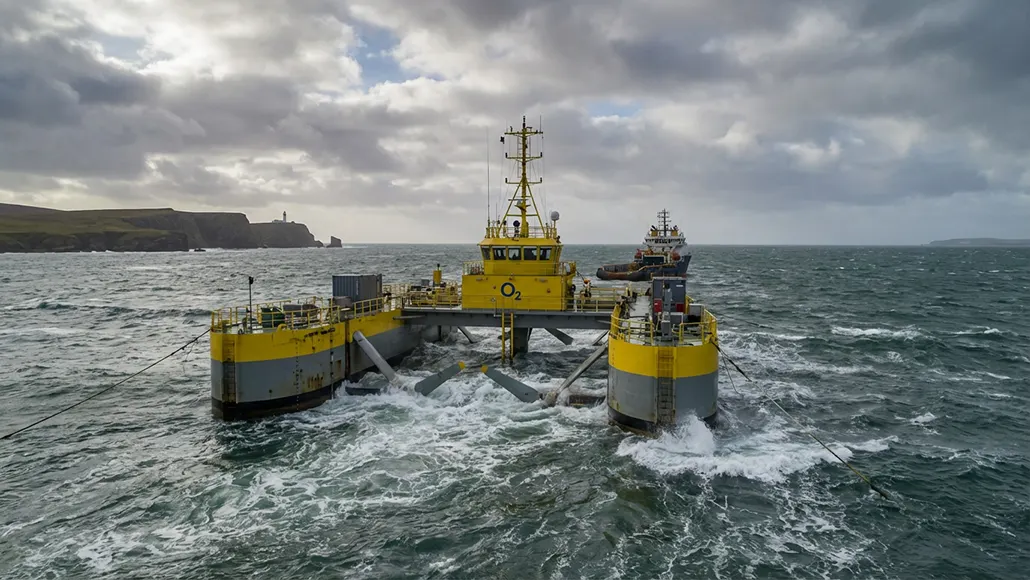

The European Marine Energy Centre – EMEC has gone ahead with the completion of demonstration work when it comes to combined battery storage, tidal power, and hydrogen production plants located at Orkney in Scotland.
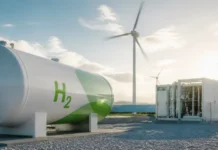
The EMEC has gone on to describe the integrated tidal, battery and hydrogen demo as a world-first integration as far as the three technologies are concerned, as during the periods of high generation, the power generated by way of the tidal turbine charged the battery, powered the hydrogen electrolyzer, and also exported power to the grid, and when it came to the periods of low generation, the battery discharged the power to the electrolyzer in order to keep it in operation.
The successful testing goes on to follow a recommendation that is made by EMEC as well as Offshore Renewable Energy – ORE Catapult, which went on to find as many as 30 tidal stream projects located around the Scottish coast, which could as well offer power to local users without having the need to connect to the national grid. The addition of batteries to the tidal power projects goes on to further enhance their resilience as well as agility, therefore making them a much more viable alternative so as to deliver dependable power without the requirement to have a grid connection.
Indeed, as per the EMEC, this combination of technologies has gone on to effectively smooth out the cyclical nature of tidal energy by making sure of a consistent supply of power, in spite of differences within the generation conditions. Technology, apparently, has been given by Orbital Power, which has delivered its O2 tidal turbine named the Invinity Energy System, which supplied vanadium flow batteries, and also ITM Power, which has delivered the electrolyzer.
As per Jonathan Marren, the CEO of Invinity, this distinct project goes on to highlight the strengths of their vanadium flow battery technology as a non-degrading, high-cycling, and fundamentally safe form when it comes to long-duration energy storage. Due to this sort of exciting demonstration, EMEC has indeed proven the suitability when it comes to the vanadium flow batteries for a couple of emerging applications, which are in the form of green hydrogen production as well as tidal power firming.
The news follows Invinity’s 20.7 MWh vanadium flow battery advancement, which is the UK’s largest and which, as per the company, may as well enter into commercial operation with a solar PV project in 2026 that is located in the southeast of England.
The integrated tidal, battery and hydrogen demo has also got the support as well as funding from numerous organizations, such as the €310 million or £270.69 million Interreg North-West Europe initiative as well as the €26.7 million FORWARD2030 programme, both of which get their funding from the EU.
Notably, the EMEC also went on to complete its testing work on all planned operational scenarios, which included successfully responding to the ripping of an electrolyzer, and that too within seconds, to prevent a complete blackout or a shutdown. The testing also underscored certain potential areas for enhancement, including the likes of better battery management as well as enhanced electrolyzer controls.
Leonore Van Velzen, the EMEC operations and maintenance manager, remarked that bringing together the three innovative technologies was indeed a very intricate challenge; however, reaching this landmark has actually offered some invaluable insights.
Running all the planned scenarios and also responding quite fast to an electrolyzer trip, and at the same time, identifying the opportunities for greater automation have all given them a clear roadmap so as to optimize their future systems. The trial also underlines an alternative pathway when it comes to tidal energy in scenarios wherein the grid export capacity is limited, which, by the way, is a likely feature in the future since one can transition to a completely renewable energy system.