
























The University of Maine has gone on to prove that large-scale 3D printing is fast becoming one of the most transformative tools when it comes to modern infrastructure development. When California-based Kairos Power set out to go ahead and build its experimental Hermes nuclear reactor based out of Tennessee, the company went on to face a familiar challenge in nuclear construction: that the traditional methods were indeed too slow and too rigid, as well as too expensive, in order to meet its timeline. The solution came from the Advanced Structures and Composites Center of UMaine, which is home to one of the world’s largest 3D printers.
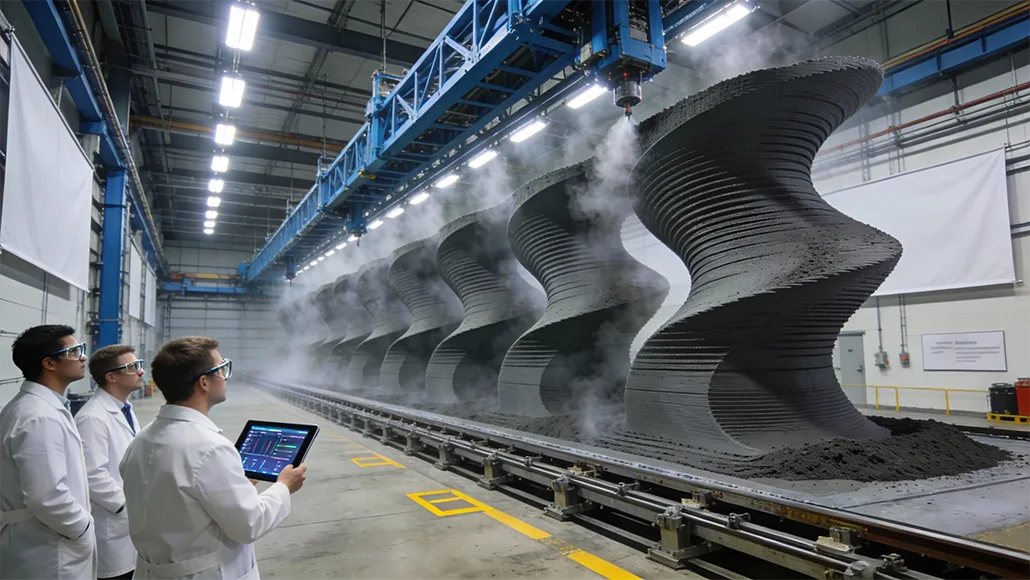
The design of the reactor required massive concrete form liners, which went on to follow a precise sinusoidal curve. Each wall section is three feet thick as well as twenty-seven feet tall, thereby demanding millimeter precision. The past approaches would have needed quite intricate machining and lengthy fabrication cycles. Rather, UMaine researchers made use of their super-sized polymer 3D printer in order to fabricate the longest forms that the center has ever produced, custom printed from digital models and also shaped for exact alignment along with the reactor geometry of Kairos Power.
Once they were printed, the structures went on to be precision-machined as well as inspected by metrology specialists from UMaine. Every curve as well as every angled surface was scanned and also compared to the digital blueprint. As per Susan MacKay, the ASCC chief sustainable materials officer, the project went on to leave no room for deviations. She also noted that the team attained a commercial-grade precision when it came to the rapid schedule, therefore calling it a milestone for the academic center, which operated at the pace of the industry.
The partnership has resulted in a hybrid casting system, which quite significantly lowered the costs and paced up the overall construction sequence. Through replacing traditional fabrication along with additive manufacturing, the team went on to shorten the production cycles without even compromising on quality, therefore making it possible for Kairos Power to keep itself on track with its reactor construction. The approach also went on to decrease the material waste and, at the same time, created a repeatable process that can go ahead and even support reactor projects in the future.
Notably, the work is part of the Specialized Materials and Manufacturing Alliance for Resilient Technologies, which is referred to as SM²ART – a collaboration that involves UMaine and Oak Ridge National Laboratory of the Department of Energy. The director of the DOE Manufacturing Demonstration Facility, Ryan Dehoff, remarked that the project indeed demonstrates how universities, along with national labs, can offer industry direct access when it comes to cutting-edge tools and also the expertise that is essential for the next generation of energy infrastructure.
UMaine researchers, apart from the physical components, are also going ahead and advancing the digital assurance by way of the Material Process Property Warehouse. This AI-supported system goes on to track every step within the additive manufacturing process, hence creating an overall digital thread that enables the components to be born certified. The approach looks forward to reducing the regulatory delays and also enhancing dependability for sectors like defense and nuclear power.
As the nuclear industry is looking out for ways so as to build safer, faster, and much more affordable reactors, UMaine’s work teamed with Kairos Power provides a model for how large-scale 3D printing can actually reshape heavy construction. With the Hermes project underway, UMaine has indeed demonstrated that additive manufacturing is no longer a future possibility for nuclear infrastructure but is already present at the job site.