






























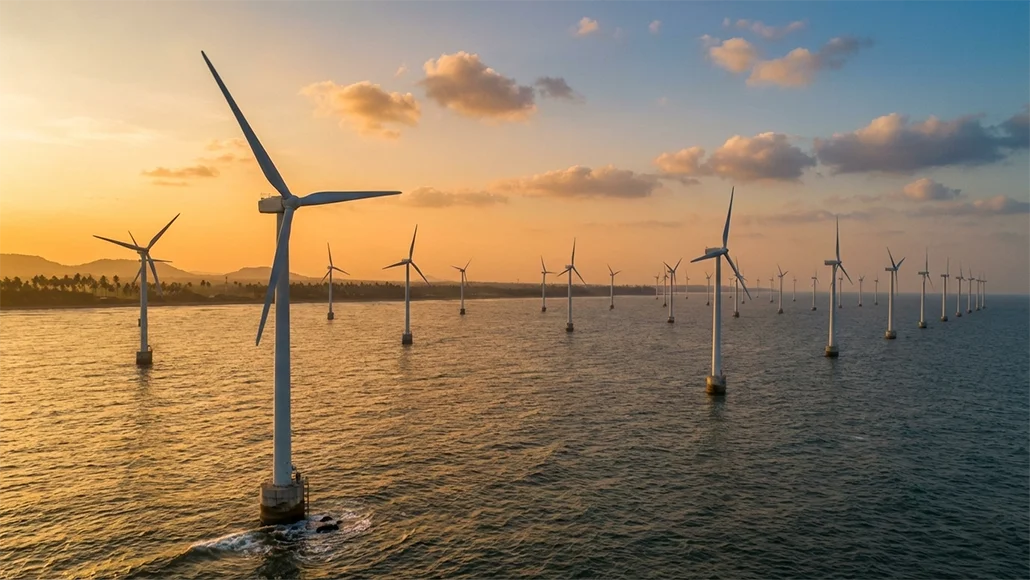

India and the United Kingdom formally launched the India-UK Offshore Wind Taskforce, establishing a joint platform to accelerate development of India’s offshore wind ecosystem, strengthen supply chains and advance financing models. The initiative, anchored under the India-UK Vision 2035 and the Fourth Energy Dialogue, positions offshore wind as a strategic pillar of India’s next phase of power sector expansion and clean energy transition, while deepening bilateral cooperation on energy security and decarbonisation.
The offshore wind taskforce was launched in the presence of Union Minister of New & Renewable Energy Pralhad Joshi, U.K. Deputy Prime Minister David Lammy and British High Commissioner to India Lindy Cameron. The platform builds on earlier commitments made during the fourth India-UK Energy Dialogue, where both countries agreed to collaborate on offshore wind and broader reforms in India’s power sector, including grid transformation support through UKPACT and the extension of the Accelerating Smart Power and Renewable Energy in India (ASPIRE) programme.
Addressing the launch, Mr. Joshi outlined the scale of India’s renewable energy expansion. “Today, India’s installed non-fossil capacity stands at over 272 GW, with solar at more than 141 GW and wind at 55 GW… to give you an idea of our scale, almost 3 million households have benefitted from rooftop solar under PMSGMBY in less than two years. We have solarised 2.1 million pumps under another single scheme, called PM-KUSUM,” he said. He also noted that in the ongoing financial year, India added more than 35 GW of solar and 4.61 GW of wind capacity, and last year achieved 50% of its cumulative installed power capacity from non-fossil sources, five years ahead of its Nationally Determined Contribution commitment.
Against this backdrop, offshore wind has been identified as a strategic priority. Promising zones have been mapped off the coasts of Gujarat and Tamil Nadu, and transmission planning for an initial 10 GW offshore evacuation capacity 5 GW each off Gujarat and Tamil Nadu has been completed. To support early deployment, the government introduced a Viability Gap Funding scheme in 2024 with a total outlay of ₹7,453 crore (approximately 710 million pounds). This includes ₹6,853 crore for installation and commissioning of 1 GW of offshore wind energy projects (500 MW each off Gujarat and Tamil Nadu), and ₹600 crore for upgradation of two ports to meet logistics requirements.
“As we all know, offshore wind is among the most complex segments of the global energy transition. It demands specialised port infrastructure, marine logistics, robust seabed leasing frameworks, clear risk allocation and bankable commercial structures. That is why this Taskforce matters,” Mr. Joshi said. He added that the taskforce would focus on three practical pillars: ecosystem planning and market design; infrastructure and supply chains; and financing and risk mitigation, including blended finance structures and mobilisation of long-term institutional capital.
The UK government has positioned the partnership as part of its broader clean energy strategy. UK Energy Secretary Ed Miliband, who participated in the fourth UK-India Energy Dialogue, stated: “The UK and India are strengthening our partnership under our Plan for Change to unlock investment and accelerate the global transition to clean, secure, affordable energy.” He further said, “Both our countries are determined to address the climate emergency to protect our way of life, while reaping the rewards of the industrial and economic opportunity of our time.”
The UK, which has developed large-scale offshore wind markets with mature supply chains, is expected to contribute expertise in early-stage deployment, commercial structuring and supply chain development. India, for its part, brings scale, long-term demand and a rapidly growing clean energy ecosystem. The taskforce is intended to provide strategic leadership and coordination to address execution challenges, improve seabed leasing frameworks, align bidding with grid readiness and strengthen revenue certainty mechanisms.
Deputy Prime Minister David Lammy commended India for “outstanding progress”, particularly surpassing the milestone of achieving 50 percent of installed electricity capacity from non-fossil sources, five years ahead of its 2030 target.
The launch comes as India pursues its target of 500 GW of renewable energy by 2030 and net-zero emissions by 2070, and as both countries prepare for further economic engagement, including negotiations on a Free Trade Agreement and Bilateral Investment Treaty. Engagement also precedes COP30 in Brazil later this year, reinforcing offshore wind cooperation as a central component of bilateral power sector collaboration.