



















Close
MCE 2026
World Hydrogen & Carbon Americas

Manchester Geothermal Energy Source Found Under City Centre

Note* - All images used are for editorial and illustrative purposes only and may not originate from the original news provider or associated company.

Subscribe

- Never miss a story with notifications

- Gain full access to our premium content

- Browse free from any location or device.

Media Packs

Expand Your Reach With Our Customized Solutions Empowering Your Campaigns To Maximize Your Reach & Drive Real Results!

– Access the Media Pack Now

– Book a Conference Call

Leave Message for Us to Get Back

Related stories

Decarbonisation Pathways for Energy Intensive Manufacturing

Decarbonisation pathways are helping energy intensive manufacturing cut emissions through cleaner power, smarter heat strategies, and advanced technologies that protect competitiveness.

Industrial Water Energy Nexus in Power Intensive Processes

The industrial water energy nexus links water use and power demand, and managing it well can lift efficiency, reduce risk, and strengthen sustainability in power intensive processes.

Electrochemical Technologies Supporting Clean Energy Systems

Electrochemical technologies are strengthening clean energy systems by enabling efficient hydrogen production, practical storage solutions, and lower-emission power processes.
- Advertisement -

Scientists have identified a major Manchester geothermal energy source deep beneath the University of Manchester, revealing the potential for large-scale clean power generation within the city.

The finding emerged from a knowledge exchange project between remote sensing firm Metatek and the University of Manchester. Researchers combined historic subsurface data from the 1980s with new land gravity measurements collected in 2025 to analyse geological structures around 2,000 metres below the university campus.

Using a simplified version of Metatek’s airborne gravity technology, the team mapped high-temperature zones created by burial depth and pressure. These zones suggest conditions suitable for geothermal energy extraction in an urban setting.

Dr David Johnstone, Senior Geoscientist at Metatek, said: “Our project, and subsequent work, provides the building blocks to create a detailed 3D geological model of the strata beneath the University campus, allowing us to select a drill location that could target high temperature zones due to the burial depth and pressure.”

He added that the Manchester geothermal energy source could “unlock a tremendous amount of cheap and clean energy” and potentially offset a significant portion of the University’s annual energy demand, which exceeds 100 GWh.

That level of output would be comparable to the electricity use of around 25,000 homes, roughly equivalent to the town of Altrincham. Researchers said the energy potential matches the output of about 100,000 solar panels, with a similar payback period to other renewable technologies.

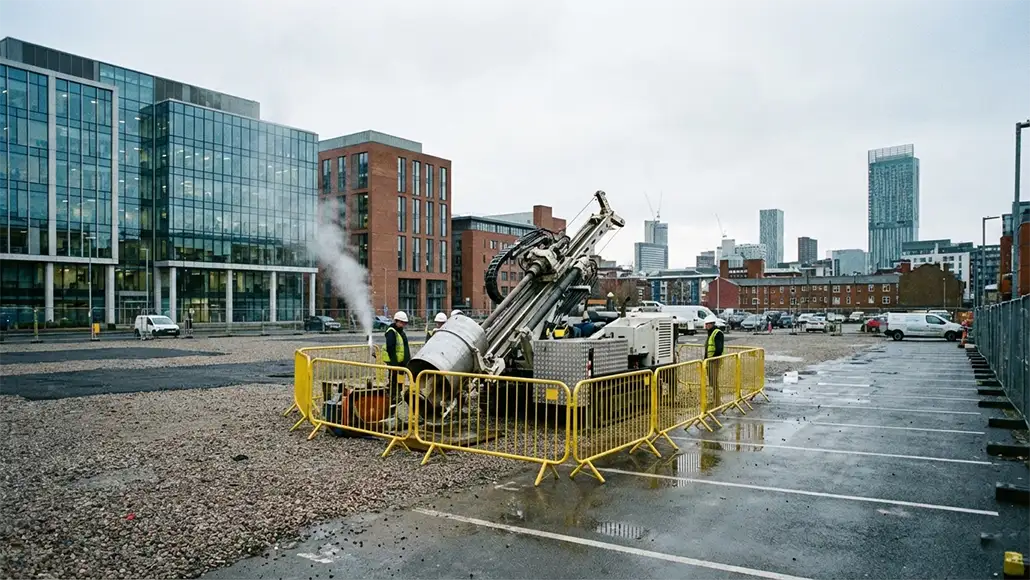
A potential drilling site has been identified within Cecil Street Car Park, requiring a surface footprint no larger than a tennis court.

Johnstone said: “We have calculated that the best access point to create a geothermal well would be an area no bigger than a tennis court, in a corner of Cecil Street Car Park.”

The recent survey has produced the most detailed geological assessment yet of Manchester’s subsurface. Given the scale of the findings, the research team plans to expand the work using Metatek’s full airborne gravity imaging system to explore geothermal opportunities beneath other urban areas.

Latest stories

Related stories

Decarbonisation Pathways for Energy Intensive Manufacturing

Decarbonisation pathways are helping energy intensive manufacturing cut emissions through cleaner power, smarter heat strategies, and advanced technologies that protect competitiveness.

Industrial Water Energy Nexus in Power Intensive Processes

The industrial water energy nexus links water use and power demand, and managing it well can lift efficiency, reduce risk, and strengthen sustainability in power intensive processes.

Electrochemical Technologies Supporting Clean Energy Systems

Electrochemical technologies are strengthening clean energy systems by enabling efficient hydrogen production, practical storage solutions, and lower-emission power processes.

Sustainable Fuel Alternatives for Industrial Power Generation

Sustainable fuel alternatives are helping industrial power generation lower carbon intensity without sacrificing dependable heat and power, especially where electrification is limited.

Subscribe

- Never miss a story with notifications

- Gain full access to our premium content

- Browse free from any location or device.

Media Packs

Expand Your Reach With Our Customized Solutions Empowering Your Campaigns To Maximize Your Reach & Drive Real Results!

– Access the Media Pack Now

– Book a Conference Call

Leave Message for Us to Get Back

Translate »