


























The global energy landscape is undergoing a structural shift as variable renewable energy sources like wind and solar become the dominant forms of new generation. While this transition is essential for sustainability, it introduces significant challenges for grid operators who must maintain a constant balance between supply and demand. Industrial scale energy storage has emerged as the critical link in this new energy paradigm, providing the flexibility needed to buffer intermittency and ensure grid stability. By deploying large scale storage solutions at industrial sites and major utility nodes, the energy sector can transform variable power into a firm, reliable resource.
The importance of industrial scale energy storage grid stability cannot be overstated. As traditional baseload plants are retired, the grid loses the inherent inertia that once kept it stable. Modern energy storage systems, particularly advanced battery storage systems, fill this gap by providing near-instantaneous response to frequency deviations and voltage fluctuations. This rapid response capability is what allows the grid to absorb higher percentages of renewable energy without compromising the reliability that modern society and industry depend on.
The Technical Fundamentals of Industrial Storage
Industrial energy storage encompasses a variety of technologies, each suited to different operational needs. The most prominent today are Lithium-ion battery storage systems, valued for their high energy density, efficiency, and falling costs. However, the market is also seeing the rise of long-duration storage technologies, such as flow batteries, compressed air energy storage, and thermal energy storage. These systems are designed to move energy across hours or even days, whereas traditional batteries are often optimized for shorter bursts of power.
The choice of technology depends largely on the specific grid stability solutions being targeted. For frequency regulation, where the storage system must react in milliseconds to balance the grid’s frequency, high-power lithium systems are ideal. For peak shaving or seasonal shifting, technologies with lower self-discharge rates and longer discharge durations are more appropriate. Regardless of the chemistry, the core function remains the same: acting as a massive energy reservoir that can be tapped into whenever the grid requires support.
Balancing Supply and Demand in Real Time
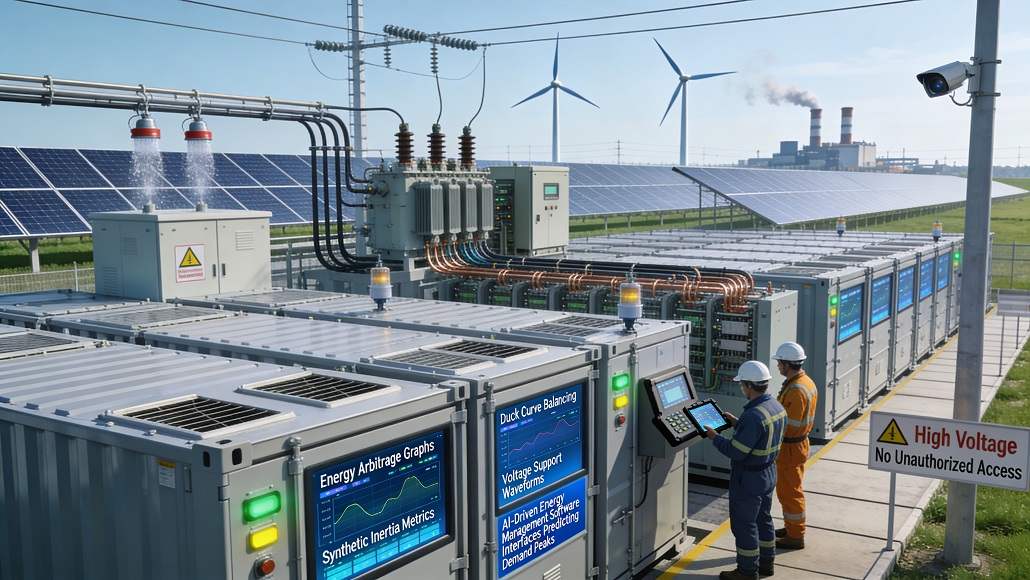
In a traditional grid, supply was adjusted to meet demand. In a renewable-heavy grid, the situation is often reversed, or at least far more complex. Supply peaks when the wind blows or the sun shines, often at times when demand is low. Conversely, demand can spike during the evening hours when solar generation drops off a phenomenon widely known as the “duck curve.” Industrial scale energy storage addresses this mismatch by capturing excess renewable energy during periods of oversupply and discharging it when demand peaks.
This balancing act is essential for preventing both blackouts and the wasteful curtailment of renewable energy. Without storage, grid operators are often forced to tell wind farms to stop spinning because there is nowhere for the power to go. By integrating large scale storage, this “lost” energy can be preserved, increasing the overall efficiency of the renewable integration process and improving the financial returns for clean energy projects. For the industrial consumer, this means a more stable power supply and potentially lower energy costs as the grid becomes more efficient at managing its resources.
Grid Stability Solutions and Ancillary Services
Grid stability involves more than just balancing megawatt-hours; it requires a suite of technical services known as ancillary services. These include frequency response, voltage support, and black-start capabilities. Historically, these services were provided by the rotating mass of large steam turbines in coal or gas plants. As these plants are phased out, industrial scale energy storage is stepping in to provide these services electronically.
Battery storage systems are particularly adept at frequency response. Because they have no moving parts and are controlled by high-speed power electronics, they can inject or absorb power much faster than any mechanical turbine. This “synthetic inertia” is becoming a standard requirement for many grid operators. Additionally, large-scale storage can provide voltage support by injecting or absorbing reactive power, helping to maintain the health of the local distribution network. These technical services are the invisible pillars that support a modern, resilient grid.
Renewable Integration at an Industrial Scale
For large industrial facilities, renewable integration often starts with on-site solar or wind. However, the intermittent nature of these sources can conflict with the steady power requirements of manufacturing. Industrial energy storage allows these facilities to decouple their renewable generation from their consumption. By storing their own solar power during the day, a plant can run on clean energy throughout the night, significantly reducing their carbon footprint and their reliance on the utility grid.
This trend toward “behind-the-meter” storage is also beneficial for the wider grid. By reducing the peak demand of large industrial customers, storage helps to lower the overall stress on the network, delaying the need for expensive transmission and distribution upgrades. In some cases, industrial facilities can aggregate their storage assets to participate in virtual power plants, providing grid stability services back to the utility and generating a new revenue stream in the process. This creates a symbiotic relationship where the industrial site gains power resilience while the grid gains a flexible resource.
Power Resilience and Business Continuity
For many industrial firms, the primary driver for investing in energy storage is power resilience. In sectors like semiconductors, pharmaceuticals, or data centers, even a few cycles of power instability can cause catastrophic failures. Industrial scale energy storage acts as an Uninterruptible Power Supply (UPS) at a massive scale. If the grid suffers a voltage dip or a complete outage, the storage system can take over the load seamlessly, ensuring that production remains uninterrupted.
This level of business continuity is a significant competitive advantage. It allows firms to operate confidently in regions where the grid might be less reliable or where the transition to renewables is causing growing pains. The peace of mind that comes from knowing that the facility is shielded from external power events is often enough to justify the investment in large scale storage, even before considering the additional benefits of peak shaving and ancillary service revenue.
The Role of Software in Energy Storage Management
Hardware is only half of the story when it comes to industrial scale energy storage. The real intelligence lies in the energy management software that dictates when to charge, when to discharge, and which services to prioritize. Modern storage systems are equipped with AI-driven algorithms that analyze weather forecasts, grid prices, and facility load patterns to optimize the storage system’s operation.
For example, if the software predicts a spike in electricity prices later in the day, it will ensure that the battery is fully charged using low-cost power in the morning. If it detects a frequency deviation on the grid, it can automatically switch to frequency response mode to support the utility. This automated decision-making ensures that the industrial scale energy storage grid stability goals are met while also maximizing the financial return for the asset owner. The integration of digital twins and remote monitoring further enhances this, allowing for continuous performance optimization throughout the life of the system.
Addressing the Challenges of Scale
While the benefits are clear, deploying storage at an industrial scale is not without its challenges. Safety is a primary concern, particularly with lithium-ion chemistries that can be prone to thermal runaway if not managed correctly. This requires sophisticated thermal management systems, robust fire suppression, and rigorous adherence to safety standards. Modern industrial storage containers are designed with these protections built-in, but site-specific risk assessments remain a critical part of the installation process.
Another challenge is the lifecycle and degradation of the battery cells. Every charge and discharge cycle causes a small amount of wear, and over time, the capacity of the system will diminish. Managing this degradation requires careful control of the state of charge and temperature, as well as a clear plan for cell replacement or system augmentation in the future. Furthermore, the industry is increasingly focused on the sustainability of the battery supply chain, leading to a surge in research into recycling and alternative chemistries that use more abundant materials.
Economic and Regulatory Drivers
The growth of industrial energy storage is being accelerated by a combination of falling costs and supportive policy. Tax credits, grants, and favorable regulatory frameworks are making storage more attractive for private investment. In many regions, the introduction of “capacity markets” or “ancillary service markets” allows storage owners to be paid for the stability they provide to the grid, creating a clear business case beyond simple energy arbitrage.
For the industrial sector, the declining cost of battery storage systems means that the payback period for these projects is shortening. When combined with the rising cost of carbon and the increasing frequency of grid instability, the economic argument for storage becomes hard to ignore. As more companies set ambitious net-zero targets, storage will be seen not as a luxury, but as an essential infrastructure component that enables the transition to a carbon-free industrial future.
The Future of Large Scale Storage
Looking ahead, we can expect to see a diversification of storage technologies and a deeper integration of storage into the very fabric of the industrial landscape. We may see the rise of “energy storage as a service,” where third-party providers install and operate the systems at industrial sites, sharing the savings and revenue with the host. We will also likely see the growth of long-duration storage technologies that can provide multi-day resilience, further reducing the need for fossil-fuel backup.
The relationship between industrial sites and the grid will continue to evolve, with industrial scale energy storage grid stability becoming a shared responsibility. The industrial facility of the future will not just be a consumer of energy; it will be a proactive participant in a decentralized energy network, using its storage assets to balance its own needs while supporting the stability of the wider community. This vision of a resilient, renewable-powered world is only possible with the continued deployment and innovation of industrial-scale storage solutions.