

























In the high-stakes world of industrial operations, power is more than just a utility; it is a critical process variable that must be managed with the same rigor as chemical reactants or high-pressure steam. Traditionally, “safety” in power systems was often focused on electrical protection preventing shocks and fires. However, as industrial facilities become more complex and integrated, a broader concept has emerged: process safety integration modern power infrastructure. This approach treats the electrical system as an integral part of the facility’s overall safety framework, ensuring that power anomalies do not lead to catastrophic process failures or environmental incidents.
The integration of process safety systems into the power network is driven by the understanding that a loss of power is rarely just an electrical event. In a refinery, chemical plant, or pharmaceutical facility, a power interruption can lead to the loss of cooling, the failure of control systems, or the uncontrolled release of hazardous materials. Therefore, modern power infrastructure must be designed not just for reliability, but for “functional safety,” ensuring that it supports the facility’s ability to reach a safe state under all conditions.
The Core Principles of Functional Safety
At the heart of process safety integration is the concept of functional safety, which is defined by international standards such as IEC 61508 and IEC 61511. These standards provide a framework for identifying “Safety Instrumented Functions” (SIFs) and assigning them a “Safety Integrity Level” (SIL) based on the degree of risk reduction they provide. In the context of power infrastructure safety, this means identifying the electrical components that are critical for maintaining safety-related processes and ensuring they meet the required SIL rating.
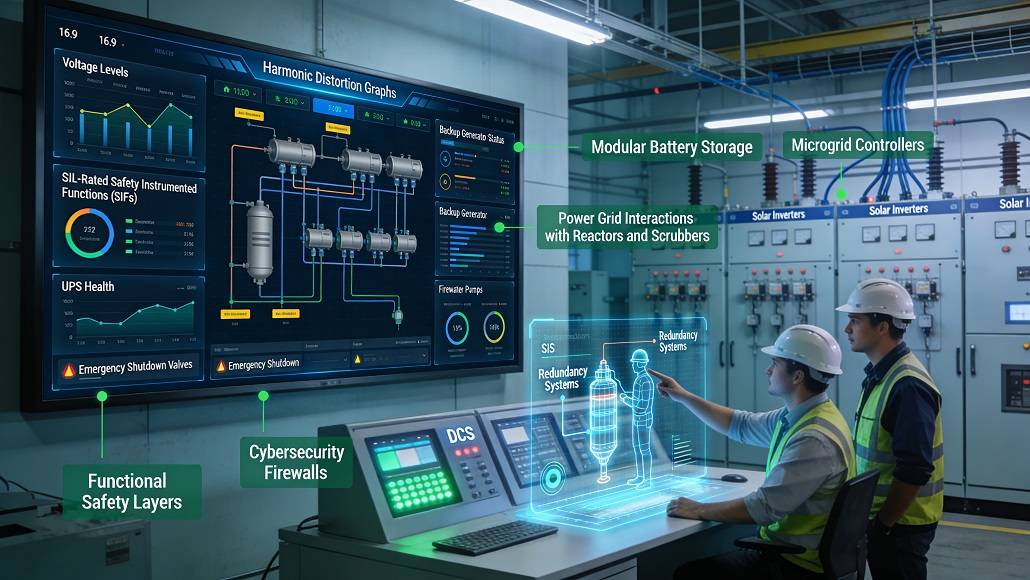
For example, the power supply to an emergency shutdown valve or a firewater pump is a safety-critical asset. Integrating process safety means ensuring that these supplies have the necessary redundancy, monitoring, and diagnostic capabilities to perform their function when needed. This shift from “generic” reliability to “task-specific” functional safety is a hallmark of modern industrial risk management. It requires a deep understanding of the interactions between the electrical system and the mechanical/chemical processes it supports.
Industrial Risk Management and Power Design
A safe power operation begins with a comprehensive risk assessment. Industrial risk management involves identifying the potential “hazards” associated with power failures such as a runaway reaction caused by the loss of an agitator or a toxic leak caused by the failure of a scrubber pump. Once these hazards are identified, the power infrastructure can be designed with the appropriate layers of protection.
These layers often include uninterruptible power supplies (UPS), backup generators, and modular energy storage systems. However, integration means more than just adding hardware; it means ensuring that these systems are coordinated with the facility’s overall safety logic. For instance, the transition from grid power to backup generation must be fast enough to prevent the “reset” of critical control systems. Furthermore, the safety system must be able to monitor the health of the backup power assets, ensuring that a “hidden failure” in a generator battery or a fuel pump does not compromise the safety of the entire facility.
The Role of Process Safety Systems in Monitoring
Modern power infrastructure is increasingly equipped with sophisticated monitoring and diagnostic tools that are integrated into the plant-wide safety network. These process safety systems can provide real-time data on electrical health, detecting subtle issues like harmonic distortion, voltage dips, or cable insulation degradation before they lead to a failure. This proactive monitoring is essential for maintaining energy sector compliance and ensuring long-term operational safety.
In a modern facility, the electrical monitoring system is not a standalone silo. It is linked to the Distributed Control System (DCS) and the Safety Instrumented System (SIS). This integration allows for “context-aware” safety responses. For example, if the electrical system detects a fault in a specific motor, the safety system can determine the criticality of that motor to the current process state. If the motor is critical for cooling a high-pressure reactor, the system might initiate a controlled shutdown of the process rather than simply tripping the electrical breaker and leaving the reactor in a dangerous state.
Ensuring Energy Sector Compliance and Standards
The regulatory landscape for industrial power and safety is becoming increasingly stringent. Energy sector compliance now requires a documented approach to risk management that includes the electrical system. Failure to demonstrate that the power infrastructure supports the facility’s safety goals can lead to legal liabilities, increased insurance premiums, and the loss of the social license to operate.
Integrating process safety means maintaining a “life-cycle” approach to the power system. This includes rigorous testing and maintenance of all safety-critical electrical components, from the sensors that detect a power loss to the breakers that isolate a fault. Every maintenance action and every test must be documented and auditable. This discipline ensures that the “as-built” safety of the power infrastructure is maintained throughout its operational life, regardless of how many times the facility is modified or expanded.
Safe Power Operations and the Human Interface
While technology is central to process safety integration modern power infrastructure, the human element remains the final layer of protection. Safe power operations require a workforce that is trained to understand the complex interactions between electricity and process safety. Operators and electricians must be able to recognize the signs of an impending electrical issue and understand the process implications of their actions.
This requires the development of “safe work practices” that are specific to the facility’s integrated safety logic. For example, during maintenance on a switchgear panel, the team must understand which safety functions might be temporarily compromised and what “compensating measures” need to be put in place. The use of digital twins and interactive training simulations is becoming a standard way to build this competence, allowing teams to practice their response to complex integrated failure scenarios in a safe, virtual environment.
Cybersecurity as a Process Safety Priority
In the age of industrial digitalisation, the safety of the power system is inextricably linked to its cybersecurity. If a hacker can gain control of the electrical protection relays or the UPS management system, they can effectively bypass the facility’s safety layers. Therefore, process safety integration must include a robust cybersecurity framework that treats electrical control networks as “high-consequence” assets.
This involves applying the same principles of redundancy and isolation to the digital network as are applied to the physical power lines. Secure communication protocols, hardware-based firewalls, and continuous network monitoring are now essential components of power infrastructure safety. By protecting the “brain” of the power system from digital intrusion, industrial firms can ensure that their physical safety measures remain effective and reliable.
The Impact of Modularity and New Technologies
The move toward modular energy systems is also having a positive impact on process safety. Modular power units are often designed with “fail-safe” characteristics built-in, and because they are factory-tested, the risk of wiring errors or configuration mistakes during site installation is significantly reduced. Furthermore, the use of modular battery storage provides a more reliable and faster-acting source of emergency power than traditional lead-acid UPS systems or diesel generators.
As new technologies like hydrogen fuel cells and advanced microgrid controllers are integrated into modern power infrastructure, the challenge will be to maintain safety integration. This requires a “safety-by-design” approach where the safety implications of new power sources are analyzed from the very beginning. By treating these new assets as part of the facility’s safety ecosystem, industrial firms can reap the benefits of cleaner and more flexible power without introducing new unmanaged risks.
Safe Power Operations in the Renewable Era
The transition to renewable energy introduces new dynamics into the safety equation. Variable generation and the increased use of power electronics can affect power quality and fault levels, potentially impacting the reliability of safety-critical equipment. Integrating process safety in this environment means using “smart” protection devices that can adapt to changing grid conditions and ensuring that on-site storage is always ready to take over if the external supply becomes unstable.
Resilience is the ultimate goal of safe power operations. A resilient facility is one that can withstand a power disturbance, maintain its critical safety functions, and return to normal operation with minimal disruption. This level of resilience is only possible through the deep integration of process safety into every aspect of the modern power infrastructure, from the high-voltage substation to the low-voltage control panel.
Conclusion: A Holistic Approach to Industrial Safety
Process safety integration modern power infrastructure is not a one-time project; it is a continuous commitment to operational excellence. It requires the breaking down of silos between electrical engineering, process safety, and operations. By treating the power system as a primary layer of protection, industrial firms can significantly reduce their risk profile while improving their efficiency and regulatory standing.
As industrial facilities continue to evolve, the integration of safety and power will only become more critical. The firms that lead the way in this area will be those that embrace a holistic view of risk, leveraging the latest technologies in monitoring, automation, and modularity to create a power infrastructure that is as safe as it is powerful. In the end, the true measure of a successful power system is not just how much energy it delivers, but how well it protects the people, the environment, and the assets it serves.