

Close
MCE 2026
World Hydrogen & Carbon Americas

Siemens receives certification for 8-MW offshore wind turbine prototype

Note* - All images used are for editorial and illustrative purposes only and may not originate from the original news provider or associated company.

Subscribe

- Never miss a story with notifications

- Gain full access to our premium content

- Browse free from any location or device.

Media Packs

Expand Your Reach With Our Customized Solutions Empowering Your Campaigns To Maximize Your Reach & Drive Real Results!

– Access the Media Pack Now

– Book a Conference Call

Leave Message for Us to Get Back

Related stories

Heat Pumps as Strategic Grid Assets Enabling Renewable Integration and Stability

Modern heat pumps have evolved beyond efficiency technologies to become strategic grid assets capable of providing demand flexibility, load shifting and seasonal balancing. Discover how large-scale heat pump deployment supports renewable integration and grid stability.

Electrification of Heating and Cooling: Reshaping Global Electricity Demand

The rapid electrification of heating and cooling systems is fundamentally transforming electricity demand patterns worldwide. Explore how thermal electrification impacts peak loads, grid infrastructure, and long-term power generation planning in the transition to decarbonized energy systems.

Buildings as Decentralized Energy Systems: Transforming Power Infrastructure

Modern buildings are evolving from passive energy consumers into active energy producers through on-site renewable generation, battery storage and intelligent control systems. Discover how decentralized energy systems are reshaping grid architecture and redefining buildings as critical nodes in the broader power ecosystem.
- Advertisement -

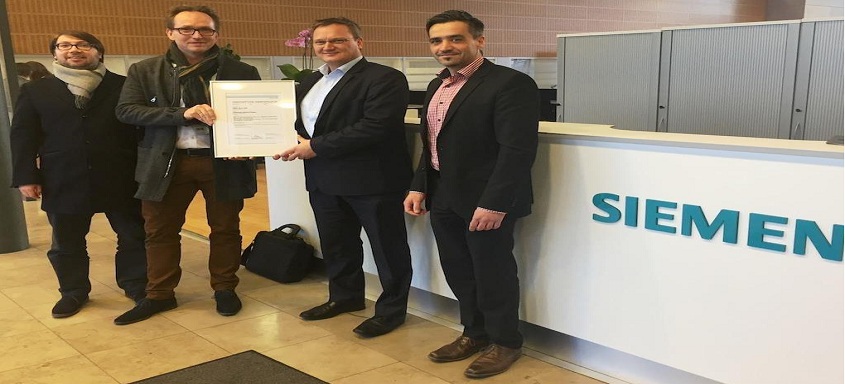
DNV GL has assessed the market’s new offshore turbine in development and awarded Siemens Wind Power with the Prototype Certificate for its 8 megawatt (MW) offshore wind turbine SWT-8.0-154.

The prototype certification confirms all relevant safety features on the turbine according to the Danish Executive Order BEK 73:2013 and IEC 61400-22, allowing installation of the prototype to demonstrate its performance. By erecting the turbine at the test centre for wind turbines in Østerild, Denmark, Siemens is able to perform the measurement campaign for the next phase of the type certification process which is crucial to bring the turbine to the market.

“We are proud to have received the prototype certificate at this early stage, allowing us to install our SWT-8.0-154 prototype according to plan. The third evolution on the Offshore Direct Drive platform truly marks the move towards industrializing offshore wind power. We are also proud to be once again cooperating with DNV GL, who is equally responsible for allowing us to reach our goals on this very short timeline,” says Morten Rasmussen, Head of Siemens Wind Power Technology.

Mike Wöbbeking, Head of Certification Body Renewables Certification at DNV GL, commented: “We are happy that the certification journey of the Siemens direct drive offshore wind turbine continues from the 7 MW to the even bigger 8 MW turbine together with DNV GL. With our certification services we support Siemens to meet customer expectations to provide the industry with an optimised turbine with an even higher output rate to reduce the levelized cost of energy.”

The SWT-8.0-154 turbine is an evolution of the SWT-6.0-154 and the SWT-7.0-154 turbines. The main changes going from SWT-7.0-154 to the SWT-8.0-154 turbine consist of an upgraded generator including the adjacent electrical system and an advanced control system. The upgrade of the offshore direct drive wind turbine to eight megawatts is made possible through the introduction of new magnet technology with an even higher grade than that introduced in the SWT-7.0-154. This enables a rated power increase of more than 14% from 7.0 to 8.0 MW.

About DNV GL
Driven by our purpose of safeguarding life, property and the environment, DNV GL enables organizations to advance the safety and sustainability of their business. We provide classification and technical assurance along with software and independent expert advisory services to the maritime, oil & gas and energy industries. We also provide certification services to customers across a wide range of industries. Operating in more than 100 countries, our professionals are dedicated to helping our customers make the world safer, smarter and greener.

DNV GL in the Energy industry
In DNV GL we unite the strengths of DNV, KEMA, Garrad Hassan, and GL Renewables Certification. DNV GL’s 2,500 energy experts support customers around the globe in delivering a safe, reliable, efficient, and sustainable energy supply. We deliver world-renowned testing, certification and advisory services to the energy value chain including renewables and energy efficiency. Our expertise spans onshore and offshore wind power, solar, conventional generation, transmission and distribu¬tion, smart grids, and sustainable energy use, as well as energy markets and regulations. Our testing, certification and advisory services are delivered independent from each other. Learn more at www.dnvgl.com/energy

Latest stories

Related stories

Heat Pumps as Strategic Grid Assets Enabling Renewable Integration and Stability

Modern heat pumps have evolved beyond efficiency technologies to become strategic grid assets capable of providing demand flexibility, load shifting and seasonal balancing. Discover how large-scale heat pump deployment supports renewable integration and grid stability.

Electrification of Heating and Cooling: Reshaping Global Electricity Demand

The rapid electrification of heating and cooling systems is fundamentally transforming electricity demand patterns worldwide. Explore how thermal electrification impacts peak loads, grid infrastructure, and long-term power generation planning in the transition to decarbonized energy systems.

Buildings as Decentralized Energy Systems: Transforming Power Infrastructure

Modern buildings are evolving from passive energy consumers into active energy producers through on-site renewable generation, battery storage and intelligent control systems. Discover how decentralized energy systems are reshaping grid architecture and redefining buildings as critical nodes in the broader power ecosystem.

How Renewable Electricity Powers Continuous Thermal Systems

The integration of renewable electricity into thermal energy systems—heating, cooling, and hot water—requires sophisticated technical solutions including thermal storage, hybrid system configurations, and intelligent dispatch algorithms. These innovations enable renewable power to reliably serve round-the-clock thermal demands while maintaining the system reliability that modern buildings and industries require.

Subscribe

- Never miss a story with notifications

- Gain full access to our premium content

- Browse free from any location or device.

Media Packs

Expand Your Reach With Our Customized Solutions Empowering Your Campaigns To Maximize Your Reach & Drive Real Results!

– Access the Media Pack Now

– Book a Conference Call

Leave Message for Us to Get Back

Translate »