


























The challenge of decarbonizing thermal energy systems heating for domestic hot water, space conditioning in buildings, and process heat for industrial applications stands among the most complex engineering and operational problems confronting energy systems. Thermal applications consume roughly 50% of global final energy demand and include both processes requiring continuous supply (industrial food production, chemical processing, district heating distribution) and systems with storage capacity (building space heating, water heating, refrigeration). Traditional thermal systems rely on direct burning of natural gas, oil, or biomass, combustion occurring locally where heat is needed. As electricity grids decarbonize, thermal systems must transition to electric heat pumps and electric resistance heaters powered by renewable sources. This transition introduces a fundamental challenge: renewable electricity is intermittent while thermal demand is often continuous or follows predictable daily/seasonal patterns. Bridging this temporal gap requires thermal energy storage, hybrid system configurations, and advanced control algorithms technologies that are now deployed at meaningful scale and demonstrate reliable performance.
The Temporal Mismatch Problem
Thermal systems differ fundamentally from electric appliances in their temporal flexibility. An electric motor can operate at any hour when electricity is available. A data center can shift computation tasks across time zones. Heating and cooling systems, by contrast, must maintain specific temperature conditions during occupied periods or for process continuity. A residential building requires space heating primarily during morning wake periods and evening hours, with minimal heating needed midday even in winter. A cold storage facility requires continuous cooling regardless of electricity prices. A manufacturing facility requires process heat during production hours.
Renewable electricity generation creates another temporal pattern: solar peaks midday and seasonally in summer; wind generation is essentially unpredictable on hourly timescales but exhibits seasonal and daily average patterns. In a renewables-powered system, midday solar electricity becomes abundantly available while space heating demand is minimal. Evening and nighttime hours, when heating demand peaks in cold climates, coincide with declining solar output and variable wind conditions. Winter months with high heating demand often experience mediocre solar resource and variable wind. This fundamental misalignment between renewable generation patterns and thermal demand patterns is precisely the problem that thermal energy storage and hybrid systems address.
The engineering solution builds on thermal inertia the property that thermal systems store energy in materials (air, water, building structure) with substantial heat capacity. A 100-ton building structure can store 50-100 MWh of thermal energy as temperature varies between 18°C and 24°C. A 200,000-liter water tank stores 20-30 MWh of thermal energy across practical temperature ranges. By charging this thermal mass during favorable renewable generation periods, systems can defer thermal output to later periods when renewable supply is constrained. This is conceptually straightforward but operationally requires sophisticated controls and precise sizing.
Thermal Energy Storage Technologies
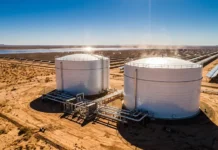
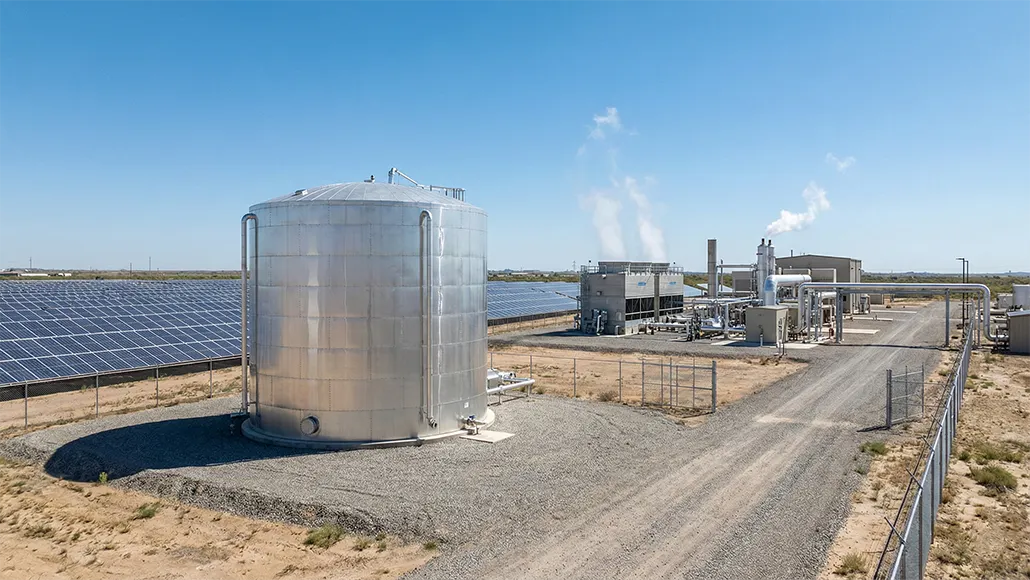
Thermal storage systems are categorized by temperature range and mechanism. Sensible heat storage, the simplest approach, exploits temperature changes in materials with high heat capacity: water, concrete, or phase-change materials. A 200,000-liter water tank charged to 90°C and discharged to 30°C stores approximately 33 MWh of thermal energy (calculated from density 1,000 kg/m³, specific heat capacity 4.18 kJ/kg-K, and temperature difference 60 K). Capital costs for such systems typically range from $100-200 per kilowatt-hour of storage capacity for municipal/industrial scale deployments, compared to $200-500 for battery electric storage, making thermal storage economically attractive for facilities with continuous or highly predictable thermal loads.
Phase-change materials (PCMs) offer higher storage density than sensible heat materials such as paraffin wax or salt hydrates absorb/release large quantities of heat when transitioning between solid and liquid states, enabling storage of 150-250 MWh per cubic meter of material. Commercial deployments in buildings use proprietary PCM capsules integrated into walls, ceilings, or dedicated thermal battery units. The technology provides benefits in space-constrained applications, though material costs ($200-400 per kilowatt-hour) and cycling durability considerations limit deployment to specialized applications.
Latent heat storage in molten salt, deployed in concentrated solar power (CSP) systems and increasingly in industrial process heat applications, achieves high temperature operation (500-600°C) enabling integration with steam cycles and process heat demands. Annual energy losses are minimal (< 1% for multi-day storage), and energy density reaches practical limits of 600-1,000 MWh per 1,000 cubic meters of salt volume. Capital costs of $150-300 per kilowatt-hour place molten salt storage competitive with battery storage for long-duration applications, with the additional advantage that materials are non-hazardous and sustainable across 30-40 year operational lifespans.
Thermochemical storage, based on reversible chemical reactions (typically involving metal hydroxides or carbonates), achieves theoretical energy densities approaching 2,000 MWh per 1,000 cubic meters and maintains essentially zero energy loss during months-long storage periods. The technology remains largely in pilot deployment stages; several demonstration projects across Europe and North America are validating performance and cost competitiveness. When mature, thermochemical systems may enable industrial facilities to store summer excess solar/wind for winter process heat needs a seasonal storage capability matching industrial demand patterns.
Hybrid System Architecture and Control
Hybrid thermal systems that intelligently integrate electric heat pumps, thermal storage, solar thermal collectors, and efficient backup boilers represent the practical implementation approach for most applications. A hybrid residential heating system might operate as follows: During morning and midday solar peaks, when electricity is abundant and inexpensive, electric heat pumps operate at high capacity, heating water tanks to 90°C for space heating and domestic hot water. Heat pump efficiency (coefficient of performance) of 3-4 during favorable outdoor temperatures means that 1 MWh of electricity yields 3-4 MWh of thermal output. This charging phase continues into early afternoon solar decline. As solar output falls and evening heating demand emerges, the system shifts to discharging stored thermal energy, reducing heat pump operation. If building thermal demand exceeds storage discharge capacity, a high-efficiency gas boiler provides supplementary heat. Modern gas boilers operating at 92-96% efficiency produce 0.92-0.96 MWh of thermal output per 1 MWh of natural gas input, acceptable for the limited operating hours required in hybrid systems.
Control logic for hybrid systems employs day-ahead and real-time optimization frameworks. A facility forecasts the next 24-48 hours of thermal demand (based on occupancy patterns, weather, and seasonal data) and renewable electricity availability (solar irradiance forecasts from weather services, wind speed forecasts). The control algorithm then determines optimal charging schedules for thermal storage, heat pump operation profiles, and backup boiler activation windows to minimize energy cost and emissions while maintaining thermal comfort. Advanced implementations incorporate building thermal models predicting how interior temperature changes as various heating/cooling strategies are executed, enabling pre-cooling or pre-heating strategies that exploit building inertia.
Real-time adaptation layers respond to actual conditions diverging from forecasts. Unexpected cloud cover reducing solar generation triggers slightly earlier activation of backup heating. Forecast errors in heating demand (e.g., unexpected occupancy or door openings increasing infiltration) result in dynamic thermal storage discharge rate adjustments. These real-time adaptations prevent the “control regret” phenomenon where optimized morning plans prove suboptimal once actual conditions emerge. The integration of machine learning has improved real-time adaptation; models trained on years of building operation data learn subtle patterns (e.g., that Tuesday-Wednesday occupancy differs from Monday) enabling 10-15% improvement in algorithm performance versus simpler rule-based control.
Industrial Process Heat Applications
Industrial thermal process integration demonstrates particularly strong economics. Food processing facilities (dairy plants, breweries, beverage production) require continuous thermal loads averaging 500-2,000 kW with daily patterns reflecting production schedules. A daytime average thermal demand of 600 kW can be shifted earlier (charging thermal storage during night-time wind generation peaks) or delayed (exploiting building thermal inertia in high-mass structures) by 2-4 hours with zero impact on product quality. Chemical processing facilities requiring stable process temperatures can buffer thermal load variations with relatively large thermal storage (e.g., reactors in which reaction rates vary by only 10-20% across ±10°C temperature ranges), enabling substantial renewable electricity integration.
Analysis of representative food processing facilities shows that installing 500 MWh of thermal storage combined with 20 MW heat pump capacity enables 60-75% renewable electricity coverage. During favorable wind periods (typically nighttime in many regions), heat pumps operate at full capacity, charging hot water storage or operating chilled water loops. During daytime hours when demand is highest, systems discharge stored thermal energy with heat pump operation supplementing as needed. The capital cost of $200 million for this system (500 × $0.3 million per MWh thermal storage + heat pump capital) represents a 2-4 year payback period in regions with large wholesale electricity price spreads ($50+ per MWh variance between peak and off-peak hours) and moderate natural gas costs ($3-6 per million BTU). Since most industrial facilities remain in operation for 20-30 years, the economic case is compelling.
District Heating and Renewable Integration
District heating systems centralized thermal plants distributing hot water through insulated piping to multiple buildings offer substantial thermal storage integration opportunities. Large hot water or molten salt storage tanks, economically justified only for district-scale operations (100 MW+ thermal capacity), enable hours to days of thermal storage. The Vestermol district heating system in Denmark integrates 2 GWh of thermal storage (equivalent to 12 hours of district system peak output) enabling 80% renewable coverage through flexible operation. Cheap off-peak electricity charges summer excess solar power into thermal storage; winter heating demand is then satisfied from stored thermal energy. The system also integrates large-scale heat pumps utilizing waste heat from data centers and other sources, amplifying renewable integration.
District heating decarbonization has achieved rapid progress in multiple European countries. Sweden derives 90% of district heating from renewable or waste heat sources (compared to 20% in less-advanced systems). District heating penetration in Nordic countries of 50-70% enables rapid decarbonization compared to individual building heating requiring separate retrofits of millions of units. Modern district heating systems employ 4th-generation designs with lower temperature operation (45-60°C supply versus historical 80-90°C), reducing distribution losses and enabling efficient integration of heat pumps, solar thermal, and heat recovery systems. The lower temperature operation is enabled through building envelope improvements and advanced radiators/heat exchangers, amortizing additional building investment against reduced thermal distribution energy losses.
Building Thermal Control Innovation
Residential and commercial building thermal integration has accelerated dramatically with heat pump adoption and smart building controls. Modern heat pumps provide simultaneous heating and cooling through reversible refrigeration cycles, enabling buildings to both shed excess heat when solar thermal gain is excessive and provide heating during cold periods. Smart thermostats now predict building thermal dynamics and adjust pre-conditioning if a building typically requires 15 minutes of heating to reach comfort temperature, the system initiates heating 15 minutes prior to occupancy, leveraging renewable generation available at that time rather than operating under peak demand conditions.
Advanced implementations employ model predictive control (MPC) frameworks that explicitly account for building thermal dynamics and electricity price forecasts. The MPC algorithm solves an optimization problem determining heating/cooling setpoints for each hour of a predictive horizon (typically 24-48 hours) to minimize energy cost and emissions while maintaining comfort bounds. The key insight is that buildings with substantial thermal mass can defer thermal conditioning a residential building heated to 23°C at 2 PM can coast to 20°C by 5 PM during afternoon peak demand, then heat to 23°C during evening wind generation peaks when electricity is inexpensive. Occupants experience comfort within the 20-23°C range while system operation optimally exploits renewable variability.
Deployments of MPC in commercial office buildings report 20-30% energy cost reduction, 30-40% renewable electricity self-consumption improvement (reducing grid-exported solar), and maintained or improved thermal comfort satisfaction. The economic driver is electricity price reduction by shifting 30-40% of heating/cooling load from peak-price to off-peak periods, cumulative savings exceed $50,000-100,000 annually for a 10,000 m² building.
Integration Challenges and Solutions
Practical integration of renewable electricity into thermal systems encounters several implementation challenges. Building retrofit costs, particularly for converting gas heating systems to heat pump-based systems with thermal storage, remain significant (€5,000-15,000 per residential unit depending on existing infrastructure). Achieving economics requires multi-decadal building lifespans and confidence in long-term electricity price advantages over fossil fuels a confidence now substantially supported by renewable cost declines making power sector decarbonization economically favorable even without carbon pricing.
Grid infrastructure challenges arise from rapid proliferation of heat pumps: if installed without demand flexibility or thermal storage, 5 million additional heat pumps adding 1 kW average load each represents 5 GW of additional baseload demand plus substantial peak capacity additions. Conversely, with thermal storage and intelligent controls, the same 5 million heat pumps add only 3-4 GW average load and minimal peak capacity while substantially absorbing renewable variability. The difference between uncontrolled and controlled heat pump deployment is literally the difference between requiring additional generation/transmission investment or enhancing grid flexibility.
Control and communications infrastructure must be both robust and cyber-secure. Buildings and industrial facilities cannot accept remote deactivation of heating systems if that introduces risk of heating failure during winter extremes. Standards and redundancy in communications and local fallback controls ensure that thermal systems maintain safe operation even if central coordination fails. Modern standards (OpenADR in North America, standardized in IEC 62746; SPINE in Europe; JIS X 9491 in Japan) enable vendor-independent interoperability.
The Integration Pathway Forward
Renewable electricity integration into thermal systems is progressing from specialist niches (innovative utility demonstrations) toward mainstream deployment. The technical feasibility is established; the economic case is compelling; regulatory frameworks increasingly support deployment. The remaining challenges are organizational and infrastructural training building operators and industrial engineers to specify and deploy thermal storage; ensuring that electricity pricing and regulatory frameworks create economic incentives for flexibility rather than penalizing it; establishing supply chains for thermal storage systems as demand accelerates.
Within the next 5-10 years, thermal energy storage and hybrid thermal systems are expected to represent 20-30% of new building heating system installations in advanced markets, 40-50% of industrial thermal system retrofits, and near-universal integration in district heating expansions. This shift will enable renewable electricity to reliably serve the 50% of global energy consumption currently provided through thermal applications a transition as significant as the original shift from biomass and coal to petroleum-based heating systems that defined the 20th century energy transformation.