



















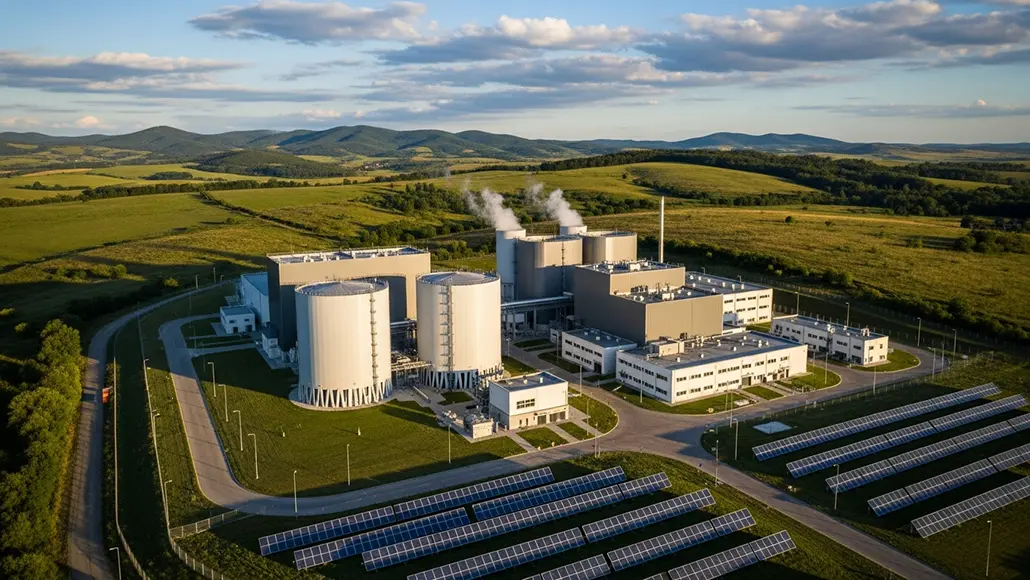

Holtec International, along with the state-owned energy company MVM from Hungary, has signed a memorandum of understanding – MoU so as to explore the rollout of SMR-300 small modular reactor technology from Holtec in Hungary, Holtec remarked in a post on X. The agreement goes on to build on the US–Hungary Nuclear Energy MOU that was signed in Washington in November 2025. The SMR-300, apparently, is based on the proven PWR technology, which is a commercially available fuel and flexible cooling option, offering Hungary a proven, safe, as well as versatile SMR technology for the sustainable energy development within the country.
The MOU was inked by CEO Károly Mátrai from MVM and Holtec’s President for the Global Clean Energy Opportunities Division, Rick Springman.
In November 2025, after talks took place between US President Donald Trump and President Viktor Orban from Hungary, both the governments went on to sign an MoU pertaining to nuclear energy, which, as per the US State Department, signals their intent to begin negotiations in order to facilitate the cooperation throughout the civil nuclear sector, which includes small modular reactors – SMRs and also spent fuel storage.
It went on to add that the United States as well as Hungary are partnering in order to make Budapest a hub in terms of the emerging Central European small modular reactors market, rolling out market-leading US nuclear innovation to begin a new transatlantic industry. Hungary went on to signal that it intends to support the construction of around 10 SMRs with a potential value coming to $20bn.
Hunatom, the Hungarian nuclear energy development firm, went ahead and inked a letter of intent in August 2025 with Synthos Green Energy from Poland to go ahead and establish a pre-framework in terms of joint activities that are related to project development for around 10 GE Vernova Hitachi BWRX-300 SMRs.
Hungary, notably at present, generates almost 50% of its electricity at the Paks nuclear power plant, which is 100 kilometers south of the capital, Budapest, and has four Russian-supplied VVER-440 pressurized water reactors that began operating between 1982 and 1987.
That plant is all set to be expanded with the Paks II project, which is an intergovernmental agreement that was signed in early 2014 for Russian enterprises as well as their international subcontractors so as to supply 3 VVER-1200 reactors at Paks and also a Russian state loan of almost $10.5bn in order to fund 80% of the project. The project has gone on to face delays that have been primarily caused by US sanctions on Russia and also certain technical problems.
But, in November 2025, after the president’s visit to Washington, the US went on to lift the sanctions that were related to Paks, and the construction schedule looks to be back on track.
Péter Szijjártó, the Minister of Foreign Affairs and Trade, went on to remark that the project is progressing much faster than it was originally planned. As per the statement from the ministry, Szijjártó first pointed out that the construction of both new Paks units goes on to guarantee the long-term energy security of Hungary.
He added that there is now a situation that has arisen where there are neither American nor European sanctions that are in connection with the construction of the Paks nuclear power plant.
He further said that they have received all Hungarian official permits, and hence now they are able to fasten up the construction. The first concrete is going to be placed in the ground on 5 February 2026, and the preparatory work will start faster than what was previously planned. Moreover, they were able to begin the construction of the reinforced concrete structure that was needed for the first concrete pouring not in January, but today. He noted that the reinforced concrete structure in question is indeed the prerequisite when it comes to the first concrete so as to go down into the ground. Overall, 133 tonnes of iron are going to be installed in the days and weeks to come.
Szijjártó stressed that the production as well as the pre-assembly had been carried out by the Hungarian companies. Its own concrete plant too has begun operating in the area of the nuclear power plant. Here, the special concrete needed for the construction of the nuclear power plant gets produced. So, they were able to speed up the construction, and they are now very well ahead of schedule and will start the work planned for January now.