









































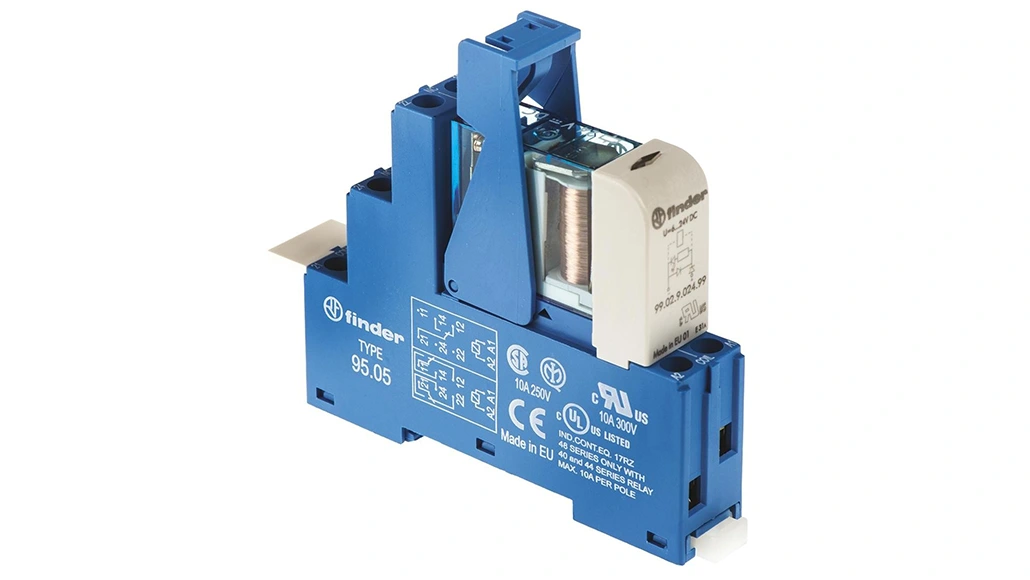

Relays are a big part of industrial systems as they allow small signals, such as those from sensors, to control a much larger electrical load. They are therefore crucial for running systems like motors and pumps efficiently and safely.
But while they do the same job, relays operate differently depending on the underlying technology. We have electromechanical relays that are based on moving parts and solid state relays that just use electrical components.
When choosing relays for maintaining different systems, understanding the difference is important as the different types are suitable for different applications.
What is a relay?
A relay is an electrical switch that makes it possible for a low-power signal to control a higher-power circuit load safely. It’s widely used in industrial systems as it makes it possible for control panels or sensors to manage systems like motors. It’s more like a regular switch, but it’s meant to be operated automatically inside circuits.
Inside the component, a relay separates the control side from the power side. It then completes or breaks a circuit when it gets a signal.
Electromechanical relays (EMRs)
These relays have a physical arm that moves to turn the circuit on or off. The arm moves due to a magnetic field that the relay creates through a coil. The field pulls the arm and holds it in position, allowing current to pass. And when it breaks, the arm goes back to “off.” It’s a simple mechanism, but it has been proven in industrial systems for decades.
As these relays have a component that moves from one position to another, they tend to produce a click sound when they are switched. They are more common in tasks where durability and straightforwardness are priorities.
Solid state relays (SSRs)
Instead of a moving arm, these relays use semiconductor element to switch on or off. In most cases, these are thyristors, triacs and diodes. When a signal is applied, the semiconductor allows power to move through the circuit, effectively switching “on.” The switch is silent and happens almost instantly as there’s nothing that needs to move.
The design makes SSRs well-suited to machines and control panels that need quick or more frequent switching. They are mostly used to control heating elements and temperature systems.
As there are no moving parts that can wear down quickly, these relays tend to last longer compared to EMRs.
Key differences between EMRs and SSRs
Here are some quick comparisons of the two main types of relays.
| Feature | Electromechanical Relay (EMR) | Solid State Relay (SSR) |
| Switching method | Mechanical contacts (moving arm) | Semiconductor components |
| Moving parts | Yes | No |
| Switching speed | Moderate | Very fast |
| Sound/noise | Audible click | Silent |
| Lifespan | Limited due to contact wear | More suitable for high-frequency use |
| Heat generation | Minimal | Requires heat dissipation |
| Handling inrush current | Strong tolerance | May require protection |
Choosing the right relay for your application
Like most other electrical components, the first thing to look at the type of demands that your system has. Here, we are talking about the type of load, the operating environment, switching frequency, and the overall expected life span.
If your application requires a high inrush current to start a motor or some other heavy load, you’ll likely be better off with an electromechanical relay. I can handle those surges without issues, and it’s also a great option when you need to ensure that there’s no constant physical connection that can be compromised by inconsistent voltage.
If you need frequent switching, like in heating elements, a solid state replay will offer better performance as it’s fast and doesn’t wear quickly. It’s more reliable, but it also needs a bit of heat management.
When you evaluate the task with the different relay characteristics, it will help you choose a more suitable type and ensure your system can work more reliably in the long term.