


















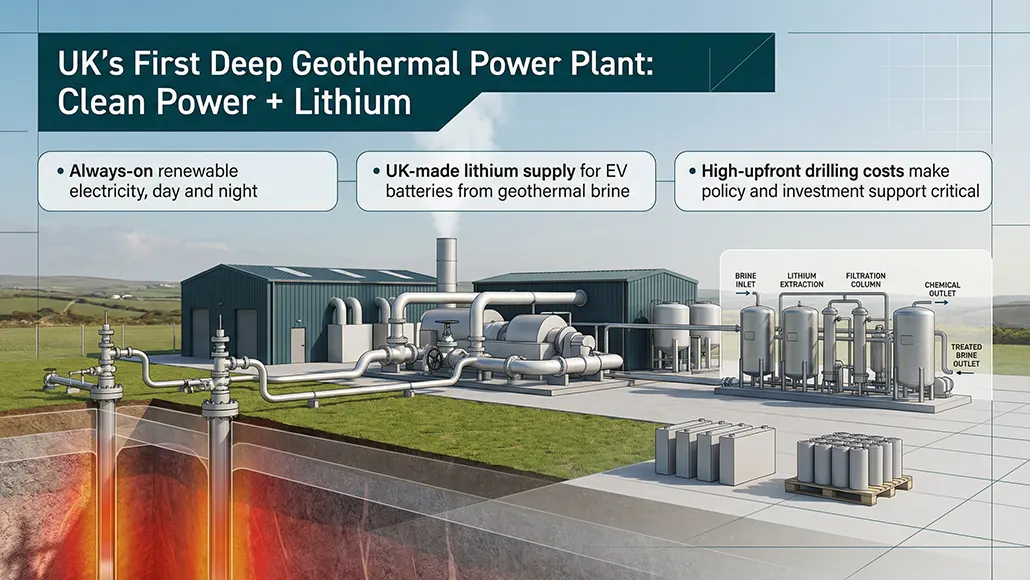

The UK’s first deep geothermal power plant has begun generating electricity at United Downs near Redruth in Cornwall, marking a milestone in the country’s renewable energy infrastructure while introducing a new domestic source of lithium for battery production. Developed by Geothermal Engineering Ltd (GEL) after nearly two decades of work, the £50m (US$63m/US$67.09m) facility combines baseload power generation with battery-grade lithium extraction, positioning geothermal as a continuous energy source with strategic industrial relevance.
The geothermal power plant draws superheated water exceeding 190°C from the UK’s deepest onshore borehole, drilled more than three miles (over 5km) into granite formations. Temperatures approach 200°C at depth, reflecting Cornwall’s geology, where heat increases by around 40°C per kilometre drilled double the typical UK gradient. Water is circulated through fractures in granite rock within the Porthtowan Fault Zone, heated at depth, and pumped to the surface. Steam drives a turbine to generate 3MW of continuous electricity before the cooled water reduced to around 50°C is reinjected underground to complete the cycle.
Electricity from the site has been sold to Octopus Energy under a long-term agreement and is delivered via the National Grid to meet the needs of up to 10,000 homes. Ryan Law, CEO of GEL, said: “Unlike other renewable sources like wind and solar we are constantly on, 24/7 electricity,” highlighting geothermal’s continuous generation profile and absence of fuel price volatility. An Octopus spokesperson described the development as “a genuine game-changer,” adding: “For the first time, we’re tapping into ‘always-on’ green power in the UK, providing a steady stream of clean, home-grown energy.”
Beyond power generation, the facility incorporates lithium carbonate extraction from mineral-rich geothermal brine. Initial output is expected to reach around 100 tonnes annually sufficient for batteries in approximately 1,400 electric vehicles. GEL has stated plans to scale production to 18,000 tonnes per year within a decade, potentially supplying around 250,000 EVs annually. The UK government contributed £1.8m (US$2.27m), covering 50% of the cost of the initial lithium extraction facility. China currently processes more than 60% of global lithium, underscoring the potential supply chain implications of domestic production. The British Geological Survey has estimated that UK demand for lithium could increase between 12 and 45 times during the 2020s.
Funding for the United Downs project has come from private investors and £15m (US$18.9m) from the European Development Fund, which the UK accessed prior to Brexit. The British Geological Survey described the plant as a “major step forward” for geothermal energy, while noting that high drilling costs could make replication challenging. Anne Murrell, Head of Geothermal UK, stated: “The challenges we have include investment, and to unlock investment and increase investor confidence, we need a supportive government policy framework – geothermal needs to be recognised by government as a key part of our energy strategy.”
Global investment in deep geothermal electricity has risen 80% year-on-year since 2018, according to the International Energy Agency, driven partly by growing electricity demand from data centres operated by Google, Meta and Microsoft. Data centre operators have increasingly explored geothermal as a source of stable, low-carbon power to support high and continuous energy loads.
GEL has two additional Cornwall sites in development targeting a combined 10MW of geothermal capacity and increased lithium output. One proposed site has been initially refused planning permission on environmental grounds, a decision the company is appealing. Deep geothermal generation is also technically feasible in Scotland and the north-east of England, though no projects have yet been approved.
The government’s appointment of Lord Whitehead as the UK’s first geothermal minister signals increased policy attention to the sector. Whether this translates into broader regulatory and financial support for deep geothermal expansion remains to be seen, particularly given the high upfront capital expenditure associated with drilling and infrastructure development.