
























The global transition to a smarter, more decentralized energy grid has introduced a new set of complexities for the professionals tasked with its maintenance and operation. In this rapidly changing environment, traditional safety measures are no longer sufficient to address the dynamic risks of high-voltage systems. Consequently, the industry is witnessing a surge in worker safety innovations grid operations that are redefining the boundaries of occupational health and safety. These innovations, ranging from wearable sensors to AI-driven hazard analysis, are creating a more transparent and responsive safety ecosystem. By embracing worker safety innovations grid operations, utility companies are building a foundation of resilience that protects their most valuable asset their people while maintaining the continuous flow of energy to society.
The core philosophy behind worker safety innovations grid operations is the shift from a reactive safety model to a proactive, data-driven one. For decades, safety improvements were often triggered by incident reports and post-accident investigations. Today, worker safety innovations grid operations allow organizations to identify and neutralize threats before they manifest. By integrating smart technology into the daily routines of the power transmission workforce safety, the industry is creating a “digital safety net” that monitors both the environment and the individual in real-time. This level of oversight was once a futuristic ideal but is now an operational reality that is significantly reducing the frequency and severity of workplace accidents.
The Role of IoT and Wearable Technology
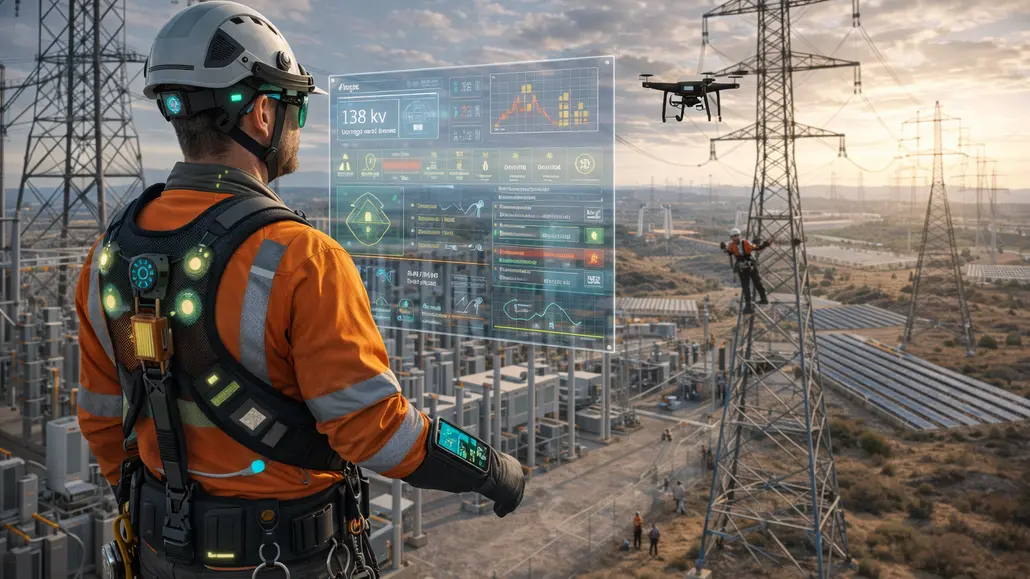
At the heart of modern worker safety innovations grid operations is the Internet of Things (IoT). Wearable devices have become an essential component of the lineman’s toolkit, providing a constant stream of information about their physical state and their proximity to danger. Smart vests and helmets equipped with biometric sensors can track heart rate, body temperature, and even detect the early signs of physical fatigue. When a worker’s vitals deviate from a safe baseline, worker safety innovations grid operations can trigger an alert, allowing the supervisor to intervene before a collapse or error occurs. This focus on the physiological well-being of the worker is a major advancement in grid safety systems.
Furthermore, worker safety innovations grid operations include the use of high-voltage proximity detectors that provide audible and haptic feedback when a technician approaches an energized zone. These devices are particularly critical in complex substations or during emergency storm response where the boundaries between safe and hazardous areas can be blurred. By providing an immediate and unmistakable warning, these worker safety innovations grid operations serve as a vital last line of defense against electrical contact. The integration of GPS tracking within these wearables also ensures that help can be dispatched to the exact location of a worker in the event of an emergency, a feature that is indispensable for those working in remote or isolated regions of the transmission network.
Fall Prevention Technology and Structural Safety
Falls from height remain one of the most significant risks in the power sector, and as such, fall prevention technology is a primary focus of worker safety innovations grid operations. We are seeing a revolution in the design of fall arrest systems that utilize kinetic energy absorption to minimize the physical impact of a fall. Modern worker safety innovations grid operations include the use of self-retracting lifelines (SRLs) that are specifically engineered for the high-anchorage demands of transmission towers. These systems provide the freedom of movement necessary for complex technical work while offering an instantaneous locking mechanism that limits the free-fall distance to mere inches.
In addition to personal equipment, worker safety innovations grid operations are being integrated into the infrastructure itself. The use of permanent horizontal and vertical lifelines on lattice towers ensures that workers are protected during every stage of their ascent and descent. These structural worker safety innovations grid operations reduce the reliance on temporary rigging, which can be prone to human error or environmental degradation. By treating fall protection as a permanent feature of the power transmission network, organizations are creating an environment where safety is inherent to the workspace rather than an add-on. This long-term investment in safety advancements is a clear indicator of a mature and professional safety culture.
AI-Driven Hazard Analysis and Predictive Safety
The next frontier of worker safety innovations grid operations lies in the application of artificial intelligence and machine learning. By analyzing vast amounts of historical safety data alongside real-time environmental conditions, AI can predict the likelihood of an incident occurring at a specific site or during a specific task. This level of predictive safety allows for a more strategic allocation of safety resources, ensuring that the most dangerous jobs receive the highest level of oversight and protection. Worker safety innovations grid operations that utilize these predictive models are transforming how safety managers approach risk assessment and project planning.
AI is also being used to analyze video feeds from drones and mast-mounted cameras to identify unsafe behaviors or hazardous site conditions in real-time. For example, worker safety innovations grid operations can automatically detect if a worker is not wearing their harness correctly or if a piece of heavy machinery is operating too close to a crew. These automated safety audits provide a level of continuous oversight that is impossible for human supervisors to maintain alone. By leveraging the power of AI, worker safety innovations grid operations are creating a more disciplined and aware workforce, where the principles of safety are reinforced by objective, data-driven feedback.
Enhancing Training through Immersive Simulations
The preparation of the workforce is another area where worker safety innovations grid operations are making a significant impact. Virtual Reality (VR) and Augmented Reality (AR) are being used to create immersive training environments that replicate the high-stakes reality of grid maintenance. Workers can practice complex procedures, such as live-line work or emergency rescue, in a risk-free digital setting. These worker safety innovations grid operations allow technicians to build muscle memory and procedural confidence before they ever set foot on a live tower. The ability to fail safely and learn from mistakes in a simulation is a powerful tool for building a more resilient and skilled workforce.
In conclusion, the integration of worker safety innovations grid operations is fundamentally strengthening the integrity and reliability of our energy networks. These innovations provide a sophisticated, multi-layered approach to protection that addresses the physical, environmental, and informational challenges of modern power work. By embracing technology and a culture of continuous improvement, the utility industry is proving that it is possible to modernize the grid while simultaneously elevating the standards of worker protection. The journey toward a zero-incident workplace is driven by the constant pursuit of worker safety innovations grid operations, ensuring that the individuals who power our world are protected by the most advanced systems available.