















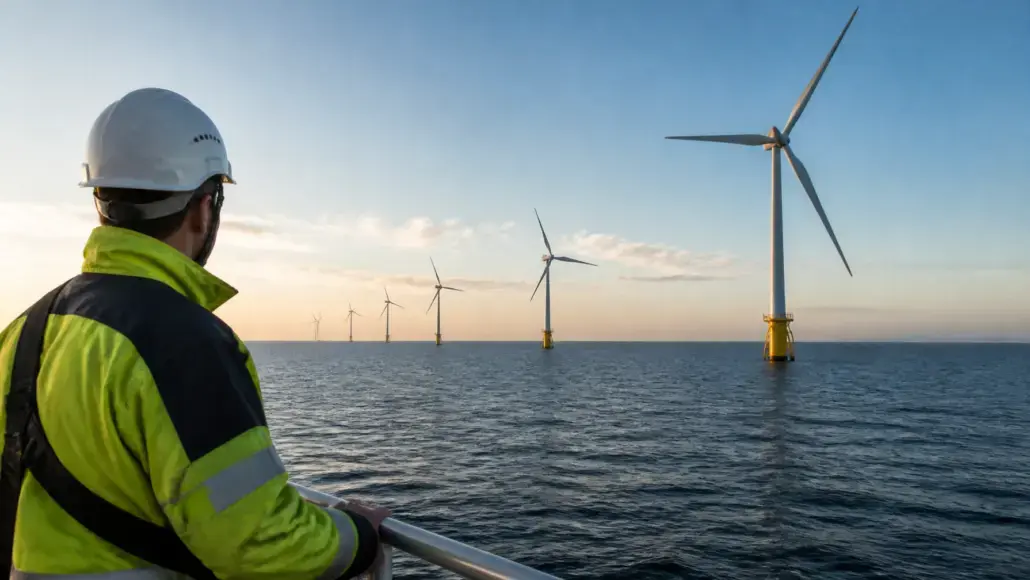

Germany’s Federal Maritime and Hydrographic Agency (BSH) has published a preliminary draft of its updated Site Development Plan (FEP), outlining a pathway to increase the country’s offshore wind capacity from approximately 11 GW to 70 GW by 2045.
Published on 22nd October 2026, the preliminary draft initiates the process of amending and updating the 2025 Site Development Plan. It builds on the current draft amendment to Germany’s Offshore Wind Energy Act (WindSeeG) and addresses future offshore wind development areas, coordination with grid connections and potential cross-border projects.
Alongside the draft plan, the BSH has released a draft scoping document for the Strategic Environmental Assessment, supported by maps and additional studies. Authorities and members of the public have until 3rd December 2026 to submit comments as part of the consultation process.
Germany Identifies 14 Areas for Offshore Wind Development
The preliminary draft proposes designating 14 areas for future offshore wind projects across several planning zones. According to the German Offshore Wind Energy Association (BWO), the proposed areas include four sites in zone N-14, eight in N-16, and two additional sites identified as N-6.9 and N-12.7.
The draft also identifies 13 further sites for potential future development. These additional areas are not expected to receive formal designation during the current planning process.
BWO has welcomed the proposed site sizes of approximately 1 GW each and the BSH’s plans to carry out centralised preliminary investigations of additional sites. The association believes these measures could broaden participation in offshore wind auctions, strengthen competition and reduce planning risks.
The preliminary draft also proposes an average adjusted power density of 7.3 MW/km² for new sites in zones 4 and 5. This is below the general upper limit of 8 MW/km² advocated by BWO.
Power density determines the installed generation capacity within a given offshore area. The association supports a lower density approach to help reduce wake effects between turbines and improve electricity generation.
Cross-Border Projects Could Support Offshore Wind Generation
International cooperation is another element of Germany’s updated offshore wind planning framework. The preliminary draft allows cross-border projects to contribute towards the country’s national capacity targets.
BWO has highlighted cooperation with Denmark as an opportunity to develop offshore wind projects connected across national borders. The association referred to a joint study with the German Association of Energy and Water Industries (BDEW), which examined the relationship between turbine density, cross-border connections and electricity generation.
According to the study, lower power densities in German waters, combined with connections to offshore wind farms in neighbouring countries, could increase electricity generation while reducing costs per kilowatt-hour.
The proposed approach places cross-border coordination alongside domestic site designation and grid planning as Germany works towards its offshore wind expansion target.
Industry Calls for Contracts for Difference in Future Auctions
While welcoming the long-term planning framework, BWO has stressed that Germany’s offshore wind ambitions will also depend on investment conditions and regulatory certainty. The association argues that the ongoing amendment to the Offshore Wind Energy Act should introduce mechanisms that improve project financing and support investment decisions.
BWO is calling for indexed, two-sided Contracts for Difference (CfDs) to be used in all future offshore wind auctions instead of a two-stage model.
Stefan Thimm, Managing Director of BWO, said the preliminary draft provides a long-term outlook for offshore wind development, while emphasising the need for political and regulatory conditions that enable planned sites to translate into investment.
Contracts for Difference can help reduce revenue uncertainty by linking payments to an agreed reference price. BWO’s proposal reflects its position that the future auction framework should provide greater predictability for offshore wind investments.
BWO Questions a Uniform Overbuilding Requirement
The association has also raised concerns about a proposed uniform requirement for offshore wind farms to install generation capacity 10% above their grid connection capacity.
Overbuilding allows a wind farm’s installed capacity to exceed the maximum power its grid connection can transmit. Although this can increase the use of grid infrastructure when generation is below the connection limit, it may also raise investment costs and lead to additional curtailment during periods of high wind generation.
A study by Frontier Economics, commissioned by BWO and BDEW, found that the economically optimal level of overbuilding ranges from 5% to 10%, depending on site-specific conditions.
On this basis, BWO supports setting individual requirements for each offshore wind site rather than applying a uniform percentage across all projects. The association argues that site-specific assessments would better reflect differences in project conditions and economics.
Grid Development Must Align With Offshore Wind Construction
Coordinating offshore wind construction with the availability of grid connections remains another planning priority. BWO has emphasised that the development sequence for projects scheduled to enter operation by 2038 should support a steady expansion aligned with grid infrastructure timelines.
The association has also welcomed the draft’s integrated approach to extending the operating life of existing offshore wind farms and planning the future reuse of their sites.
BWO is calling for grid connections to remain available until decommissioning activities have been completed. It also wants dismantling work and subsequent construction plans to be coordinated sufficiently in advance.
These issues form part of the wider challenge of aligning offshore wind development, electricity transmission and the management of existing infrastructure as Germany plans for additional capacity.
Consultation Will Inform the Updated Site Development Plan
BWO plans to review the preliminary draft’s detailed provisions with its member companies during the public consultation period before submitting its comments in early December.
The consultation provides an opportunity for stakeholders to respond to proposed offshore wind areas, environmental assessment requirements, grid coordination and other planning provisions before the updated plan is finalised.
Until the revised Site Development Plan is formally adopted, the 2025 plan, as most recently amended, will remain in force.
The preliminary draft sets out a pathway towards Germany’s target of 70 GW of offshore wind capacity by 2045. Its implementation will depend on the final planning framework, investment conditions, grid infrastructure development and coordination between national and cross-border projects.