



































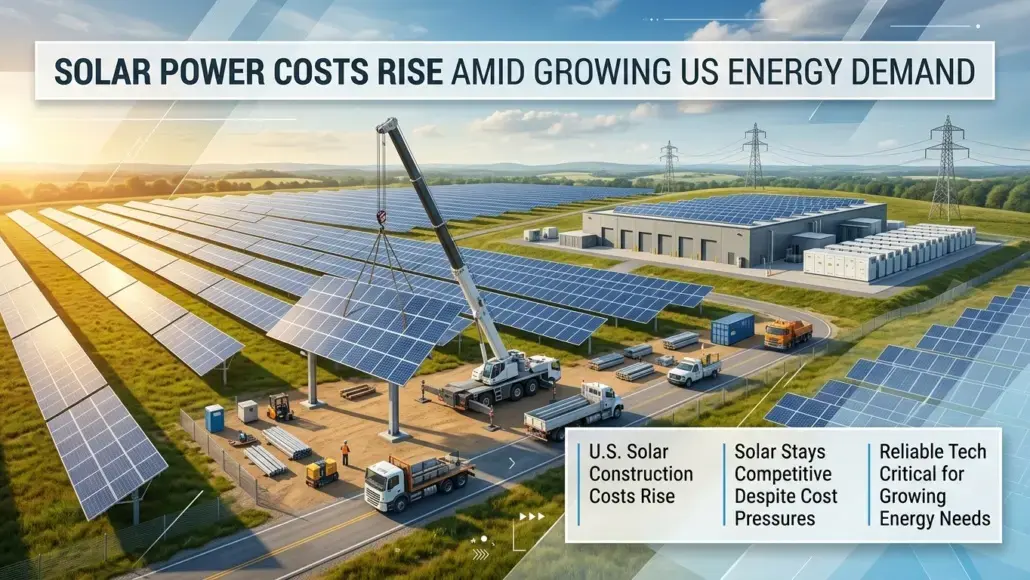

The financial advisory firm Lazard released an annual report on Monday indicating that the expense associated with constructing solar power projects in the United States has surged by 18% over the past year. This increase is attributed to a combination of tariffs, elevated interest rates, and various other cost pressures. Despite these rising figures, the report confirms that this specific renewable energy source continues to be the most economical form of new electricity generation available for construction. Simultaneously, the levelized cost of energy for new combined-cycle natural gas plants has reached a 15-year peak. Lazard has cautioned that these costs may continue to escalate as the market faces pressure from equipment shortages and a significant surge in power demand.
Impact of Economic Pressures on Renewable Energy
This record-breaking demand for electricity in the United States is being propelled by the expansion of data centers and the ongoing electrification of various sectors, including transportation. Such growth has intensified the requirement for new generating capacity while concurrently driving up capital costs. According to Lazard’s findings, the levelized cost—representing the average expense of producing a unit of electricity over a power plant’s operational lifespan—for utility-scale solar has climbed to a range of $40-$98 per megawatt hour, up from the previous year’s range of $38-$92 per MWh. The firm noted that data centers are a primary driver of this capacity need, which in turn impacts the overall capital costs of development.
Factors Driving the Increase in Development Expenses
Samuel Scroggins, who serves as the head of renewables and sustainable infrastructure at the firm, noted that the levelized Solar Power Costs, along with storage costs, have risen due to several influential factors. These include elevated interest rates and inflationary pressures stemming from tariff pass-throughs. Additionally, the repricing of supply chains as they transition away from China toward other regions, such as Southeast Asia, has contributed to the upward trend. Even with these shifts, renewable energy options like onshore wind remain a primary choice for new capacity. Onshore wind costs also saw an increase, moving to a range of $37-$99 per MWh from the prior $37-$86 per MWh.
The report emphasizes that even when factoring in the expenses required to back up intermittent renewable energy to maintain grid reliability, solar and wind projects remain broadly competitive against new gas-fired options. This highlights the significant role that renewable energy is expected to play in addressing the nation’s rising power needs while maintaining grid reliability. Meanwhile, the levelized cost for electricity generation over a plant’s operational lifespan for combined-cycle natural gas plants rose to between $51 and $129 per MWh. These natural gas plants remain a functional choice for utilities and developers due to their consistent power output, even as the industry navigates a complex landscape of Solar Power Costs.