





































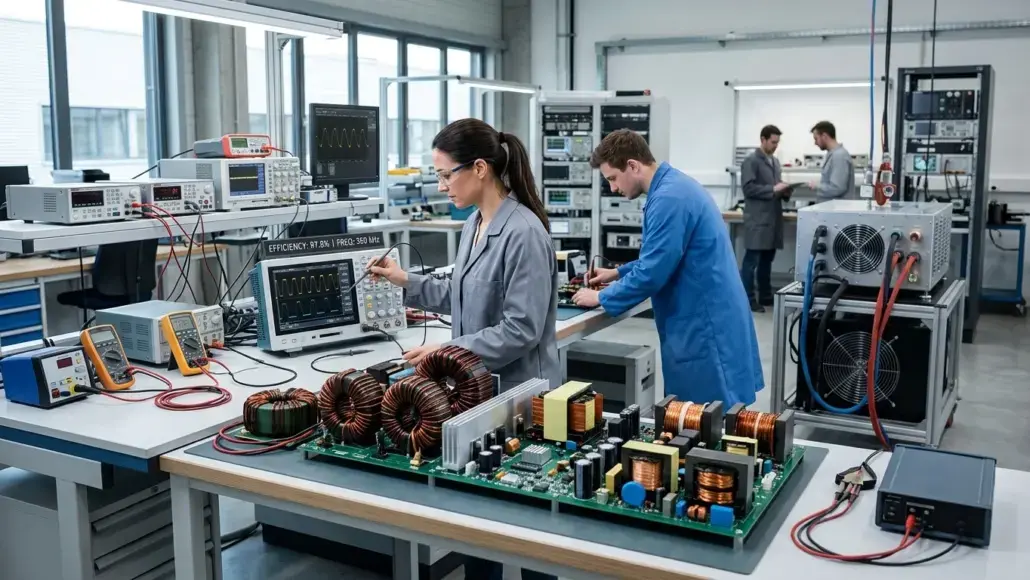

In the rapidly shifting landscape of power electronics, public and professional attention is often captivated by the spectacular advancements in semiconductor technology. We are frequently informed about the massive leaps in efficiency provided by silicon carbide or the ultra-high-speed switching capabilities of gallium nitride. However, there is a quieter, equally critical revolution taking place within the passive infrastructure of these systems. Specifically, the magnetic components modern power conversion depends upon primarily transformers and inductors are undergoing a transformation that is essential for the continued miniaturization and efficiency of our electrical devices. Without the corresponding evolution of these magnetic elements, the gains made in semiconductor technology would be severely stifled by bulky, inefficient and thermally limited passive components.
The Vital Role of Energy Storage and Voltage Transformation
Magnetic components are the fundamental building blocks for energy storage and voltage level shifting in almost every modern power converter. An inductor is used to store energy in its magnetic field to smooth out current ripples and maintain steady output, while a transformer allows for the safe isolation and precise scaling of voltage levels between the power source and the final load. In the context of magnetic components modern power conversion, the primary challenge has always been one of power density. As we demand more power from ever-smaller packages from the sleek chargers for our personal electronics to the compact power modules in electric vehicle drivetrains the magnetics must become smaller without sacrificing their performance or thermal integrity. This relentless pursuit of power density has led to a complete re-evaluation of how these components are designed, starting from the atomic structure of the core materials and moving to the complex geometric arrangement of the copper windings.
Breakthroughs in Advanced Magnetic Core Materials
The core of a magnetic component is responsible for channeling the magnetic flux, and its inherent material properties define the efficiency limits of the entire device. Traditionally, ferrite materials have been the mainstay of high-frequency power electronics due to their relatively low cost and acceptable performance levels. However, as modern switching frequencies push into the megahertz range, conventional ferrites begin to struggle with significant core losses and magnetic saturation. This has paved the way for the adoption of advanced magnetic materials, such as nanocrystalline and amorphous alloys.
These materials offer significantly higher permeability and a much lower coercive force, meaning they can handle greater flux density with far less energy lost as heat. In the world of magnetic components modern power conversion, utilizing a nanocrystalline core can often allow a transformer to be reduced to half its original physical size while maintaining the same efficiency. This is a critical factor for weight-sensitive and space-constrained applications like aerospace engineering, satellite communications, and high-performance automotive systems. By reducing the “iron losses” within the core, engineers can also manage thermal loads more effectively, leading to longer-lasting and more reliable power systems.
The Strategic Shift Toward High-Frequency Operation
One of the most effective strategies for reducing the physical size of magnetic components is increasing the switching frequency of the power converter. According to the fundamental laws of electromagnetism, the size of the required magnetic core and copper windings is inversely proportional to the frequency. By switching faster, we can utilize smaller inductors and transformers to achieve the same power output. However, high-frequency operation introduces its own set of “parasitic” problems, most notably the skin effect and the proximity effect in the windings.
These phenomena cause the alternating current to crowd at the edges of the conductors, effectively increasing the AC resistance and generating more heat than a DC signal would. To combat these issues, modern designs for magnetic components modern power conversion utilize specialized Litz wire which consists of hundreds of thin, individually insulated strands twisted together in a specific pattern or planar windings etched directly into multi-layer printed circuit boards. These advanced techniques are essential for keeping the magnetics viable at the extreme speeds demanded by the latest generation of GaN and SiC semiconductor switches.
Planar Magnetics and the Future of Integration
A significant and growing trend in high-end power supply design is the transition away from traditional wire-wound “bobbin” components toward planar magnetics. Planar transformers and inductors replace bulky copper wire with flat copper foils or traces on a PCB. This architectural approach offers several distinct advantages, including excellent repeatability in automated manufacturing, superior thermal management due to the high surface-area-to-volume ratio, and an extremely low physical profile.
For high-density data center power supplies, where vertical space is at a premium and cooling is a major expense, planar magnetic components modern power conversion solutions are becoming the industry standard. They allow for a much tighter integration with the rest of the electronic assembly, often being embedded directly into the motherboard or a daughter card. This close proximity also reduces the length of the interconnects, which minimizes the associated electromagnetic interference (EMI) and parasitic inductance that can plague high-speed power systems.
Thermal Management Strategies in Advanced Magnetic Design
Heat is the ultimate enemy of both efficiency and long-term reliability in power electronics. While engineers often focus on the heat generated by power transistors, magnetic components can also be significant heat sources due to their core and copper losses. Effective thermal management in magnetic components modern power conversion requires a holistic, system-level approach. Engineers are now employing thermally conductive potting compounds to help move heat away from the core and windings toward the outer casing or a dedicated heatsink.
Additionally, advanced computer-aided design (CAD) and finite element analysis (FEA) tools allow for the incredibly precise mapping of magnetic flux density and temperature gradients within the component before a physical prototype is even built. By optimizing the airflow around these components or utilizing liquid cooling in high-power applications—such as EV fast-charging stations the power handling capacity of a given magnetic design can be significantly increased without increasing its size.
Addressing the Complexity of EMI and Signal Integrity
As power converters switch faster and at higher voltages, they generate more electromagnetic noise. Magnetic components are uniquely positioned as both a potential source of this noise and its primary solution. A poorly designed inductor can act as an unintended antenna, radiating interference that disrupts nearby sensitive electronics or causes the device to fail regulatory compliance. Conversely, specialized magnetic devices like common-mode chokes are used to filter out this very noise.
In the design of magnetic components modern power conversion, the use of magnetic shielding and “low-leakage” geometries is becoming increasingly vital. By carefully managing the “leakage inductance” the flux that escapes the intended path within the core designers can not only reduce EMI but also improve the efficiency of the power transfer. This is particularly crucial in sensitive environments like medical operating rooms and telecommunications hubs, where signal integrity is non-negotiable and electrical noise can have serious consequences.
The Horizon: Smart Magnetics and Material Innovation
Looking toward the future, we are likely to see the emergence of “smart” magnetic components. By embedding miniature sensors or utilizing the properties of the magnetic material itself as a sensing element, it may be possible for the power management system to monitor the state of the magnetics in real-time. This would allow the converter to dynamically adjust its switching strategy to avoid core saturation or to optimize efficiency as the component heats up during peak loads.
Furthermore, the development of additive manufacturing (3D printing) for magnetic materials is a burgeoning area of research. This technology could allow for the creation of complex, non-linear core shapes that are physically impossible to manufacture with traditional pressing or casting methods. Such innovations would lead to even more efficient and compact magnetic components modern power conversion architectures, pushing the boundaries of what is possible in power electronics.
In conclusion, while they may lack the high-profile glamour of the latest processor or semiconductor chip, magnetic components are the unsung heroes of the green energy revolution and our increasingly digital world. The ongoing innovations in materials science, geometric design, and manufacturing processes are ensuring that these passive elements keep pace with the rapid advancements in the rest of the industry. As we move toward a world characterized by ubiquitous electric power and hyper-efficient devices, the role of magnetic components modern power conversion will only become more central to our technological success. They are the essential conduits of energy, and their continued optimization is a key pillar of modern engineering excellence.