


































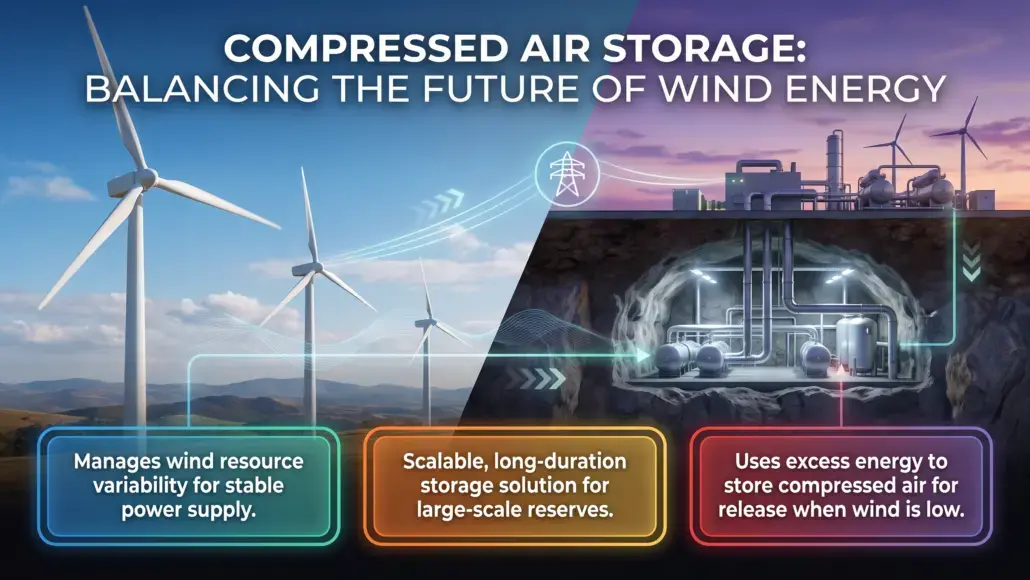

As wind energy penetration rises, managing the variability of atmospheric resources is a primary concern. Large-scale wind integration requires flexible reserves that balance fluctuations in power supply. Among the available mechanical reserves, compressed air storage offers a scalable solution for long-duration storage. This technology involves using excess electricity to compress air and store it in vast underground reservoirs, which is then released to generate electricity when wind speeds are low. The interest in compressed air storage is driven by its ability to provide ancillary services without geographical limitations. While batteries are effective for short-duration response, the volume of energy required to balance wind farms necessitates mechanical systems. By utilizing salt caverns, the power generation sector can create massive energy reserves. The integration of advanced thermodynamic cycles is improving round-trip efficiency, making them a competitive option for decarbonizing the grid.
Thermodynamic Principles of Diabatic and Adiabatic Storage
The efficiency of compressed air storage is fundamentally determined by how the heat generated during compression and the cooling required during expansion are managed. Traditional diabatic systems, such as those currently in operation in Germany and the United States, release the heat of compression to the atmosphere and utilize natural gas to reheat the air before it enters the expansion turbine. While these systems are highly reliable and offer high power density, their reliance on fossil fuels and their lower round-trip efficiency have led to a search for more sustainable alternatives. The thermodynamic cycle of a diabatic plant is essentially a variation of a conventional gas turbine, but with the compression and expansion phases separated in time.
Advanced adiabatic systems represent the next generation of compressed air storage, designed to achieve higher efficiencies without the use of external fuel. These systems capture the thermal energy generated during the compression phase and store it in specialized thermal energy storage units, such as rock beds or molten salts. When the stored air is needed for power generation, it is passed through the thermal reserve to regain its heat before entering the turbine. This approach significantly improves the round-trip efficiency of the process, with target rates of seventy percent or higher. The challenge for engineers is to design thermal storage systems that can withstand the high pressures and temperatures involved while maintaining their performance over thousands of cycles.
Isothermal systems are also being explored as a way to minimize the temperature changes during the compression and expansion phases. By injecting water spray into the compression chamber, the heat can be absorbed as it is generated, keeping the air at a constant temperature. This reduces the mechanical work required for compression and eliminates the need for complex thermal storage systems. While isothermal technology is still in the developmental phase, its potential for high efficiency and simpler system design makes it an attractive prospect for future wind integration projects. Each of these thermodynamic pathways offers different trade-offs in terms of cost, complexity, and efficiency, allowing for tailored solutions based on the specific requirements of the regional power market.
Geological Requirements for Subterranean Cavern Integration
The economic feasibility of large-scale compressed air storage is closely tied to the availability of suitable geological formations for underground reservoirs. Salt caverns are the preferred choice for high-pressure storage due to the unique properties of rock salt. Salt is naturally impermeable to gases and has a “self-healing” property that allows it to seal small cracks, ensuring the integrity of the reservoir over decades of operation. These caverns are created through solution mining, where water is pumped into a salt deposit to dissolve the rock and create a precisely engineered cavity. The shape and volume of the cavern can be optimized to handle the rapid pressure cycling required for balancing intermittent wind power.
Depleted natural gas fields provide additional options for compressed air storage. However, these formations present technical challenges in air purity. Compressed air can interact with residual hydrocarbons, potentially leading to corrosion. Managing flow rates in porous rock is complex. Repurposing oil and gas infrastructure provides an opportunity for reducing the cost of new storage projects. Site selection requires geological surveying to ensure the reservoir can withstand mechanical stresses. The stability of cavern walls and the integrity of wellhead seals are critical for safety. As the industry scales, the development of regional storage hubs can provide the reserves needed to support wind-dominated grids. This geological approach turns the subterranean environment into a component of clean energy infrastructure.
Efficiency Metrics in Large-Scale Mechanical Energy Reserves
To evaluate the performance of compressed air storage, engineers use a range of efficiency metrics that account for both the mechanical and thermal components of the cycle. Round-trip efficiency, the ratio of the electrical energy recovered during discharge to the electrical energy used during charging, is the primary indicator of the system’s economic value. In modern adiabatic designs, this metric is heavily influenced by the effectiveness of the thermal energy storage and the aerodynamic efficiency of the compression and expansion machinery. Improving these components requires precision engineering and the use of advanced materials that can operate at high temperatures and pressures.
Another critical metric is the power density of the plant, which determines the rate at which energy can be stored or released. For wind integration, the ability to rapidly ramp production up or down is essential for responding to sudden changes in wind speed or grid demand. Compressed air storage plants can provide fast frequency response and spinning reserves, competing directly with gas-fired peaking plants. The mechanical inertia of the massive turbomachinery also provides natural stability to the grid, helping to maintain the system frequency in the face of sudden disturbances. This combination of high energy capacity and rapid response makes compressed air a valuable asset for grid operators managing high levels of variable renewables.
The levelized cost of storage is the ultimate measure of the technology’s competitiveness. This metric includes the capital cost of the facility, the cost of the electricity used for charging, and the long-term operations and maintenance expenses. While the initial investment for a large-scale compressed air plant is high, its long operational life,often exceeding forty years,and its low maintenance requirements compared to electrochemical batteries lead to a very competitive lifecycle cost. As the price of carbon rises and the value of grid flexibility increases, the economic case for compressed air storage continues to strengthen, making it a central pillar of the long-term strategy for wind energy integration.
Operational Balancing of Intermittent Renewable Inputs
The primary role of compressed air storage is to bridge the gap between the supply of wind energy and the demand for electricity. During periods of high wind speed and low demand, such as overnight or during the spring and autumn months, the excess power generated by wind farms can lead to grid congestion and negative pricing. Instead of curtailing this clean energy, it can be captured by compressed air systems, effectively “shifting” the wind generation to periods when it is more valuable. This operational balancing is essential for maximizing the utilization of the wind fleet and for ensuring that the transition to renewables does not lead to a reduction in grid reliability.
Integrating storage with wind farms also allows for more predictable power scheduling. By using the storage reservoir to smooth out the fluctuations in wind output, developers can provide “firm” capacity to the market, which is often rewarded with higher capacity payments and more favorable power purchase agreements. This reduction in the volatility of wind power makes it a more attractive option for large corporate energy buyers and utilities who require a stable supply of electricity. The ability to manage the intermittency of wind at the source also reduces the need for expensive transmission upgrades, as the storage facility can act as a buffer for the regional grid.
Advanced control algorithms and forecasting models are used to optimize the charging and discharging cycles of the storage plant. By analyzing historical wind patterns and real-time market signals, the plant’s management system can determine the most profitable times to store or release energy. This sophisticated approach to energy management ensures that the storage asset provides the maximum benefit to the grid while maximizing the return on investment for the operator. As the grid becomes more complex and the share of variable renewables grows, the role of intelligent storage systems in balancing the power system will only become more critical.
Integration Strategies for Regional Power Grid Stability
The integration of large-scale compressed air storage into the regional power grid requires a coordinated strategy between storage operators, wind developers, and transmission system operators. At the regional level, storage facilities can provide a wide range of ancillary services that are essential for maintaining the stability and security of the power system. This includes black-start capability, where the storage plant can provide the initial power needed to restart the grid after a major blackout. The high reliability and long-duration capacity of compressed air systems make them ideal for this critical safety role.
Strategic placement of storage facilities near wind hubs helps mitigate grid congestion. By absorbing wind power locally, the storage plant prevents transmission lines from becoming overloaded. This localized balancing improves voltage stability. As more wind capacity is added, the need for stabilizing services will increase, making compressed air storage an essential component of future grid architecture. Long-term planning for energy storage must account for evolving regulatory frameworks. Reforming markets to recognize the system-wide benefits of compressed air storage is essential for encouraging investment. By providing a predictable revenue stream for storage projects, policymakers can accelerate the integration of wind energy. The continued development of compressed air storage remains a focus for the power generation industry as it seeks to meet the challenges of the energy transition.