


























Hydropower has long been considered one of the most stable and mature forms of renewable energy. Yet, beneath this perception of reliability lies a growing challenge: much of the world’s hydro infrastructure is aging. Turbines installed decades ago are now operating under conditions they were never designed for variable water flows, evolving grid demands, and stricter efficiency expectations.
In response, the industry is undergoing a quiet but significant transformation. Hydropower digitalization combined with turbine modernization is emerging as a critical strategy to extend asset life, enhance efficiency, and align hydro plants with the demands of modern energy systems.
Why Turbine Upgrades Are No Longer Optional
Hydropower turbines are engineered for longevity, often operating for 30 to 50 years or more. However, longevity does not equate to optimal performance.
Over time, several issues emerge:
- Mechanical wear reduces efficiency
- Outdated designs limit adaptability to fluctuating water conditions
- Increased maintenance frequency impacts operational costs
- Performance gaps widen compared to modern turbine technologies
At the same time, grid expectations have changed. Hydropower plants are no longer just base-load generators they are increasingly required to provide flexibility, rapid ramping, and grid balancing.
This shift makes turbine upgrades less of a technical improvement and more of a strategic necessity.
What Modern Turbine Upgrades Actually Deliver
Turbine modernization is not simply about replacing old components. It involves a combination of design optimization, material improvements, and performance engineering.
Key upgrade outcomes include:
- Higher efficiency levels, often improving output without increasing water usage
- Enhanced flexibility, enabling better response to variable flow conditions
- Reduced cavitation and wear, extending equipment lifespan
- Improved reliability, lowering unplanned downtime
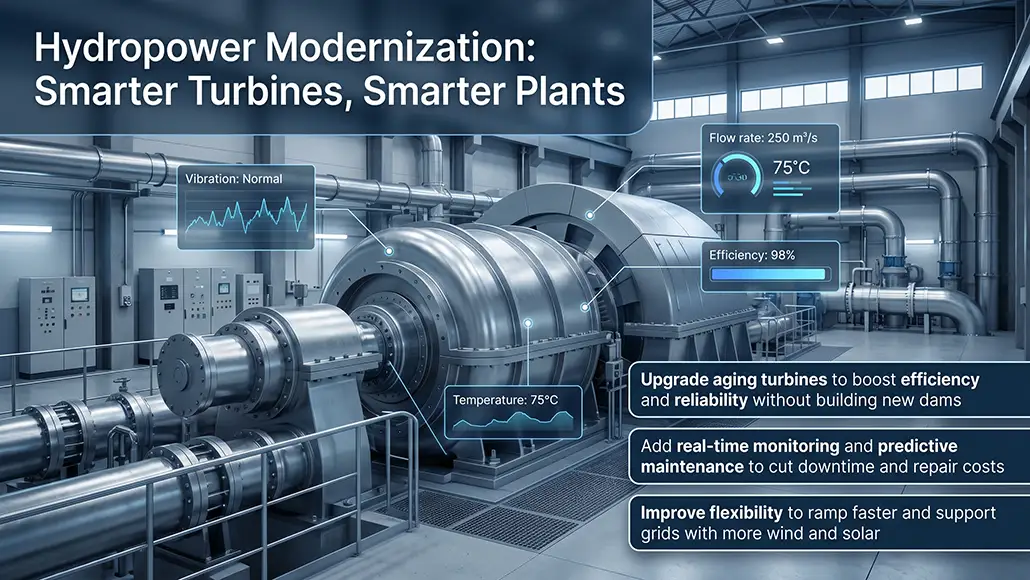
In many cases, upgraded turbines can increase plant capacity without major civil infrastructure changes. This makes modernization a cost-effective alternative to building new hydro facilities.
Digitalization: Turning Hydro Plants into Smart Assets
While turbine upgrades address mechanical performance, hydropower digitalization introduces a new layer of intelligence into plant operations.
Digital technologies are transforming hydro plants in several ways:
Real-Time Monitoring
Sensors continuously track parameters such as vibration, temperature, flow rates, and turbine efficiency. This provides operators with a live view of plant performance.
Predictive Maintenance
Advanced analytics can identify early signs of component failure, allowing maintenance to be scheduled before breakdowns occur. This reduces downtime and lowers repair costs.
Performance Optimization
Digital systems analyze operational data to optimize turbine settings, maximizing efficiency under varying conditions.
Remote Operations
Control systems enable centralized monitoring and management of multiple plants, reducing the need for on-site intervention.
The result is a shift from reactive operations to data-driven, proactive management.
The Convergence: Where Turbines Meet Data
The real transformation happens when turbine upgrades and digitalization are implemented together.
Modern turbines generate high-resolution operational data. When integrated with digital platforms, this data can be used to:
- Fine-tune performance in real time
- Adjust operations based on water availability
- Improve coordination with grid requirements
- Extend asset lifespan through optimized usage
This convergence creates a feedback loop where mechanical performance and digital intelligence continuously reinforce each other.
Efficiency Gains Beyond Generation
One of the most compelling outcomes of hydropower digitalization is that efficiency improvements extend beyond energy generation.
They also impact:
- Water utilization efficiency, maximizing output per unit of water
- Operational costs, through reduced maintenance and downtime
- Grid integration, enabling smoother interaction with intermittent renewables
- Environmental performance, by optimizing flow management and reducing waste
In an era where resource efficiency is critical, these gains are becoming increasingly valuable.
Retrofitting vs New Builds: A Strategic Advantage
Building new hydropower plants involves significant capital investment, regulatory approvals, and long development timelines. In contrast, upgrading existing infrastructure offers a faster and more economical pathway to capacity enhancement.
Retrofitting turbines and integrating digital systems allows operators to:
- Increase output without new dam construction
- Extend the life of existing assets
- Improve return on existing capital investments
- Align legacy plants with modern grid requirements
This makes modernization a key strategy for utilities and operators looking to balance cost, performance, and sustainability.
Challenges Slowing Adoption
Despite clear benefits, the adoption of turbine upgrades and digitalization is not without challenges.
Common barriers include:
- High upfront investment for modernization projects
- Integration complexities with legacy systems
- Limited digital expertise within traditional hydro operations
- Concerns around cybersecurity in connected systems
Additionally, decision-making can be slow in large infrastructure projects, where upgrades must be carefully planned to avoid operational disruptions.
However, as performance gaps widen between modernized and non-modernized plants, the cost of inaction is becoming more apparent.
The Role of Hydropower in a Renewable Grid
The broader energy transition is adding urgency to hydro modernization.
With increasing penetration of solar and wind, grids require flexible and dispatchable energy sources. Hydropower is uniquely positioned to fulfill this role but only if it can operate with the required responsiveness and efficiency.
Upgraded turbines and digital systems enable hydro plants to:
- Ramp output quickly to balance intermittent renewables
- Provide frequency regulation and grid stability
- Operate more efficiently under variable load conditions
This positions hydropower not just as a renewable source, but as a critical enabler of the energy transition.
A Shift in How Hydro Assets Are Valued
Traditionally, hydropower assets were valued based on installed capacity and generation output. Today, additional factors are coming into play:
- Flexibility and responsiveness
- Operational efficiency
- Digital capability
- Lifecycle performance
Modernized plants equipped with advanced turbines and digital systems are increasingly seen as higher-value assets, both operationally and financially.
As highlighted across industry coverage in Power Info Today, this shift reflects a broader trend where infrastructure value is increasingly tied to performance intelligence, not just physical capacity.
Conclusion: Modernization as a Strategic Imperative
The future of hydropower will not be defined solely by new projects, but by how effectively existing assets are upgraded and optimized.
Hydropower digitalization, combined with turbine modernization, offers a pathway to:
- Enhance efficiency without new construction
- Extend the lifespan of critical infrastructure
- Improve alignment with modern grid requirements
- Strengthen the role of hydro in a renewable energy mix
For operators and utilities, the question is no longer whether to modernize, but how quickly and effectively it can be done.
In a sector built on long-term assets, the ability to adapt through technology will determine which plants remain competitive and which are left behind.