























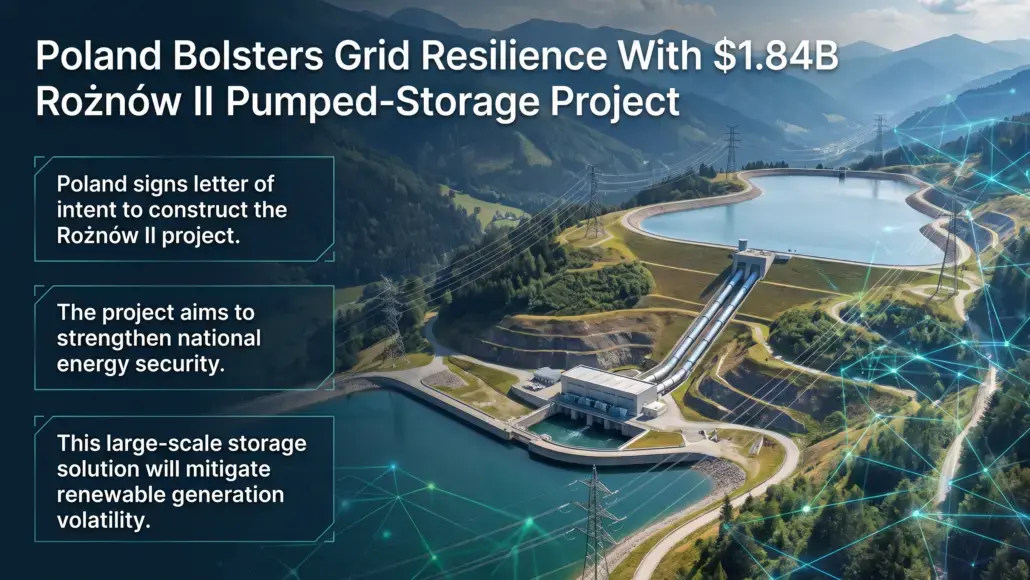

The structural transformation of the European energy landscape is increasingly predicated on the development of large-scale, flexible storage solutions that can mitigate the volatility of renewable generation. In a decisive move to strengthen national energy security, Poland’s Ministry of Energy and Tauron Polska Energia have signed a letter of intent to cooperate on the construction of the Rożnów II project. Valued at PLN 7 billion (approximately US$ 1.84 billion), the 767 MW/3.1 GWh facility represents a cornerstone of Poland’s strategy to expand pumped-storage energy projects across its domestic grid. Located in the foothills of the Beskidy Mountains in southern Poland, the project is designed to utilize the existing Rożnów hydropower reservoir on the Dunajec river as its lower reservoir, effectively integrating legacy infrastructure with modern energy management capabilities.
The agreement, finalized on July 15, was signed by Miłosz Motyka, Minister of Energy, alongside Tauron CEO Grzegorz Lot and Vice President Michal Orlowski. The initiative aligns with a broader governmental mandate to ensure that the rapid growth of variable renewable energy is supported by a resilient and responsive power system. “There can be no safe energy transformation without modern energy storage. Poland’s energy security today requires not only new sources of energy generation but also the ability to store it effectively,” stated Minister Motyka. “Therefore, we consider the development of large-scale energy storage facilities to be one of the priorities in building a modern, flexible, and resilient power system.”
Development Timeline and Economic Impact
The Rożnów II project is currently in its preparatory stage, having completed basic engineering design in 2025. This technical foundation is now being utilized to draw up environmental impact assessments and proceed with hydrological and geological studies. A critical milestone was reached in November 2025 when the national Transmission System Operator (TSO), PSE, granted power grid connection conditions for the site. Tauron has already secured the majority of the land required for the development and anticipates obtaining a final environmental permit and investment siting decision by 2027. If the current timeline holds, construction is slated to begin in 2028, with the facility reaching full operational status by 2034.
Beyond its primary role in balancing grid fluctuations, the project is expected to deliver significant domestic economic benefits and environmental safeguards. Tauron estimates that approximately 80 percent of the project’s total value could remain within the Polish economy through the engagement of local engineering teams, contractors, and suppliers. Furthermore, the facility will provide enhanced flood protection for the surrounding region by allowing Lake Rożnowskie to absorb up to 10 percent of the Dunajec River’s flood wave flow during extreme weather events. This multi-functional approach to infrastructure highlights the strategic value of pumped-storage energy projects in addressing both energy and climate resilience.
Scaling National Storage Capacity
Poland’s current pumped-storage capacity of 1,767 MW—comprising 1,383 MW from pure pumped-storage plants and 383 MW from mixed facilities—is increasingly viewed as insufficient to handle the complexities of a modernizing grid. To address this gap, the Polish government announced plans in 2023 to develop an additional 5.5 to 6 GW of pumped-storage capacity. Rożnów II is one of several large-scale developments aimed at reaching this target by the early 2030s.
Other major projects in the national pipeline include the 1,050 MW Młoty facility, which offers 4 GWh of storage capacity, and the 1,040 MW Tolkmicko project, which is designed for a storage capacity of up to 12 GWh. Together, these initiatives represent a combined storage potential of approximately 16 GWh. By prioritizing these massive infrastructure builds, Poland aims to create a robust buffer against the intermittency of wind and solar power, ensuring that its energy transformation remains grounded in stability and technological sovereignty.