

















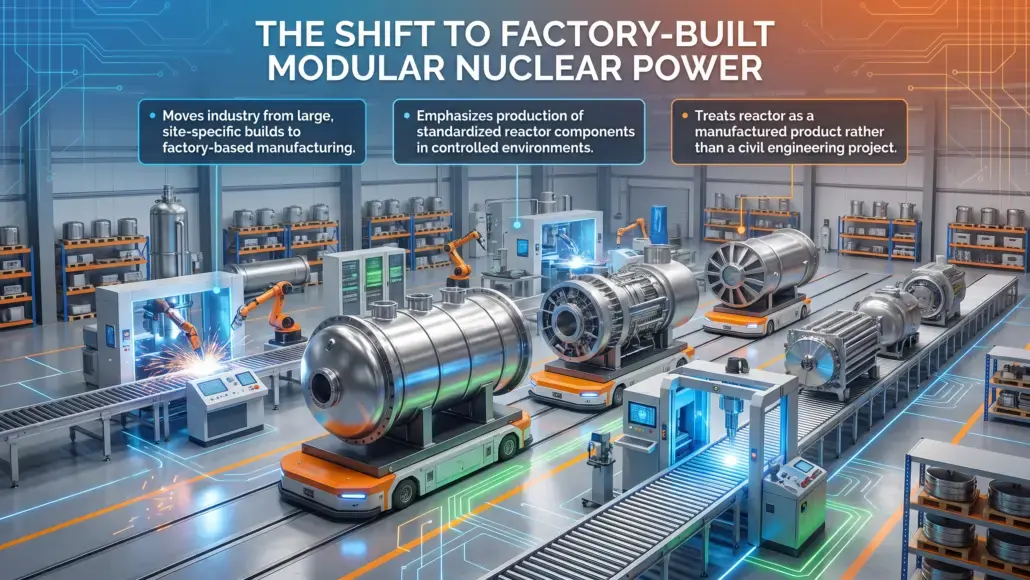

The paradigm of nuclear energy construction is undergoing a fundamental shift as the industry moves away from large scale, site specific builds toward factory based manufacturing. This evolution is driven by the emergence of modular nuclear power, a concept that emphasizes the production of standardized reactor components in controlled industrial environments. By treating the reactor as a manufactured product rather than a civil engineering project, the sector aims to address the chronic issues of schedule delays and cost overruns that have historically challenged traditional nuclear developments. This shift is not merely about size but about a comprehensive change in the philosophy of power plant delivery, focusing on reproducibility and quality control at every stage of the fabrication process.
Central to this transition is the development of Small Modular Reactors (SMRs), which are designed to be transported in sections from a central factory to their final destination. This approach allows for the simultaneous preparation of the site and the fabrication of the reactor core, significantly compressing the overall project timeline. As the global demand for reliable, dispatchable power continues to rise, the ability to deploy nuclear capacity in smaller, more manageable increments offers a compelling solution for utility operators and industrial energy consumers. The following examination details the technical and economic mechanisms through which factory built reactors are altering the trajectory of the nuclear energy sector.
Standardization and Supply Chain Optimization in Reactor Fabrication
The move toward modular nuclear power relies heavily on the principles of industrial standardization. In the traditional nuclear model, each plant was often a unique design, requiring specialized engineering and one off components that drove up costs and complicated the supply chain. In contrast, modular designs are built around a set of identical components that can be produced in large volumes. This standardization allows manufacturers to optimize their production lines, investing in specialized tooling and automated processes that improve precision and reduce the likelihood of human error. By producing dozens or hundreds of identical units, the industry can achieve a level of quality assurance that is difficult to match in a field construction environment.
Supply chain optimization is a natural consequence of this standardized approach. When a reactor design is fixed, suppliers can commit to long term production schedules, allowing them to invest in their own infrastructure and workforce. This creates a more stable and predictable environment for the hundreds of companies involved in nuclear component manufacturing, from specialized alloy producers to electronics firms. The ability to source components from a reliable and qualified pool of suppliers reduces the risk of bottlenecks and ensures that high quality parts are available when needed. Additionally, the centralized nature of factory production makes it easier to implement advanced monitoring and tracking systems, providing real time visibility into the status of every component in the assembly process.
The integration of advanced manufacturing techniques such as robotic welding, 3D printing of metallic components, and automated non destructive testing further enhances the efficiency of the factory model. These technologies allow for the creation of complex geometries and high performance structures that would be challenging to produce using traditional methods. By moving these processes into a factory, the industry can maintain the stringent environmental controls required for high precision work, such as specialized atmospheres for welding or clean room conditions for sensitive instrumentation. This level of control is essential for ensuring the long term reliability and safety of advanced reactor systems.
Cost Reduction via Repetitive Factory Manufacturing Processes
One of the most significant advantages of modular nuclear power is the potential for cost reduction through the learning curve effect. In manufacturing, the cost of producing an item typically decreases as the cumulative volume of production increases, due to improvements in efficiency and the refinement of processes. By building reactors in a factory setting, the nuclear industry can finally capture these economies of scale. The first unit produced in a facility will always be the most expensive, but by the tenth or twentieth unit, the time and labor required for assembly will be significantly reduced. This repetitive process allows workers to become highly skilled in specific tasks and enables engineers to identify and eliminate inefficiencies in the design.
The shift to factory production also alters the financial structure of nuclear projects by reducing the amount of high interest capital tied up in long construction periods. Traditional reactors can take a decade or more to build, during which time the owner must pay interest on billions of dollars in loans without generating any revenue. Modular reactors, which can be assembled and commissioned in a fraction of that time, provide a much faster return on investment. This reduced duration significantly lowers the total cost of capital, making nuclear power more attractive to private investors and reducing the burden on taxpayers and utility customers.
In addition, the controlled environment of a factory eliminates many of the unpredictable factors that lead to cost increases on construction sites, such as adverse weather, local labor disputes, or logistical challenges in remote areas. A factory operates on a fixed schedule with a stable workforce and a consistent supply of materials, providing a level of predictability that is essential for large scale energy infrastructure projects. When a utility orders a modular reactor, they are buying a product with a defined price and delivery date, rather than entering into an open ended construction contract. This shift in risk profile is a fundamental change in how nuclear power is valued in the energy market.
Site Selection and Reduced Physical Footprint Advantages
The compact nature of modular nuclear power systems opens up a wide range of new possibilities for site selection. Conventional large scale reactors require massive amounts of land and huge volumes of cooling water, which limits their deployment to coastal areas or sites near very large rivers. Modular reactors, however, have much smaller physical footprints and lower cooling requirements, allowing them to be located closer to industrial centers or on the sites of retired coal plants. This ability to reuse existing grid infrastructure and land significantly reduces the costs associated with site preparation and transmission interconnection, making the transition to carbon free energy more efficient.
The reduced footprint also makes nuclear energy a viable option for regions with limited space or complex geography. In areas where a 1,000 acre exclusion zone would be impossible to secure, a modular plant occupying only a few dozen acres could still provide hundreds of megawatts of power. This flexibility is particularly valuable for small island nations or mountainous regions where flat land is at a premium. By bringing power generation closer to the load centers, modular reactors also help to reduce transmission losses and improve the overall resilience of the electrical grid.
Additionally, the modular nature of these plants allows for a phased approach to capacity expansion. A utility can start by installing a single module to meet immediate demand and then add additional units as the population grows or as older fossil fuel plants are retired. This scalability ensures that power generation capacity always matches the actual needs of the community, preventing the waste of resources associated with overbuilding. The ability to deploy units in parallel also means that maintenance can be performed on one module while the others continue to operate, ensuring a continuous and reliable supply of electricity to the grid.
Financial De-risking for Utility Investors and Stakeholders
Investing in large scale nuclear power has traditionally been seen as a high risk endeavor due to the potential for catastrophic financial failure if a project is cancelled or significantly delayed. small scale nuclear generation addresses this issue by breaking down the investment into smaller, more manageable pieces. Instead of committing ten billion dollars to a single project, an investor can commit a fraction of that amount to a series of modular units. This allows for a more diversified investment strategy and reduces the impact of any single project delay on the overall portfolio. The ability to generate revenue from the first completed modules while subsequent units are still being built further improves the cash flow and reduces the financial pressure on the utility.
The standardized and certified nature of modular designs also simplifies the due diligence process for lenders and insurers. When a design has been approved by a national regulator and has a track record of successful factory production, the uncertainty regarding its performance and safety is greatly reduced. This leads to lower insurance premiums and more favorable loan terms, further improving the economic viability of the projects. By providing a clear and transparent path to completion, the modular model builds confidence among stakeholders and encourages the long term commitment required for nuclear energy development.
Government support and policy frameworks are also evolving to facilitate the financing of modular nuclear projects. Many nations are offering loan guarantees, production tax credits, and other incentives to encourage the early adoption of SMR technology. These policies are designed to bridge the gap between initial demonstration projects and the widespread commercial deployment of modular reactors. By reducing the early stage risks, governments can help to catalyze a self sustaining market for small scale nuclear generation, leading to a more secure and sustainable energy future for their citizens.
Accelerating Deployment Timelines through Modularization Techniques
The ultimate measure of success for the small scale nuclear generation model is its ability to deliver clean energy to the grid faster than traditional methods. Modularization techniques achieve this by moving as much work as possible from the construction site to the factory. This includes not only the reactor vessel itself but also the internal components, the primary cooling loops, and the control systems. By delivering pre assembled and pre tested modules to the site, the amount of complex field work is minimized, reducing the risk of installation errors and accelerating the final commissioning process.
Advanced logistics and transportation strategies are essential for the success of this model. The modules must be designed to fit within standard shipping constraints, such as rail gauges or barge capacities, to ensure they can be moved efficiently from the factory to the site. This requires close collaboration between reactor designers and logistics experts from the earliest stages of the project. The development of specialized heavy lift equipment and modular transport systems further enhances the ability to move these massive components safely and quickly.
The acceleration of deployment timelines is critical for meeting global climate goals. To achieve net zero emissions by mid century, the world needs to rapidly replace a vast fleet of aging fossil fuel plants with carbon free alternatives. The slow pace of traditional nuclear construction is a major obstacle to this goal. By enabling the rapid deployment of nuclear capacity, modularization provides a scalable and timely solution to the climate crisis. The ability to build, transport, and install a reactor in a matter of years rather than decades changes the calculus of energy planning and offers a realistic pathway to a sustainable global energy system.