
























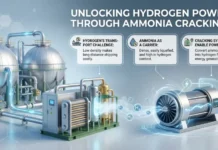


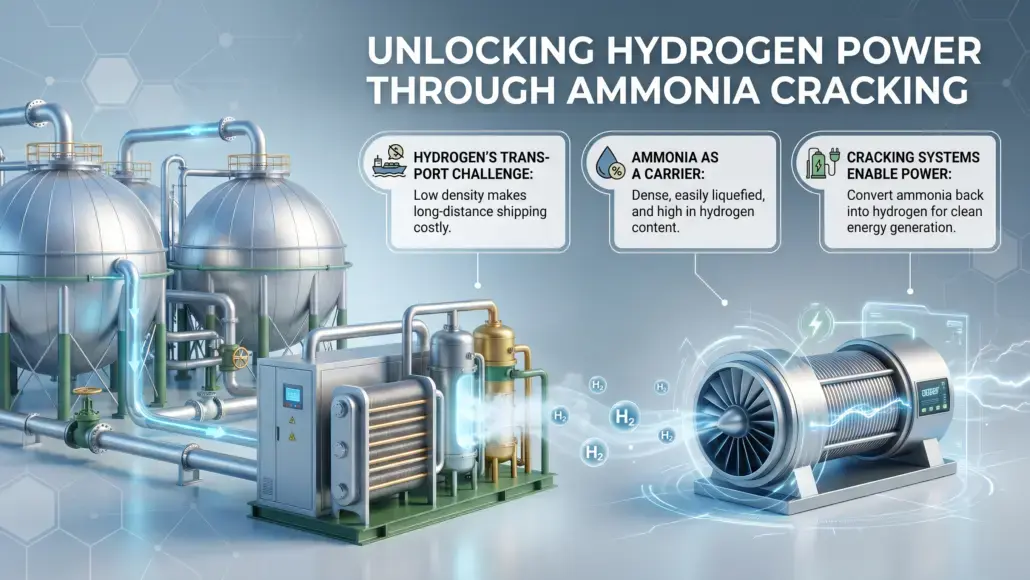

The challenge of transporting hydrogen over long distances remains a significant barrier to the global adoption of a clean energy economy. Hydrogen’s low volumetric energy density makes it expensive to move as a compressed gas or a cryogenic liquid. Ammonia, by contrast, is a dense and easily liquefied chemical that contains a high percentage of hydrogen by weight. Consequently, ammonia is emerging as a preferred carrier for renewable energy, with ammonia cracking systems enabling hydrogen-based power generation serving as the critical link at the destination. By converting ammonia back into hydrogen and nitrogen, these systems allow power producers to utilize high-energy-density fuel that has been shipped from regions with abundant wind and solar resources.
The deployment of these cracking systems is particularly relevant for decentralized power generation and for the decarbonization of remote industrial sites. The technology involves a catalytic process that breaks the chemical bonds of ammonia, releasing pure hydrogen gas. While the cracking process itself requires energy, the overall efficiency of the ammonia-to-hydrogen pathway can be optimized through sophisticated heat integration and advanced catalyst development. As the global supply chain for green ammonia matures, the ability to efficiently recover hydrogen at the point of use will be a determining factor in the economic feasibility of hydrogen-fired power assets.
Thermochemical Principles of Catalytic Ammonia Dissociation
The dissociation of ammonia into hydrogen and nitrogen is an endothermic reaction, meaning it requires a continuous input of heat to proceed. This reaction typically occurs over a solid catalyst at temperatures ranging from four hundred to eight hundred degrees Celsius. Ammonia cracking systems enabling hydrogen-based power generation utilize a variety of catalyst materials, including nickel, ruthenium, and cobalt, each offering different trade-offs in terms of cost, activity, and durability. Ruthenium-based catalysts are known for their high activity at lower temperatures, which can improve the overall energy efficiency of the system, but their high cost remains a barrier for large-scale applications.
Nickel-based catalysts are a more cost-effective alternative and are widely used in industrial ammonia plants, although they require higher operating temperatures to achieve high conversion rates. The choice of catalyst influences not only the reactor design but also the thermal management strategy of the power plant. Engineers are actively researching new alloy compositions and nano-structured supports to enhance the surface area and stability of the catalysts, aiming to reduce the energy penalty associated with the cracking process. The goal is to achieve near-complete ammonia conversion at the lowest possible temperature, minimizing the thermal stress on the reactor components.
The kinetics of the cracking reaction are also affected by the pressure and the presence of any impurities in the ammonia feedstock. High-pressure operation can reduce the size of the reactor vessels but can also negatively impact the equilibrium conversion of ammonia. Therefore, a careful optimization of the operating pressure is required to balance capital cost and chemical efficiency. Modern cracking systems are designed with modularity in mind, allowing for easy scaling to meet the specific requirements of different power generation facilities, from small-scale fuel cell installations to large gas turbine plants.
Reactor Design and Heat Integration for High-Efficiency Cracking
The design of the cracking reactor is central to the performance of the entire system. Common designs include fixed-bed reactors, where the ammonia gas passes over a stationary bed of catalyst particles, and membrane reactors, which combine the cracking and separation steps into a single unit. In ammonia cracking systems enabling hydrogen-based power generation, the integration of the reactor with the power generation cycle is a key focus. For example, the waste heat from a gas turbine’s exhaust or a fuel cell’s thermal management system can be used to provide the energy needed for the ammonia dissociation, significantly improving the round-trip efficiency of the process.
Thermal integration involves a complex network of heat exchangers that recover every available joule of energy. The hot hydrogen and nitrogen gas leaving the reactor can be used to pre-heat the incoming liquid ammonia, while the exhaust gas from the combustion process can provide the high-temperature heat needed to drive the cracking reaction. In some advanced configurations, a portion of the produced hydrogen is burned within the reactor itself to maintain the required operating temperature. This self-sustaining approach simplifies the system but requires a careful balance to ensure that the maximum amount of hydrogen remains available for power generation.
Material selection for the reactor is also a critical consideration. The combination of high temperatures and the presence of hydrogen and ammonia creates a highly corrosive environment. Stainless steels and nickel-based alloys are commonly used, but they must be carefully monitored for signs of nitriding or hydrogen embrittlement. The use of ceramic components or advanced coatings is being explored to enhance the durability of the reactors and to allow for even higher operating temperatures, which can further accelerate the cracking reaction.
Purification and Separation Technologies for Fuel Cell and Turbine Feedstocks
The gas stream exiting the ammonia cracker consists of hydrogen, nitrogen, and a small amount of unreacted ammonia. Depending on the type of power generation technology being used, further purification may be required. For PEM fuel cells, which are highly sensitive to even trace amounts of ammonia, a rigorous purification step is necessary to ensure that the ammonia concentration is reduced to parts-per-billion levels. Ammonia cracking systems enabling hydrogen-based power generation often utilize pressure swing adsorption (PSA) or specialized membranes to achieve this level of purity.
For gas turbines, the requirement for purity is generally less stringent. A blend of hydrogen and nitrogen can be burned directly, provided the combustion system is designed to handle the lower heating value of the mixed gas. The nitrogen acts as a diluent, which can actually be beneficial for controlling NOx emissions, as discussed in other contexts. However, the presence of any residual ammonia must be carefully managed, as it can lead to the formation of fuel-NOx during combustion. Therefore, even for turbine applications, a basic level of ammonia removal is often necessary to meet environmental regulations.
Membrane separation technologies offer a promising way to simplify the purification process. Palladium-based membranes are highly selective for hydrogen, allowing it to pass through while blocking nitrogen and ammonia. By integrating these membranes directly into the cracking reactor, the hydrogen can be removed as it is produced, which also helps to drive the chemical equilibrium toward complete ammonia dissociation. While palladium membranes are expensive, researchers are developing cheaper alternative materials, such as carbon-based or metallic alloy membranes, to make this technology more accessible for large-scale power generation projects.
Lifecycle Efficiency and Economic Analysis of the Ammonia-to-Power Pathway
The economic viability of using ammonia as a hydrogen carrier depends on the total cost of the entire value chain, including production, transport, cracking, and power generation. While the cracking step adds a layer of cost and an energy penalty, it can be offset by the significantly lower cost of transporting ammonia compared to other forms of hydrogen. A thorough analysis of the integrated supply chain must consider the levelized cost of electricity (LCOE) produced through this pathway. In many scenarios, particularly for transoceanic energy transport, the ammonia-to-hydrogen route is the most cost-effective option available.
The efficiency of the cracking system is a major driver of the LCOE. Every percentage point of efficiency gained through better catalysts or heat integration directly translates to a lower cost of power. Additionally, the ability to utilize existing ammonia infrastructure, such as ships, terminals, and storage tanks, provides a significant head start for this technology. As carbon taxes and emission regulations become more stringent, the financial incentive to move away from fossil fuels will continue to grow, making the ammonia-to-power pathway increasingly attractive to investors and utilities.
The flexibility of ammonia as a fuel also adds economic value. Ammonia can be stored for long periods, providing a form of long-duration energy storage that can help balance the seasonal variability of renewable energy. This storage capability allows power producers to decouple the timing of renewable energy generation from the timing of power demand, enhancing the reliability and resilience of the grid. The role of ammonia as a strategic energy reserve is a key factor in its growing importance in the global energy transition.
Safety and Handling Protocols for Integrated Ammonia Cracking Facilities
Ammonia is a toxic and hazardous chemical that requires careful handling and resilient safety protocols. The integration of an ammonia cracking facility with a power plant involves the management of large volumes of ammonia at various temperatures and pressures. Safety systems must be designed to detect and mitigate any leaks, which can pose a risk to both plant personnel and the surrounding community. Ammonia cracking systems enabling hydrogen-based power generation are equipped with advanced gas sensors, automated shut-off valves, and specialized containment systems to ensure safe operation.
Personnel training and emergency response planning are also vital components of a safe facility. Operators must be familiar with the properties of ammonia and the specific risks associated with the cracking process. The use of digital twin models can help in training staff and in simulating various failure scenarios to test the effectiveness of the safety systems. Similarly, the design of the facility should take into account the prevailing wind directions and the proximity to populated areas to minimize the potential impact of an accidental release.
Regulatory compliance is another critical aspect of safety management. Facilities must adhere to international standards for the storage and handling of hazardous chemicals, as well as local environmental regulations. The long history of ammonia use in the fertilizer and chemical industries provides a solid foundation of best practices and safety standards that can be applied to the power generation sector. By maintaining the highest levels of safety and transparency, the industry can build the public trust necessary for the widespread deployment of ammonia-based energy solutions.