






















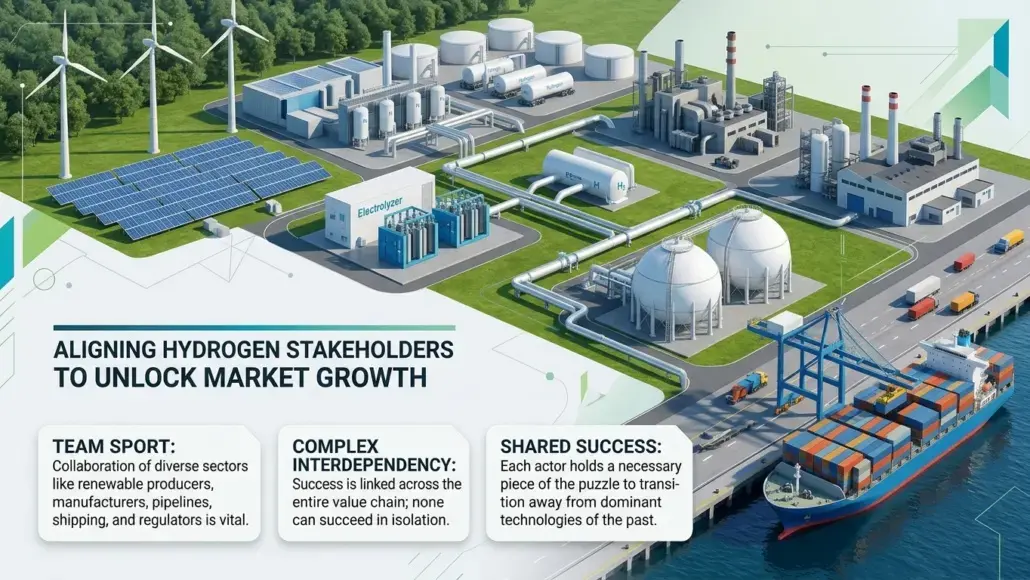

The transition to a hydrogen-based energy system is often described as a “team sport.” Unlike previous energy shifts, which were often driven by a single dominant technology or discovery, the hydrogen economy is a complex web of interdependent sectors. It involves renewable energy producers, electrolyzer manufacturers, pipeline operators, international shipping firms, industrial end-users, and government regulators. Each of these actors holds a different piece of the puzzle, and none can succeed in isolation. Aligning hydrogen stakeholders for market growth is, therefore, the most critical “soft” infrastructure challenge we face. Without a unified vision and a coordinated roadmap, the multi-billion-dollar investments required to scale the industry will remain on the sidelines, stalled by uncertainty and fragmented efforts.
Alignment is about more than just a shared goal it is about synchronizing the timing of investments across the entire value chain. A renewable energy developer will not build a massive wind farm if there is no electrolyzer facility to take the power an electrolyzer operator will not build a plant if there is no pipeline to transport the gas and a steel mill will not convert its furnaces if there is no guarantee of a steady, affordable hydrogen supply. This “coordination failure” is the primary barrier to market take-off. By creating forums for cross-sectoral collaboration, we can replace this hesitation with a virtuous cycle of mutual commitment and rapid scaling.
Bridging the Gap Between Public and Private Interests
At the heart of aligning hydrogen stakeholders for market growth is the relationship between the public and private sectors. Governments play a vital role as “market makers,” providing the initial policy scaffolding that de-risks private capital. However, for this to be effective, the policy must be designed in close consultation with the industry. Rigid, top-down regulations can inadvertently stifle innovation or lead to “stranded assets.” Conversely, purely market-driven approaches may fail to account for the long-term societal benefits of decarbonization, leading to under-investment.
Public-private partnerships (PPPs) are emerging as the preferred vehicle for this alignment. These initiatives bring together government funding, academic research, and industrial expertise to tackle specific bottlenecks, such as the development of safety standards or the creation of local hydrogen hubs. By sharing both the risks and the rewards, these partnerships allow for the deployment of “first-of-a-kind” projects that would be too risky for any single entity. This collaborative de-risking is essential for proving the economic viability of hydrogen to the broader financial community, eventually paving the way for low-cost institutional capital to enter the market.
Harmonizing Standards and Certification
A significant point of friction in the current hydrogen landscape is the lack of standardized definitions and certifications. What one country calls “green” hydrogen might be labeled “yellow” or “blue” in another, based on different carbon-intensity thresholds or production methods. For an international market to thrive, buyers and sellers must speak the same language. Aligning hydrogen stakeholders for market growth requires a global consensus on the “Guarantee of Origin” (GO) for hydrogen molecules.
This alignment is being driven by international organizations and industry consortia who are working to create digital “passports” for hydrogen. These certificates track the carbon footprint of the hydrogen from the point of production to the point of use, ensuring transparency and accountability. When stakeholders align on these standards, it reduces transaction costs and allows for the creation of liquid, transparent commodity markets. It also prevents “greenwashing,” ensuring that the environmental benefits of the transition are real and verifiable. For investors, this level of standardization provides the “rulebook” they need to evaluate projects and manage ESG (Environmental, Social, and Governance) risks.
The Role of Finance and Insurance
The financial sector is perhaps the most influential stakeholder in the hydrogen ecosystem. To reach the trillions of dollars in investment needed for net zero, we must move from venture capital and government grants to “bankable” project finance. Aligning hydrogen stakeholders for market growth involves educating lenders and insurers about the specific risks and opportunities of hydrogen technologies. This includes understanding the degradation rates of electrolyzer stacks, the safety profiles of hydrogen transport, and the long-term price dynamics of the hydrogen market.
Innovative financial instruments, such as “green bonds” and “sustainability-linked loans,” are being tailored for hydrogen projects. Furthermore, the insurance industry is developing new products to cover the technical and operational risks unique to the hydrogen value chain. By bringing these financial actors into the core planning process, industrial developers can ensure that their projects are structured in a way that attracts the widest possible pool of capital. This alignment of financial interests with industrial capability is what will ultimately drive down the cost of capital, making green hydrogen competitive with fossil fuels.
Local Communities and the Social License to Operate
Often overlooked in the technical discussions of energy transition is the role of local communities. No large-scale infrastructure project be it a pipeline, an electrolyzer plant, or a massive wind farm can succeed without a “social license to operate.” Aligning hydrogen stakeholders for market growth must, therefore, include local citizens, environmental groups, and labor unions. These stakeholders need to see the tangible benefits of the hydrogen economy, from job creation and air quality improvements to local economic investment.
Transparent communication and community engagement are essential for overcoming “NIMBY” (Not In My Backyard) opposition. This involves being honest about safety risks, providing clear information on the environmental impact, and ensuring that local workers are trained for the new roles being created. When communities are treated as partners rather than obstacles, they become champions for the projects, facilitating faster permitting and more stable long-term operations. This social alignment is the bedrock upon which the physical infrastructure of the hydrogen economy will be built.
Conclusion: Orchestrating the Transition
The growth of the hydrogen market is not a foregone conclusion it is an orchestrated event. It requires a level of collaboration and strategic alignment that is rare in the history of industrial development. By aligning hydrogen stakeholders for market growth, we are building a foundation of trust and common purpose that can withstand the inevitable technical and economic challenges of the energy transition.
We are moving away from a world of siloed competition toward a world of “co-opetition,” where companies collaborate on the foundational standards and infrastructure while competing on the efficiency and quality of their products. This shift in mindset is the true engine of the hydrogen revolution. As governments, industries, and communities align their efforts, the path to a global, vibrant hydrogen market becomes clear. The transition is complex, but with everyone pulling in the same direction, the clean energy future is not just a dream it is an imminent reality.