






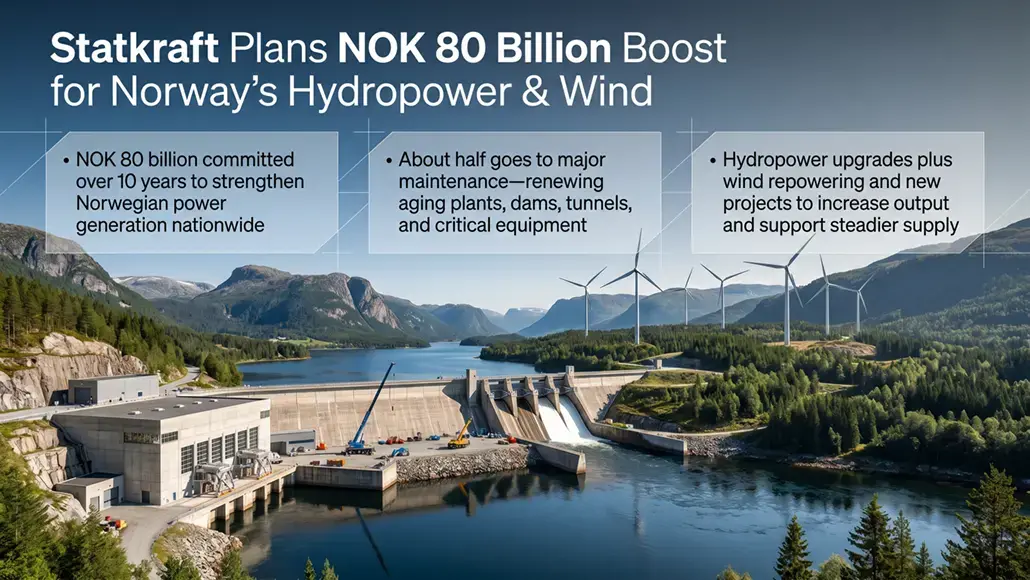

Statkraft has announced updated investment estimates for Norwegian power generation, with plans to commit approximately NOK 80 billion over the next ten years. The announcement, made in connection with the Statkraft Conference 2026, positions the company as one of the largest contributors to new industrial activity in mainland Norway in the years ahead, with projects planned across the entire country.
The revised Norwegian hydropower investment figure marks a substantial increase compared to the earlier estimate of NOK 44–67 billion presented in January 2024. The company attributes the increase to a larger project portfolio, the effects of inflation, and an extended planning horizon.
Approximately half of the NOK 80 billion investment will go towards major maintenance of existing assets to safeguard current generation capacity. The remaining half is earmarked for upgrades, further development, and new capacity and output.
Hydropower accounts for the bulk of the planned investments, exceeding NOK 70 billion in total. Statkraft has previously stated its ambition to initiate at least five major hydropower upgrade projects by 2030. These refurbishments are expected to enable capacity increases and enhance the ability to generate electricity during periods of peak demand, helping to reduce price spikes and sustain supply when wind generation is low.
President and CEO Birgitte Ringstad Vartdal noted that over the past two years, the company has already invested nearly NOK 4 billion in Norwegian hydropower, including the ongoing construction of the new Svean hydropower plant in Trøndelag at an approximate cost of NOK 1.2 billion. She noted that this level of investment will increase substantially in the years ahead, in line with the company’s updated strategy to concentrate resources in its core business.
“Statkraft is helping to build and strengthen Norway. By investing NOK 80 billion, we are undertaking one of the largest industrial programmes in Norway for many decades. In practice, we are rebuilding major hydropower plants,” said Pål Eitrheim, Executive Vice President for Nordics. He added that these investments will generate activity from Finnmark in the north to Telemark in the south, and from Innlandet in the east to Vestland in the west, ensuring power plants can continue generating electricity well into the next century.
A significant driver behind the Norwegian hydropower investment programme is the age of many existing facilities. Several of Norway’s largest hydropower plants are approaching or have already reached the end of their operational lifetimes. Statkraft is currently assessing upgrade opportunities at Nore in Buskerud, which opened in 1928, Mår in Telemark, opened in 1948, and Aura in Møre og Romsdal, opened in 1953. The company is evaluating the potential for these sites to be upgraded to modern, more powerful installations capable of producing more electricity when it is most needed.
In Alta, Statkraft plans to expand the existing facility from two to three generating units, which would enable the utilisation of water that currently bypasses the plant during the flood season.
Beyond generation upgrades, the investment programme also addresses structural and safety requirements. Statkraft is required to reinforce several older dams to withstand greater climate variability and to comply with stricter safety standards. Critical technical equipment across multiple plants will also need to be replaced, and water tunnels require refurbishment. These works are expected to create opportunities for both small and large contractors across the country.
Vartdal acknowledged the scale of the challenge, describing the company’s facilities as remarkable assets that have delivered electricity for decades. She stated that many of the tunnels were excavated 60 to 80 years ago and that a significant portion of the equipment is now reaching the end of its service life. She also highlighted that several large dams are mandated for modernisation, underlining the considerable investment required to sustain a robust energy system.
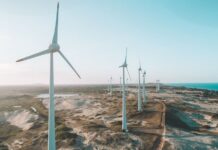
In addition to hydropower modernisation, Statkraft plans to invest in wind power over the same period. Three of the company’s existing wind farms are approaching the end of their operational lifetimes, while new projects are under development.
Eitrheim drew a direct comparison between the two technology types, noting that the combined initial investments planned for hydropower upgrades and development over the next ten years would deliver less new energy output than the planned Moifjellet wind farm alone. He described wind power as the only technology currently capable of delivering substantial additional energy output at a price level acceptable to industry in the short term.
On the subject of repowering ageing wind farms, Eitrheim stated that Statkraft aims to significantly increase output while reducing the number of turbines, drawing on experience from comparable repowering projects in Spain. The company’s estimates indicate that wind power generation will more than double over the next ten years, with an expected contribution to lower power prices and job creation across Norway. This wind power expansion is an integral part of Statkraft’s broader renewable energy capacity strategy.
Statkraft has noted that all projections are subject to change depending on electricity demand and other factors. New projects will require licensing from the Norwegian Water Resources and Energy Directorate, while wind power developments are also contingent on approvals from municipal authorities. The company expects to prioritise between projects and has stated it will only proceed with investments that meet profitability requirements prior to final investment decisions.
The scale of the programme, combined with its geographic reach and the volume of hydropower modernisation and renewable energy capacity work involved, reflects a broad and long-term commitment to Norwegian energy infrastructure that is expected to unfold over the coming decade.