










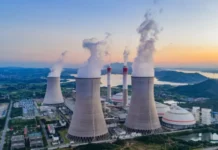









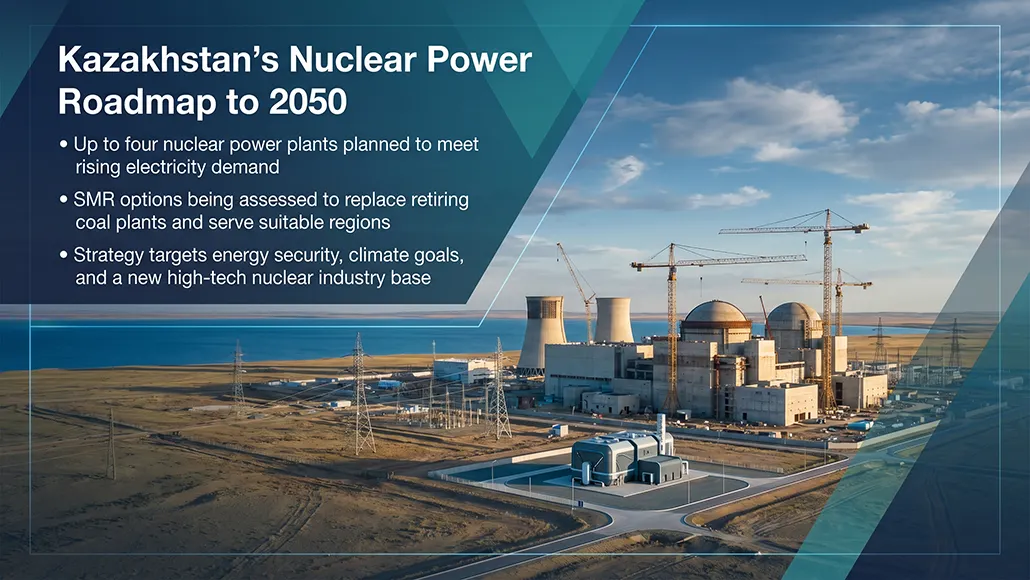

Kazakhstan has formalised a long-term roadmap for its atomic energy sector, with the Kazakhstan nuclear plan outlining the development of up to four nuclear power plants by 2050. The strategy, now officially adopted, indicates that at least three facilities are expected to be operational within this timeframe, while a fourth project remains under consideration to meet future electricity demand.
The Kazakhstan Atomic Energy Agency said the expansion reflects projections of rising consumption nationwide. It stated that “given the projected growth in electricity consumption, a project to build a fourth plant is envisaged, which will fully meet the growing needs of the economy and the population for reliable and environmentally-friendly energy”. In parallel, the agency noted that “options for constructing SMR-based nuclear power plants in suitable regions of the country will also be considered, taking into account technological and economic feasibility, as well as for replacing decommissioned coal-fired plants with equivalent nuclear capacity”.
The framework sets out national priorities for the peaceful use of nuclear energy and broader economic objectives. It defines “the goals, approaches and priority areas of state policy in the field of peaceful uses of nuclear energy”, while linking nuclear expansion to energy security and sustainability. According to the agency, “The document aims to ensure the country’s energy security and sustainable economic growth, fulfil international climate commitments, develop high-tech industries and strengthen Kazakhstan’s position in the global nuclear industry.” Key areas include the construction of new plants — including one potentially using small modular reactors — alongside advancements in nuclear science, waste management systems, safety infrastructure, workforce development, and the “rational use of uranium resources”. The agency added that “The implementation of the strategy will enable the formation of a modern and sustainable nuclear cluster in Kazakhstan, integrated into the global nuclear ecosystem.”
Kazakhstan enters this phase with prior nuclear experience despite not currently producing nuclear-generated electricity. As the world’s leading uranium producer, it operates three research reactors and previously ran a Russian-designed BN-350 sodium-cooled fast reactor near Aktau until 1999. Preparations for a nuclear programme have been underway for years, including the creation of Kazakhstan Nuclear Power Plant (KNPP) in 2014. Public support has also been evident, with more than 70% of 7.8 million voters backing nuclear development in a 2024 referendum. Initial projects are progressing, with Russia’s Rosatom selected in June last year to lead construction of the Balkhash plant in Ulken, while China National Nuclear Corporation is expected to develop additional plants in the same region. The Kazakhstan nuclear plan also aligns with the government’s target of achieving a 5% share of nuclear energy in the national power mix by 2035.