

















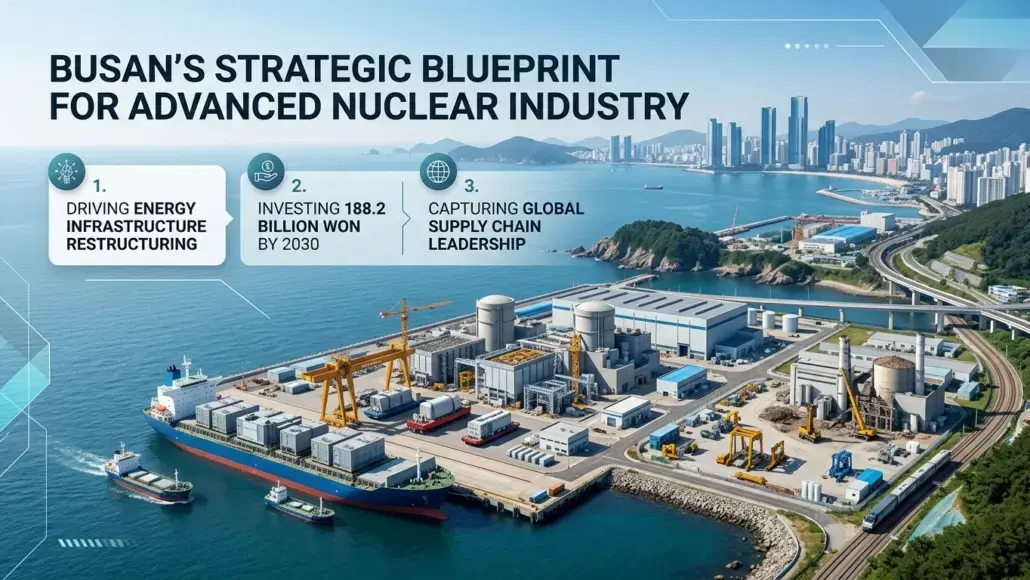

The metropolitan government of Busan has officially announced a mid- to long-term blueprint to restructure its existing energy infrastructure. The strategy transitions the city’s focus from traditional large-scale systems toward small modular reactors and facility decommissioning. The comprehensive nuclear industry development plan outlines an investment of approximately 188.2 billion won by 2030, executing 18 key projects designed to capture global supply chains ahead of market competitors.
Designated as the “Nuclear Industry Development Plan (2026-2030),” the initiative establishes a five-year roadmap emphasizing safety and innovation. The framework is the first comprehensive directive established under the Ordinance on the Promotion and Support of the Nuclear Industry. The policy directly responds to the rapid global reorganization prioritizing small modular reactors while advancing the complete decommissioning project for Korea’s first commercial reactor, Kori Unit 1.
In the area of talent development, the strategy focuses on cultivating field-oriented specialists to support the physical expansion of the Kori Unit 1 decommissioning project. The blueprint establishes a direct supply system for specialized personnel capable of responding to new operational demands within radioactive waste management and facility decommissioning, alongside standard reactor operations. Building this dedicated workforce guarantees high regulatory standards and operational safety for radioactive waste management across the region.
To solidify its position as a primary nuclear power hub, Busan will concentrate next-generation infrastructure around a newly established manufacturing support center for auxiliary equipment. The local government aims to strengthen corporate competitiveness by assisting nuclear equipment companies with acquiring necessary international certifications, linking operations to policy financing, and supporting comprehensive business diversification.
This full-cycle support system is explicitly designed to ensure that local nuclear equipment companies secure export competitiveness and successfully enter expanding global markets. Furthermore, an industry-academia-research-government cooperation system will be formalized through an operational industry council, new export networks, and the creation of a dedicated promotion center designed to improve public acceptance and expand the broader industrial ecosystem.
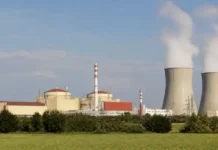
Hosting six of the country’s 26 operating reactors, Busan currently operates as the most concentrated nuclear power hub in South Korea. The city’s existing geographic density and industrial infrastructure firmly position it to lead the transition into next-generation systems and related high-value export sectors.
The strategic nuclear industry development framework aims to evolve the region beyond its legacy large-reactor-centered structure into a definitive, modern innovation center. Kim Ki-hwan, head of the city’s Citizen Safety Office, stated, “We will actively support Busan’s leap into a global nuclear industry hub by developing SMRs, reactor decommissioning, and export industries as core future growth axes.”