




















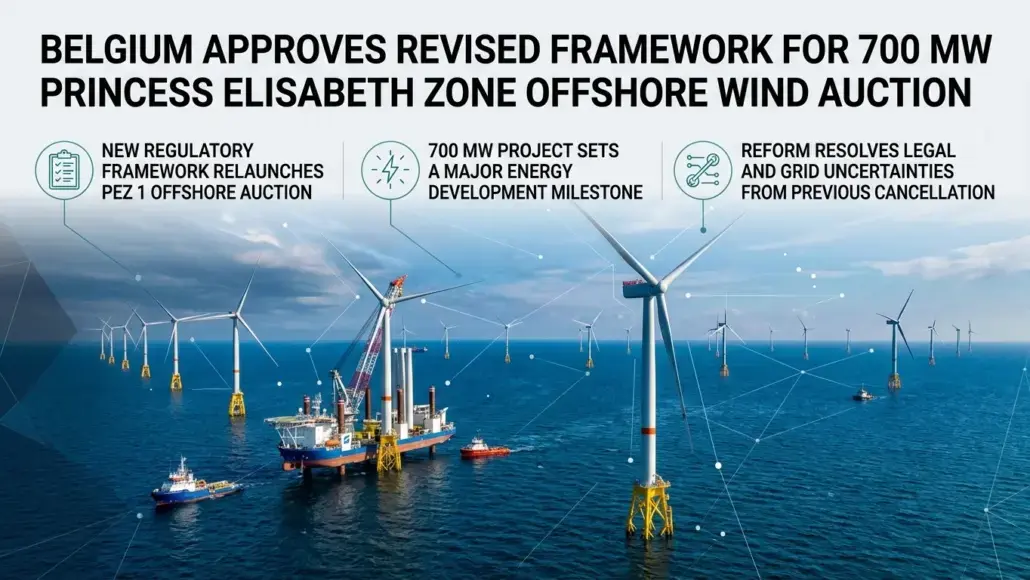

The Belgian government has officially approved a new regulatory framework to relaunch the offshore wind auction for the first farm in the Princess Elisabeth Zone (PEZ 1). This project, which has an expected capacity of approximately 700 MW, represents one of the country’s most significant offshore energy developments. The reform follows the cancellation of a previous auction in July 2025, which was halted due to legal and financial uncertainties regarding support mechanisms and grid reinforcement timelines. By extending the maximum construction period from four to five years and removing strike price caps, the government aims to address current supply chain constraints and seasonal installation restrictions in the North Sea.
A central component of the new framework is the adoption of a single two-sided Contract for Difference (CfD) support mechanism. Under this model, developers will submit bids with their own strike prices, ensuring long-term revenue certainty. If market prices fall below the strike price, the producer receives a top-up; conversely, if market prices exceed the threshold, the producer repays the surplus to the state. This mechanism is designed to attract private investment while protecting public finances from windfall profits. Additionally, the government has eliminated a separate support regime for power purchase agreements (PPAs), requiring all bidders to compete under a unified set of rules while retaining the freedom to sign private contracts after the award.
Strategic Alignment With the Net-Zero Industry Act
In a first for the national energy sector, the upcoming offshore wind auction fully incorporates the requirements of the European Union’s Net-Zero Industry Act (NZIA). The revised tender introduces mandatory prequalification criteria focused on supply chain resilience, cybersecurity, and environmental sustainability. Most notably, the rules specify that at least 75 percent of the project’s wind turbines must not be manufactured or assembled in China. These measures are intended to reduce strategic dependence on single-country suppliers and bolster Europe’s internal clean energy manufacturing base.
The government has also implemented restrictions on critical components and permanent magnets sourced from China. These provisions serve to strengthen the security of strategic energy infrastructure while encouraging responsible business conduct within the supply chain. By simplifying administrative requirements and lowering financial barriers, officials expect the streamlined framework to deliver more competitive bids. The government remains focused on minimizing costs for electricity consumers while ensuring that the infrastructure meets the highest standards of operational security and environmental responsibility.
Grid Integration and Next Steps for Relaunch
As part of the broader energy package, the Council of Ministers has set October 1, 2031, as the firm deadline for commissioning the first phase of the Princess Elisabeth Energy Island (MOG II). This artificial energy island is a critical piece of infrastructure that will serve as a hub connecting future offshore wind farms in the zone to Belgium’s onshore electricity grid. The alignment of the auction timeline with the MOG II commissioning date provides developers with the necessary clarity regarding grid connection availability, which was a significant point of contention in previous tender rounds.
Before the PEZ 1 auction can be officially reopened, the amended Royal Decree must undergo a review by the Council of State and be formally notified to the European Commission under state aid rules. Once these procedural steps are finalized, the Belgian government intends to relaunch the tender as soon as possible. This updated regulatory environment is expected to reinvigorate investor interest in the Belgian North Sea, supporting the country’s long-term decarbonization goals and its transition toward a more resilient and self-sufficient energy system.