


































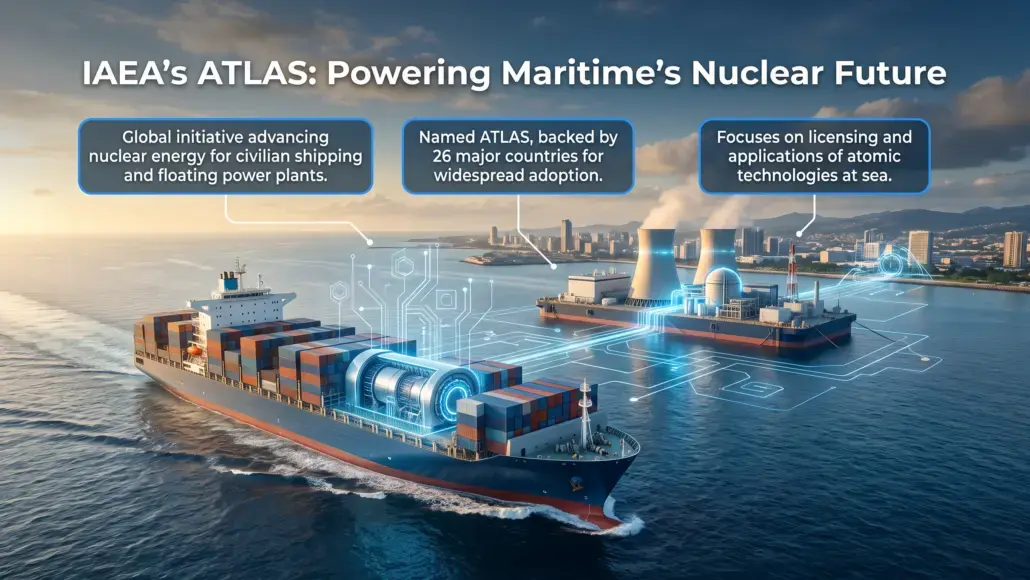

The International Atomic Energy Agency (IAEA) has officially launched a landmark global initiative aimed at advancing the use of nuclear energy in civilian shipping and floating nuclear power plants. Named ATLAS — Atomic Technologies Licensed for Applications at Sea — the initiative has already secured the backing of 26 countries, including several of the world’s largest economies.
The ATLAS initiative was unveiled at the International High-level Forum on the ATLAS Launch, hosted by the United States in Washington, D.C., drawing approximately 600 participants from more than 50 countries, along with representatives from international organizations, industry leaders, maritime companies, and port authorities.
26 Nations Sign Joint Statement in Support
At the forum, 26 countries formally signed a joint statement in support of ATLAS. Signatories include the United States, the United Kingdom, France, Italy, Canada, Japan, South Korea, India, Finland, Norway, the Netherlands, the United Arab Emirates, and Brazil. Slovenia, Romania, Greece, and Turkey were also among the countries that added their names to the statement. Germany, China, and Russia were not among the signatories.
According to the IAEA, the initiative is designed to support the safe, secure, and peaceful use of nuclear power across both civilian maritime operations and floating nuclear power plant deployments.
Nuclear Power Meets the Maritime Sector
Maritime transportation currently accounts for approximately 80% of global trade, with seaborne demand growing at roughly 2% annually. The IAEA highlighted that this sustained growth underscores the need for reliable long-distance transportation solutions that strengthen global energy security.
Nuclear power, including advanced and innovative reactor technologies such as small modular reactors (SMRs), offers high energy density and long operational endurance. This means ships powered by SMRs could operate for extended periods without requiring refueling — a significant advantage for long-haul maritime routes.
Floating Nuclear Power Plants for Coastal and Remote Communities
Beyond propulsion, floating nuclear power plants represent another dimension of the ATLAS initiative. These installations could deliver reliable electricity to coastal communities, remote regions, and offshore industries where conventional energy infrastructure is limited or unavailable. The joint statement confirmed that innovations in floating nuclear power plants could offer consistent power supply to such areas and industries.
IAEA Director General Rafael Mariano Grossi outlined the broader ambition of the initiative. “By bringing together the nuclear and maritime sectors, we have the opportunity to shape the future of two crucial industries – energy and shipping – and to build global confidence in the safe, secure and peaceful use of nuclear technology at sea,” he stated.
US Energy Secretary Highlights American Commitment
At the opening session of the Washington, D.C. forum, US Secretary of Energy Chris Wright addressed attendees and noted that the ATLAS initiative complements President Donald Trump’s broader efforts to restore American nuclear leadership. Wright affirmed that the United States is committed to carrying this momentum forward alongside the IAEA and its international partners.
Implementation Underway in 2026
The IAEA has confirmed that implementation of the ATLAS initiative will begin in 2026. Six expert project groups will be established to address the safety, security, safeguards, and regulatory dimensions of nuclear energy applications at sea. These groups are expected to form the technical backbone of the initiative as it progresses from policy commitment to operational frameworks.
The launch of the ATLAS initiative marks a concrete step toward integrating nuclear energy into two of the world’s most essential sectors — energy and maritime transportation — with a growing coalition of nations aligned behind its objectives.