

















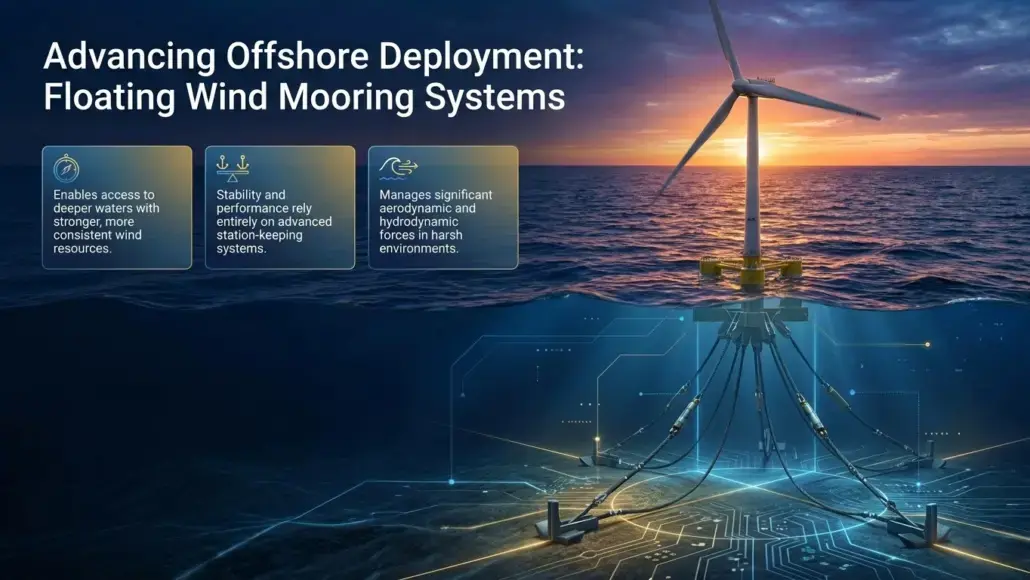

The transition of offshore wind into deeper waters requires a fundamental shift in how turbine foundations are secured to the seabed. While fixed bottom structures are limited to depths of around sixty meters, floating foundations can be deployed in much deeper areas, tapping into vast and consistent wind resources. The stability and performance of these floating platforms are entirely dependent on their station keeping systems. These systems must manage the significant aerodynamic and hydrodynamic loads while keeping the platform within strict operational limits. The development of floating wind mooring systems advancing offshore deployment is thus a critical technical enabler for the global expansion of the sector. As the industry moves toward commercial scale projects, the engineering, material selection, and installation of these mooring lines are becoming central to project bankability and operational reliability in the power generation sector.
Taut Leg and Catenary Mooring Configuration Analysis
The two primary mooring configurations used for floating wind are catenary and taut leg systems. Catenary mooring is the more traditional approach, relying on the weight of heavy steel chains to provide the restoring force for the floating platform. A large portion of the chain rests on the seabed, providing a horizontal load at the anchor point. This configuration is well suited for shallower deepwater sites and is relatively simple to install. However, the sheer weight of the steel chains can be a significant cost driver and can also affect the buoyancy requirements of the floating foundation itself. Designers must carefully calculate the length and weight of the chains to ensure the platform remains stable under extreme storm conditions.
Taut leg mooring systems, by contrast, use lines that are under constant tension, providing a more direct and stiffer connection between the platform and the anchors. These systems often use synthetic materials or wire rope instead of heavy chains, which significantly reduces the total weight of the mooring assembly. Taut leg systems exert a vertical load on the anchors, necessitating more complex anchoring solutions such as suction piles or vertically loaded anchors. The stiffness of a taut leg system can be advantageous for minimizing the footprint of the wind farm and reducing the movement of the platform, which is beneficial for the performance of the dynamic power cables. The choice between these two configurations depends on the water depth, seabed conditions, and the specific motion characteristics of the chosen floating platform design.
Advanced Anchor Solutions for Variable Seabed Conditions
The effectiveness of any mooring system is only as good as its connection to the seabed. Anchoring solutions must be tailored to the specific geology of the site, which can range from soft clay and sand to hard rock. Drag embedment anchors are a common choice for catenary systems in soft soils, as they are relatively inexpensive and easy to install. However, they are not suitable for carrying vertical loads. For taut leg systems or sites with more challenging conditions, suction piles are often preferred. These large cylindrical structures are driven into the seabed by creating a pressure differential, providing high resistance to both horizontal and vertical forces. The design and sizing of these piles require detailed geotechnical analysis to ensure long term stability.
In regions with rocky seabeds, drilled and grouted piles or gravity based anchors may be necessary. These solutions involve higher installation costs and require specialized offshore equipment. Manufacturers are also developing innovative shared anchoring solutions, where multiple turbines are secured to a single anchor point. This approach could significantly reduce the total number of anchors required for a large wind farm, lowering both the capital expenditure and the environmental impact on the seabed. The ongoing refinement of floating wind mooring systems advancing offshore deployment involves the development of these versatile anchoring technologies, ensuring that floating wind can be deployed in a wide variety of maritime environments around the world.
Synthetic Material Adoption for Weight and Cost Efficiency
The move toward synthetic materials in mooring lines is a major trend in the offshore wind industry. Traditional steel chains are incredibly heavy, making them difficult to handle and install in deep water. Synthetic fibers, such as polyester or high modulus polyethylene, offer a high strength to weight ratio and are resistant to corrosion in the marine environment. Using synthetic lines can significantly reduce the load on the floating foundation, allowing for smaller and more cost effective platform designs. These materials also have specific elastic properties that can be used to tune the dynamic response of the mooring system, helping to absorb the energy of large waves and wind gusts.
However, the adoption of synthetic materials also introduces new challenges. These lines are more susceptible to damage from abrasion and can be affected by long term creep and fatigue. Rigorous testing and certification programs are essential to ensure the reliability of synthetic mooring systems over a twenty five year project life. Researchers are working to develop new fiber coatings and termination designs that enhance the durability of the lines. The integration of these advanced materials into floating wind mooring systems advancing offshore deployment is a key pathway for reducing the levelized cost of energy for floating wind. By lowering the weight and cost of the station keeping hardware, the industry can improve the economic feasibility of deepwater projects and accelerate the growth of the power generation capacity. Additionally, the use of synthetic lines can reduce the environmental footprint of the mooring system, as they require less energy to manufacture and transport compared to heavy steel chains. The development of hybrid mooring solutions, which combine synthetic lines with short sections of chain in high wear areas, is also gaining traction. These hybrid systems offer the best of both worlds, providing the durability of steel where it is most needed while benefiting from the weight savings of synthetic materials elsewhere. Continued innovation in material science will be essential to further refine these solutions and meet the evolving needs of the floating wind sector.
Monitoring and Inspection Protocols for Mooring Integrity
Maintaining the integrity of the mooring system is vital for the safety and availability of a floating wind farm. A failure in a single mooring line could lead to excessive platform motion, damaging the dynamic power cables or even resulting in the total loss of the turbine. Regular inspection and monitoring are therefore a high priority for asset managers. Traditional inspection methods involve the use of Remotely Operated Vehicles to visually check the lines and anchors for signs of wear, corrosion, or marine growth. While effective, these operations are expensive and are often limited by weather conditions.
To improve the efficiency of maintenance, the industry is increasingly adopting continuous monitoring systems. These systems use sensors embedded in the mooring lines or attached to the platform to track tension, angle, and vibration in real time. Advanced data analytics can then be used to detect potential issues before they lead to a failure. For example, a sudden change in the tension profile of a line might indicate a problem with an anchor or a local material defect. The integration of these digital tools into floating wind mooring systems advancing offshore deployment enhances the operational reliability of the entire farm. By enabling predictive maintenance, operators can reduce the need for costly offshore interventions and extend the service life of the mooring hardware, contributing to the overall sustainability of the power generation sector.
Logistics and Installation Strategies for Deepwater Arrays
The logistics of installing hundreds of mooring lines and anchors for a commercial scale floating wind farm are immense. Specialized installation vessels are required, equipped with high capacity winches and crane systems. The installation process must be carefully synchronized with the deployment of the floating platforms and the connection of the subsea power cables. Strategic planning is essential to minimize the time spent at sea and to manage the risks associated with weather delays. Many developers are exploring the use of pre installed mooring systems, where the anchors and lines are placed on the seabed before the turbine platforms arrive at the site. This allows for a more rapid and efficient hook up process once the platforms are towed to the location.
Regional port infrastructure also plays a crucial role in supporting these logistics. Ports must have the space and heavy lift capacity to handle the massive mooring components and to support the mobilization of the installation fleet. The development of specialized mooring assembly and storage areas within ports is a key feature of the next generation of offshore wind hubs. As the industry scales toward gigawatt level projects, the efficiency of the installation process will be a major factor in the overall project cost. The continuous improvement of floating wind mooring systems advancing offshore deployment is thus not just about the hardware, but also about the methods and logistics required to bring these systems to life in the most remote and challenging maritime locations. The collaboration between technology developers, offshore contractors, and port authorities is essential for the successful delivery of these complex infrastructure projects.
As the sector matures, the standardization of mooring components and installation procedures will be vital for achieving the economies of scale needed for commercial success. Strategic focus on lifecycle management, from initial design to final decommissioning, will ensure that floating wind projects remain safe and productive throughout their operational life. By addressing the technical and logistical challenges of station keeping today, the industry is paving the way for a future where deepwater wind resources are a central pillar of the global power generation mix. The success of floating wind mooring systems advancing offshore deployment is a testament to the industry’s ability to innovate and adapt in the face of significant engineering challenges. The ongoing evolution of these systems will remain a key focus for researchers and practitioners alike, driving the continued growth and sustainability of the offshore wind industry for years to come. Strategic investment in training and workforce development will also be required to ensure that the next generation of offshore engineers is equipped to handle the complexities of deepwater mooring installation and maintenance.