



























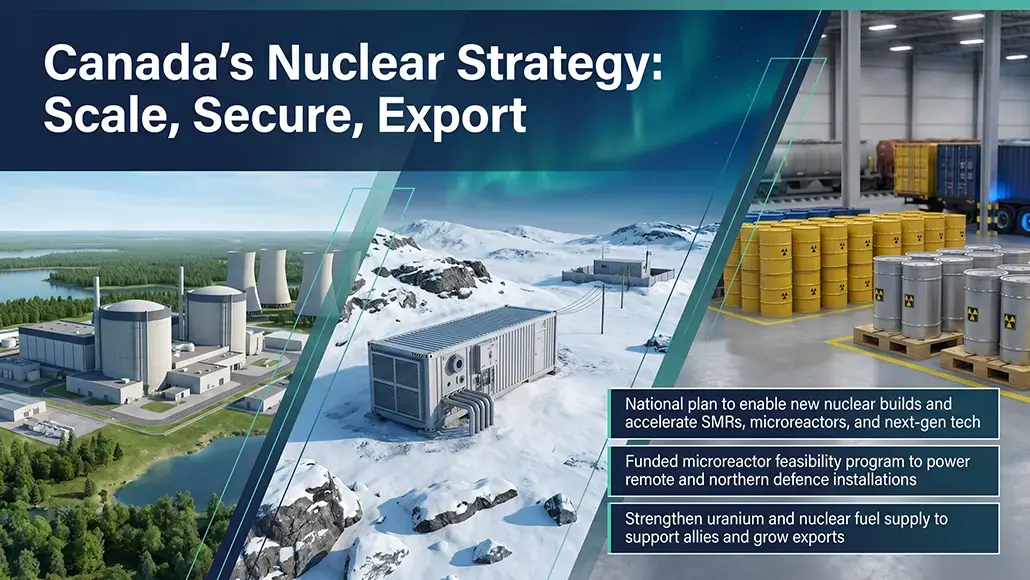

Canada has outlined a Canada nuclear strategy aimed at strengthening domestic energy security, expanding nuclear capacity, and positioning the country as a global supplier, alongside launching a funded microreactor feasibility programme targeting remote and defence applications. The announcement, made by Minister of Energy and Natural Resources Tim Hodgson at the Canadian Nuclear Association Conference, signals a coordinated push to scale nuclear deployment and innovation across the country.
Strategic Framework and Policy Direction
The forthcoming Canada nuclear strategy, being developed by Natural Resources Canada, is expected to be released by the end of 2026. It is structured around four core pillars designed to accelerate nuclear deployment and industrial growth:
- Enabling new nuclear builds across Canada, including both small and large-scale projects
- Positioning Canada as a global supplier and exporter of nuclear technology and services
- Expanding uranium production and strengthening nuclear fuel supply capabilities
- Advancing next-generation nuclear technologies, including small modular reactors (SMRs), microreactors, and fusion
The government highlighted that the global nuclear market could grow by up to CAD200 billion annually by 2030, reinforcing the strategic importance of scaling domestic capabilities while capturing export opportunities.
From an industry standpoint, Power Info Today observes that the structured multi-pillar approach aligns capital deployment, trade strategy, and innovation pathways into a unified policy framework, reducing fragmentation across Canada’s nuclear value chain.
Investment and Financial Commitments
A key component of the strategy is targeted public investment to support both infrastructure and innovation. The federal government has committed CAD2.2 billion over 10 years to modernise research infrastructure at Chalk River Laboratories. This includes development of the Advanced Materials Research Centre and upgrades to critical laboratory facilities to support reactor technology, fuel development, and safety research.
In parallel, the Department of National Defence is allocating over CAD40 million in the 2026–2027 fiscal year to evaluate the feasibility of deploying Canadian-controlled microreactors. This builds on earlier investments, including CAD6 million in 2025–2026 directed toward research and development activities.
Microreactor Deployment and Operational Impact
The microreactor feasibility programme, delivered in collaboration with Department of National Defence and Atomic Energy of Canada Limited, is designed to assess whether next-generation reactors can provide reliable heat and electricity to remote and northern defence installations.
This initiative reflects operational priorities tied to energy resilience in off-grid regions, where energy costs remain high and supply stability is limited. The programme also has potential applications beyond defence, including industrial sites and remote communities requiring continuous, low-emission power.
Supply Chain and Export Positioning
The strategy places strong emphasis on leveraging Canada’s uranium resources to support allied nuclear expansion. Canada accounted for approximately 24% of global uranium production in 2024, with around 90% of output exported for use in nuclear power generation.
The government aims to strengthen its position across the nuclear supply chain by aligning trade policy tools, including export financing and international market development support. This includes coordination with agencies such as the Trade Commissioner Service and Export Development Canada to target high-growth markets.
Market Relevance and Strategic Outlook
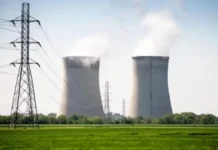
Canada’s nuclear sector currently contributes CAD22 billion annually to the national economy and generates approximately 13% of electricity through 17 CANDU reactors operating in Ontario and New Brunswick. The strategy is expected to further integrate nuclear energy into national electrification efforts while supporting grid expansion and long-term energy security.
As global momentum builds toward tripling nuclear capacity by 2050, Canada’s policy direction signals a dual focus on domestic deployment and international competitiveness. The Canada nuclear strategy is positioned to play a central role in aligning infrastructure investment, innovation, and export growth within the country’s broader energy transition framework.