

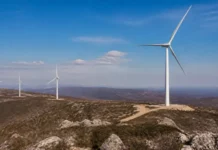
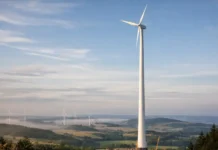












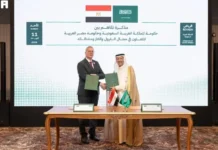


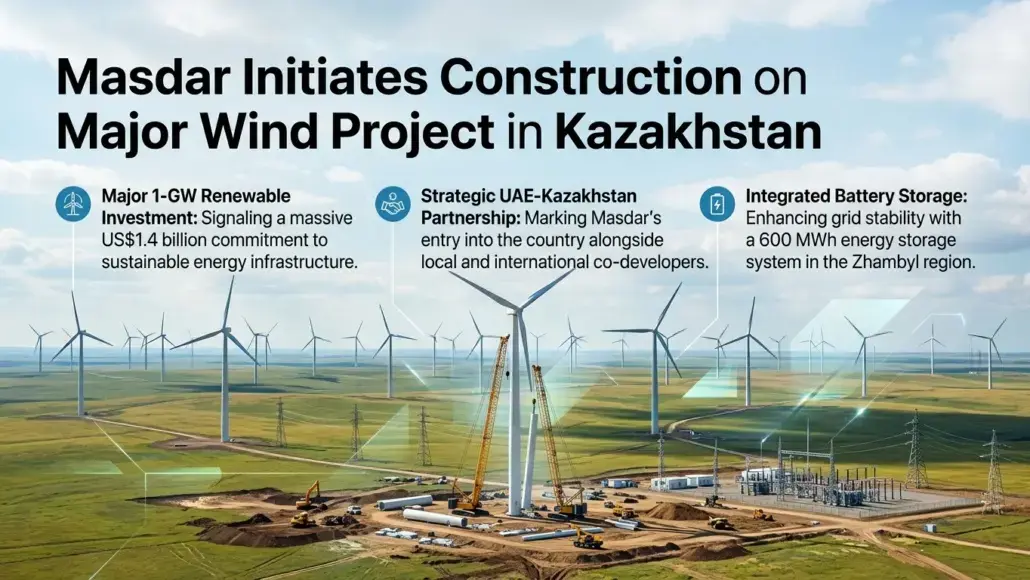

Abu Dhabi Future Energy Company PJSC – Masdar has officially commenced construction on a 1-gigawatt (GW) wind farm located in the Zhambyl region of Kazakhstan. This Kazakhstan wind farm represents an investment of US$1.4 billion and marks Masdar’s inaugural renewable energy project within the country. The development, co-developed with W Solar, Qazaq Green Power a Samruk-Kazyna Fund company and the Kazakhstan Investment Development Fund, integrates a 600-megawatt-hour (MWh) battery energy storage system (BESS) designed to maintain grid stability. The groundbreaking ceremony on 29th June, 2026, was attended by government officials from both the UAE and Kazakhstan, underscoring the collaborative effort to expand clean energy deployment and sustainable development between the two nations.
Upon its completion, the facility is expected to generate sufficient clean electricity to supply approximately 880,000 households in southern Kazakhstan, effectively preventing roughly 2.5 million tonnes of carbon dioxide emissions each year. The project also involves the installation of over 400 km of overhead transmission lines to upgrade the regional grid infrastructure. Concurrently, Masdar entered into a roadmap agreement with the Ministry of Artificial Intelligence and Digital Development to pursue Kazakhstan’s first Round-the-Clock (RTC) clean energy initiative. This RTC project aims to provide 24/7 utility-scale power, with an initial 200MW phase dedicated to supporting the country’s AI ambitions through data centres and infrastructure.
Nurlan Zhakupov, Chief Executive Officer of Samruk-Kazyna, said, “We are proud to launch this landmark project together with Masdar, marking an important milestone in our strategic partnership. The 1GW wind farm opens a new chapter in the cooperation between Kazakhstan and the United Arab Emirates and reflects our shared commitment to advancing a low-carbon economy, deploying innovative technologies and building a sustainable energy future for Kazakhstan.” Following this, Yerlan Akkenzhenov, Kazakhstan Minister of Energy and Infrastructure, stated, “Our partnership with Masdar drives renewable energy development and propels Kazakhstan toward carbon neutrality. This project will strengthen regional energy security and bring cutting-edge technologies to the renewable energy sector. We appreciate our partners’ commitment to investing in the country’s sustainable development and will provide all the necessary support to ensure the successful delivery of every project phase.”
Mohamed Jameel Al Ramahi, Chief Executive Officer of Masdar, noted, “This project represents a significant step forward in Masdar’s global expansion and our growing presence in Central Asia. As our first project in Kazakhstan, it bolsters our leading position in the region and reflects our commitment to enhancing the country’s long-term growth and energy security. We are also delighted to sign a roadmap agreement to expand the deployment of Round-the-Clock renewable energy solution in Kazakhstan, helping to provide the industries of the future with the reliable, affordable, clean power that they need.” Furthermore, Engineer Hamad Al Ameri, Managing Director and Group CEO of Alpha Dhabi Holding, commented, “This groundbreaking marks another milestone in Alpha Dhabi’s strategy to position climate investment as a core driver of sustainable growth. Through our partnership with Masdar and our subsidiary W Solar, we are demonstrating that the UAE’s leadership in clean energy extends far beyond our borders; mobilising capital, expertise, and long-term commitment to markets where the energy transition is accelerating. The wind project, combined with a battery energy storage system in the Zhambyl region, reflects our belief that patient, purpose-driven investment in clean infrastructure is the defining opportunity of our era and essential for long-term value creation.” This Kazakhstan wind farm aligns with the nation’s goal of reaching 15% renewable energy in its electricity mix by 2030 and 50% by 2050, supporting Masdar’s target to achieve 100GW of global portfolio capacity by 2030.