































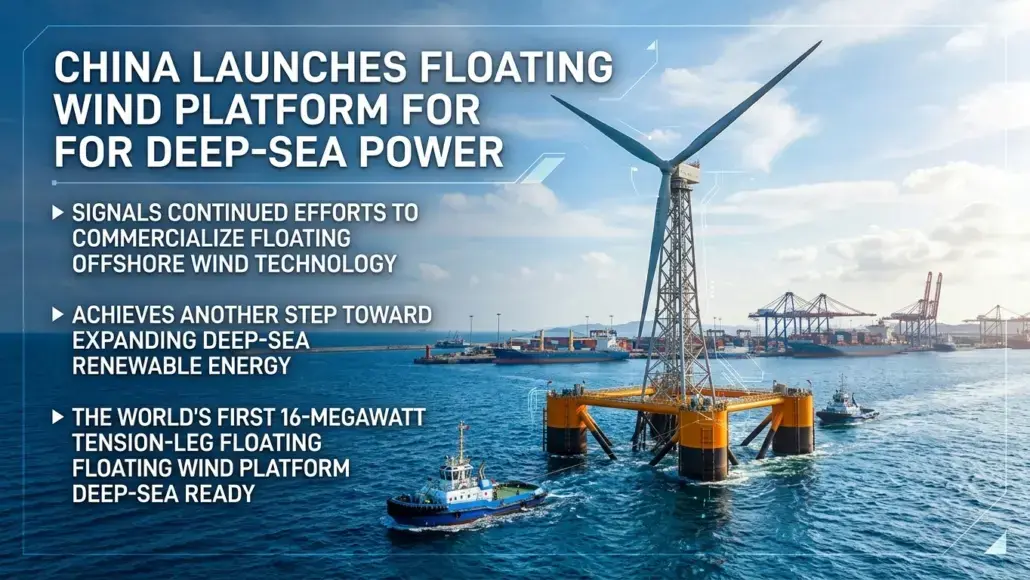

China has taken another step toward expanding deep-sea renewable energy with the departure of the world’s first 16-megawatt tension-leg floating wind platform from Gaolan Port in Zhuhai, Guangdong Province. The milestone signals the country’s continued efforts to commercialize floating offshore wind technology following a series of successful demonstration projects. Rising more than 307 meters and weighing close to 8,000 tons, the platform is designed to produce around 54 million kilowatt-hours of electricity each year after entering service. According to China Media Group, the project is expected to reduce carbon dioxide emissions by approximately 35,000 tons annually while lowering fuel oil consumption by about 15,000 cubic meters. The electricity generated offshore will be transmitted directly to an offshore oilfield power grid through subsea cables, creating an integrated system that combines renewable electricity generation with offshore oil and gas production.
The project reflects China’s broader strategy to strengthen deep-sea offshore wind development as global energy systems increasingly shift toward cleaner power sources. Beyond lowering emissions from offshore oilfield operations, the platform is expected to support the development of the floating offshore wind supply chain across the Pearl River Delta while contributing to a cleaner, low-carbon and more efficient energy system. China has also advanced supporting infrastructure this year, including the completion of the offshore floatover installation of the world’s largest offshore converter station, “Heart of Sea Wind,” in Yangjiang, Guangdong Province. The converter station is entering its final commissioning stage and will play a key role in transmitting electricity generated by large-scale offshore wind farms to the mainland grid.
Industry experts said offshore wind remains an important contributor to China’s low-carbon transition because projects located near coastal demand centers provide clean electricity while reducing dependence on fossil fuels. They also noted that as nearshore development opportunities become more limited, the industry is increasingly moving into deeper waters where wind resources are stronger. According to the National Energy Administration, China’s installed power generation capacity reached 4.01 billion kilowatts by the end of May, while installed wind power capacity increased 17 percent year on year to 660 million kilowatts. A separate industry report released in Shanghai on June 17 further highlighted China’s leadership, showing that the country accounted for 78 percent of newly grid-connected offshore wind capacity worldwide during 2025, reinforcing the significance of the floating wind platform in advancing commercial deployment.