





















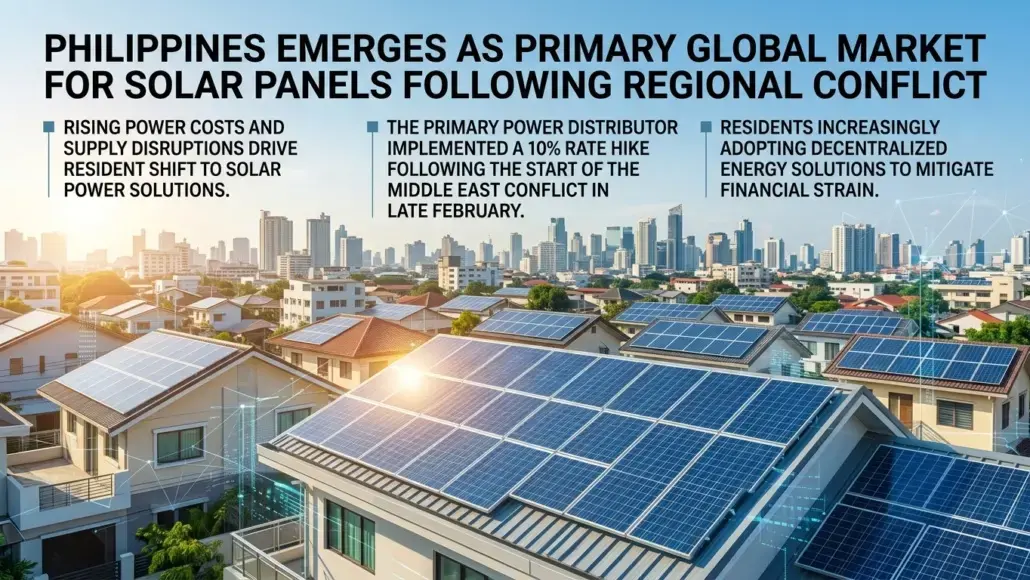

The Philippines has become the leading international destination for solar panel expenditures since the onset of the conflict in Iran. Driven by a necessity to mitigate rising power costs and frequent supply disruptions, residents are increasingly turning to decentralized energy solutions. The primary power distributor in the region implemented a 10% rate hike following the start of the Middle East conflict in late February. Consequently, a median family now allocates approximately 12% of their household income toward electricity, assuming a standard monthly usage of 200 kilowatt-hours. Unlike many neighboring Southeast Asian nations, the Philippines operates with minimal subsidies, resulting in the highest residential electricity rates in the region. This economic pressure is clearly reflected in recent trade statistics, which reveal that panel imports reached $407 million during the three-month period ending in May.
Surging Demand and Infrastructure Growth
Despite a broader shift in the global supply chain, the Philippines recorded a 145% year-on-year increase in imports, with the majority of equipment arriving from China. Adrian Sabatera, a software engineer who recently invested 570,000 pesos in a rooftop system, observed, “I wouldn’t be shocked if a third of the middle-class population eventually finds their way to this setup.” This transition is helping many families significantly reduce their monthly bills. Local installers, such as Philergy German Solar, reported a massive spike in interest, at one point fielding 3,000 inquiries in a single day. Managing partner Jochen Staudter noted that “Demand will continue to be driven by high electricity prices.” Market analysts now project substantial capacity growth, suggesting that the Philippines solar market could see its distributed capacity triple to 3,500 megawatts within the next two years.
Economic Barriers and Future Outlook
The rapid expansion of the Philippines solar market is supported by shrinking payback periods, which have dropped from four years to 3.1 years. However, significant hurdles remain for widespread adoption. Solar currently accounts for less than 4% of total national energy consumption, and a weakening currency has exacerbated the cost of imported fuels used for traditional power generation. Brenda Valerio of New Energy Nexus highlighted that a volatile supply chain and equipment hoarding have occasionally delayed installations. Furthermore, while the government offers 5% interest loans, these programs often exclude private-sector workers, making the upfront cost prohibitive as it frequently exceeds the average annual household income. As the nation continues to monitor its trade statistics and energy security, the push to lower monthly bills remains a primary driver for capacity growth. Alnie Demoral, an analyst at Ember, concluded, “The opportunity is real, but the upfront cost is often too high for a household or business, no matter how quick the payback time is.”