










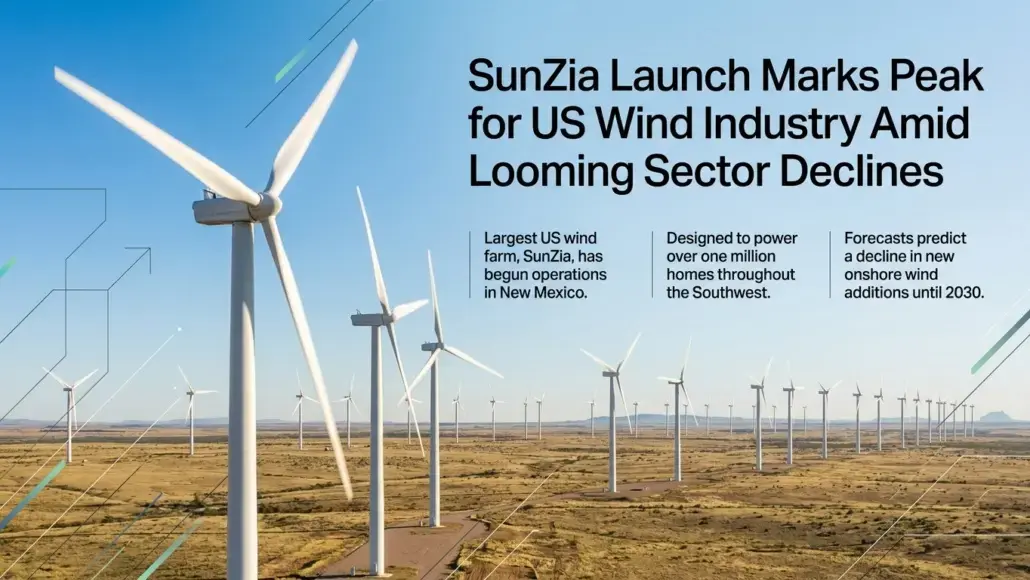

The largest wind farm in the history of the United States commenced operations this month in New Mexico. Known as SunZia, this massive complex of spinning turbines is designed to provide electricity to over one million homes across the Southwest. However, despite this milestone, the US wind industry is entering a period of anticipated contraction. Industry forecasts suggest that annual onshore wind power additions will likely decline until 2030. This shift is attributed to a combination of political opposition, persistent inflation, supply chain constraints, and local resistance that has intensified since the previous administration. Furthermore, the sector is grappling with the expiration of significant tax credits, new tariffs, and extensive delays in connecting to regional power grids.
The US wind industry also faces stiff competition from other sources of renewable energy. Solar power and battery storage are currently outpacing wind in terms of new annual capacity additions. Experts note that solar technology is generally cheaper and faster to install, which is a vital advantage as demand grows from energy-intensive data centers. Additionally, the geographic locations suitable for a large-scale wind farm are becoming increasingly limited. Many prime onshore areas, such as the Texas panhandle, have already been heavily developed, leaving fewer sites where installing massive turbines remains economically viable.
Political and regulatory hurdles have further complicated the landscape for any new wind farm project. The current administration has implemented several measures to restrict development, including an executive order aimed at halting approvals on federal lands and waters. While some of these decrees have been challenged in court, other obstacles remain, such as alleged delays in security reviews by the Pentagon. David Carroll, chief executive officer of Engie North America and chair of the American Clean Power Association, stated that the difficulty in securing permitting approvals has left the sector in a precarious state. “You’ve got capital investments that are just frozen,” Carroll remarked, noting that many boards are now questioning the feasibility of future domestic projects. While existing stalled projects may move forward, the high risk profile is currently deterring significant new investment in turbines and infrastructure. Consequently, the lack of timely permitting approvals and the struggle to integrate with power grids continue to hinder the expansion of renewable energy across the country.