

























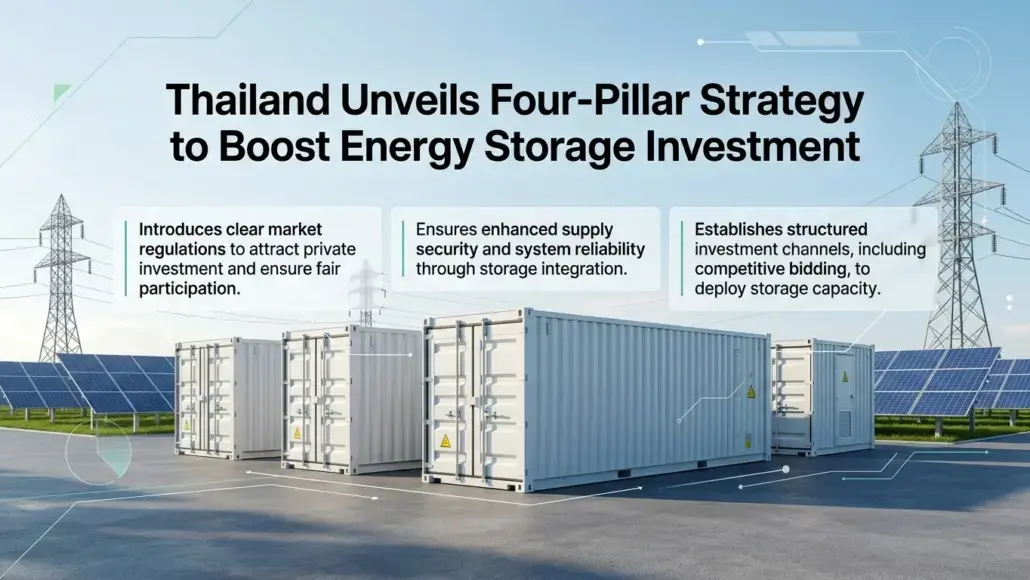

Thailand’s Ministry of Energy has introduced a comprehensive four-pillar power strategy aimed at driving investment in energy storage, positioning it as a fundamental component of the country’s future electricity infrastructure. During the Energy Storage Summit Asia 2026 on July 2, Wattanapong Kurovat, Director-General of the Energy Policy and Planning Office (EPPO), delivered a keynote address highlighting that energy storage is a critical foundation for modern electricity systems. He explained that these electricity systems require adaptability and dependability to integrate variable renewable energy sources while ensuring consistent power delivery. Kurovat emphasized that storage constitutes a “fundamental support for Thailand’s energy roadmap,” reinforcing the objective of achieving net-zero emissions by 2050. This initiative, supported by updated market regulations, aims to facilitate the expansion of clean energy without compromising supply security.
Current Infrastructure and Strategic Pillars
Despite the sector’s potential, the development of large-scale battery storage in the region has faced hurdles. Data from the Asian Development Bank indicates that by the end of 2024, Thailand operated only three utility-scale solar-plus-storage projects, totaling 184 MW of solar capacity and 345 MWh of battery storage. To accelerate progress, the government is implementing a four-pronged approach that includes smart grid integration, the development of local manufacturing supply chains, and market regulations reform. A key advancement in this area is the creation of direct power purchase agreements, which allow third-party grid access for large-scale consumers such as data centers, thereby opening new investment channels for developers. This Thailand energy storage initiative is expected to transform the local market by improving accessibility and boosting system adaptability.
Future Targets and Grid Integration
The forthcoming 2024 Power Development Plan (PDP), slated for publication in autumn 2026, will formalize the transition toward a 70% renewable energy target by 2050. Warit Rattanachuen, deputy governor for strategy at the Electricity Generating Authority of Thailand (EGAT), asserted that solar power represents the “most practical technology currently available” for Thailand to achieve these climate goals. To manage grid integration issues like generation curtailment, EGAT intends to deploy a mix of battery storage and pumped hydro energy storage. The draft PDP outlines a target of 10,485 MW of battery storage by 2037. By expanding smart grid capabilities and diversifying investment channels, Thailand aims to bolster its supply security. Dr. Pimpa Limthongkul, director at the National Energy Technology Center, emphasized that this Thailand energy storage roadmap must be paired with the continued adoption of electrification technologies to ensure a robust and sustainable energy transition.