






































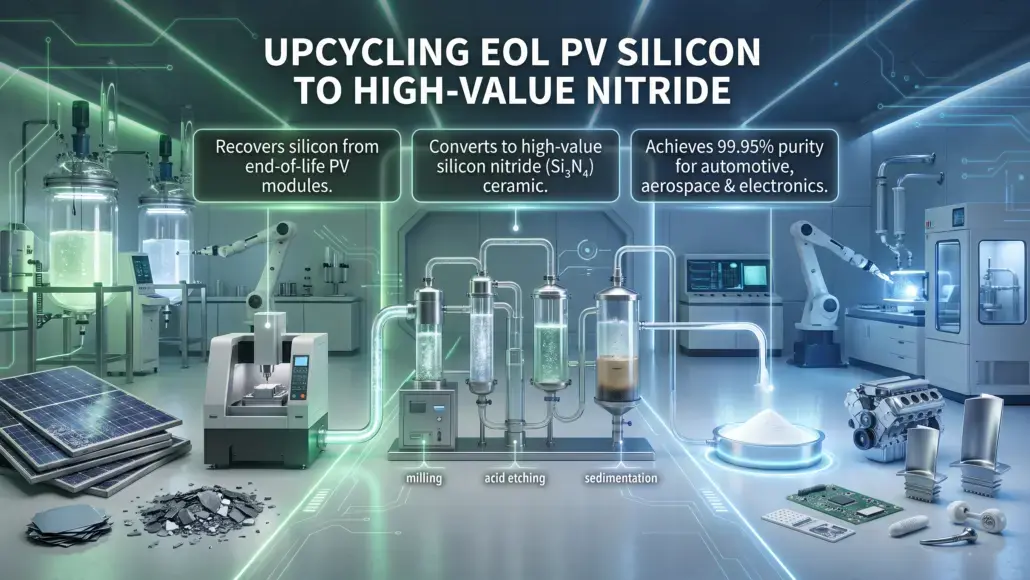

A South Korean research team has successfully developed a method to upcycle silicon recovered from end-of-life (EoL) PV modules into silicon nitride (Si₃N₄), a high-value ceramic material utilized across the automotive, aerospace, electronics, and medical industries. The process, led by researchers from the Korea Institute of Energy Research and Chungnam National University, achieved a recycled silicon purity of 99.95% through a series of optimized milling, acid etching, and sedimentation steps. This development marks the first demonstration of converting silicon recovered from actual EoL modules into recycled silicon nitride, providing a practical pathway for giving waste silicon a higher-value industrial application rather than treating it merely as a secondary raw material.
The research utilized a Suntech STP200-18/Ub module containing 54 polycrystalline silicon cells based on an aluminum back-surface field (Al-BSF) architecture. Following the removal of the junction box and aluminum frame, the team separated the glass from the laminate using a hot knife and milled the material at various speeds to assess the impact on impurity removal. The study determined that milling at 400 rpm was optimal for preventing particle agglomeration, which significantly improved the subsequent removal of metallic impurities. A two-stage purification process followed, involving 36 wt% hydrochloric acid (HCl) to remove aluminum, copper, tin, and lead, and 36 wt% nitric acid (HNO₃) to dissolve silver.
Optimization of Purification and Nitridation Processes
To address acid-resistant titanium dioxide (TiO₂) originating from the module backsheet, the researchers implemented a sedimentation process. By dispersing the powder in water and allowing it to settle for five minutes, they were able to remove 71.4% of TiO₂ impurities while maintaining a silicon recovery rate of 92.3%. The resulting high-purity powder was then nitrided under a flow of 95% nitrogen and 5% hydrogen at temperatures up to 1,450 C. This precisely controlled environment led to a final product containing 93.1% α-Si₃N₄, a significant improvement over the 54.7% α-phase proportion achieved without the additional purification steps. The findings demonstrate that controlling impurities from waste PV modules directly influences the structural properties of the final recycled silicon nitride.
Scalability and Environmental Impact
The research team is now working to transition from proof-of-concept toward a scalable, mobile recycling technology in collaboration with Wonkwang S&T, a Korean PV recycling firm. This mobile approach is designed to process EoL modules closer to their generation sites, potentially reducing transportation costs by approximately 30% and lowering carbon emissions by more than 10% compared to centralized recycling facilities. “To the best of our knowledge, this is the first demonstration of converting silicon recovered from actual EoL PV modules into Si₃N₄,” stated corresponding author Jin-Seok Lee. The complete findings of the study, titled “Upcycling silicon recovered from photovoltaic waste into silicon nitride via the field-applicable control of metal and ceramic impurities,” have been published in Materials Today Sustainability.