

































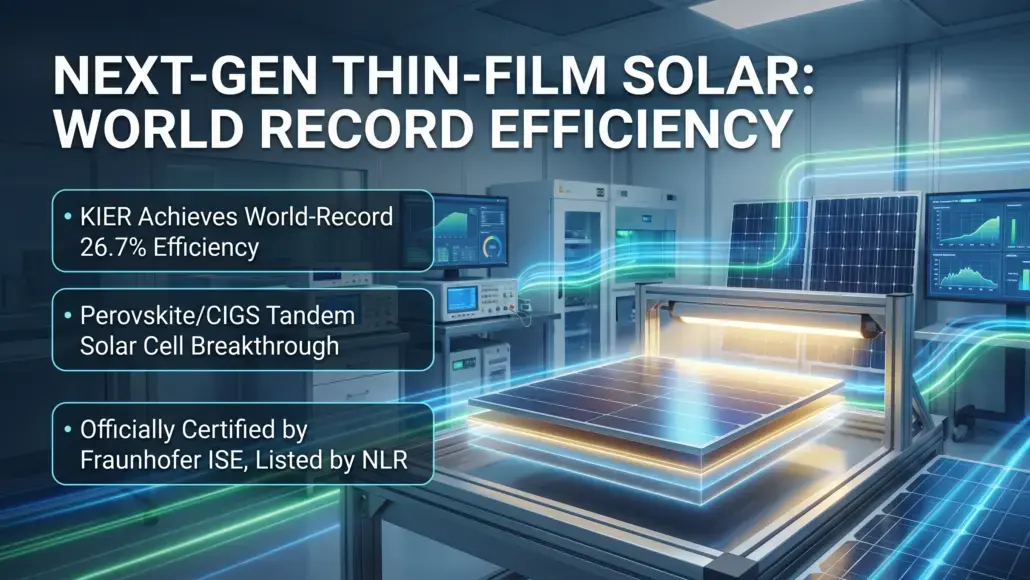

The Photovoltaic Research Department of the Korea Institute of Energy Research (KIER) has achieved a certified world-record efficiency of 26.7% for perovskite/CIGS tandem solar cells, marking a new chapter in next-generation thin-film photovoltaics. The result was officially certified by the Fraunhofer Institute for Solar Energy Systems (ISE) in Germany and has been listed in the Best Research-Cell Efficiencies Chart published by the US National Laboratory of the Rockies (NLR, formerly NREL).
A Record That Surpasses Its Korean Predecessor
The previous world-record solar cell efficiency of 26.3% for perovskite/CIGS tandem configurations was set just a year earlier by a joint research team from Seoul National University and the Korea Institute of Science and Technology (KIST). The fact that this benchmark has now been surpassed by another Korean research institution — KIER — reinforces the country’s leading position in next-generation thin-film solar cell technology.
Silicon solar cells, which currently dominate the global photovoltaics market, have reached a stage of technological maturity. Fundamental physical limitations now leave little room for meaningful efficiency gains within that technology. Against this backdrop, tandem solar cells are emerging as a compelling next-generation solution for high-efficiency photovoltaics.
The tandem approach works by stacking multiple solar cells, each with different absorption characteristics, to capture a broader range of sunlight wavelengths simultaneously. This multi-layer structure allows for considerably higher energy conversion than any single-junction cell can achieve on its own.
The perovskite/CIGS tandem solar cells developed by the KIER research team are configured with a perovskite cell at the top and a CIGS cell at the bottom. This design enables the two cells to absorb different wavelengths of sunlight at the same time. Since both perovskite and CIGS materials are well-suited for thin-film processing, the technology combines high efficiency with the practical advantages of light weight and structural flexibility.
However, integrating the two cell types introduces its own engineering challenges. The assembly process can potentially degrade the perovskite light-absorbing layer, while certain cell layers may absorb unwanted light, ultimately reducing overall efficiency.
To overcome these obstacles, the KIER research team undertook a comprehensive analysis of the root causes behind efficiency losses. This led to the development of an advanced interfacial layer material and processing technology specifically designed to protect the perovskite layer from potential damage during integration.
The team also optimized the structure of the top transparent electrode and charge transport layer to minimize undesired light absorption and prevent photocurrent loss. This dual-focus approach resulted in a laboratory-measured efficiency of 27% and the officially certified Fraunhofer ISE figure of 26.7%.
Broad Application Potential Across Industries
The developed technology is expected to increase electricity generation per unit area, expanding the potential applications of photovoltaic power generation considerably. The lightweight and flexible thin-film design makes perovskite solar cell systems promising candidates for deployment not only in buildings and automobiles but also as power sources for small satellites and space-based data centers — future applications where weight and space constraints are particularly critical.
Inyoung Jeong, a senior researcher at KIER who led the research, stated: “This achievement is significant in that both cell efficiency and stability can be enhanced by minimizing potential interfacial and optical losses during the integration of perovskite and CIGS. The resulting efficiency was also officially certified by a world-renowned institute and recognized as a world-record performance, underscoring Korea’s technological competitiveness.”
Looking ahead, the KIER research team will focus on scaling the technology so that large-area modules achieve efficiency levels comparable to those demonstrated in the small-area laboratory devices developed during this study. The team plans to collaborate with industry partners interested in mass production and commercialization, with active pursuit of technology transfer as a priority.
Over the longer term, the research program aims to expand into next-generation space solar cells — leveraging the high efficiency and low weight of tandem solar cells to enable reliable energy generation in space environments.